

Chia Seed Water Recipe: Exact Ratio, Soaking Time, and Hydration Science
Mix 1 tablespoon (12 grams) of whole chia seeds into 1 to 1.25 cups (240 to 300 mL) of water, stir twice during the first 3 minutes to prevent clumping, and soak for 15 to...
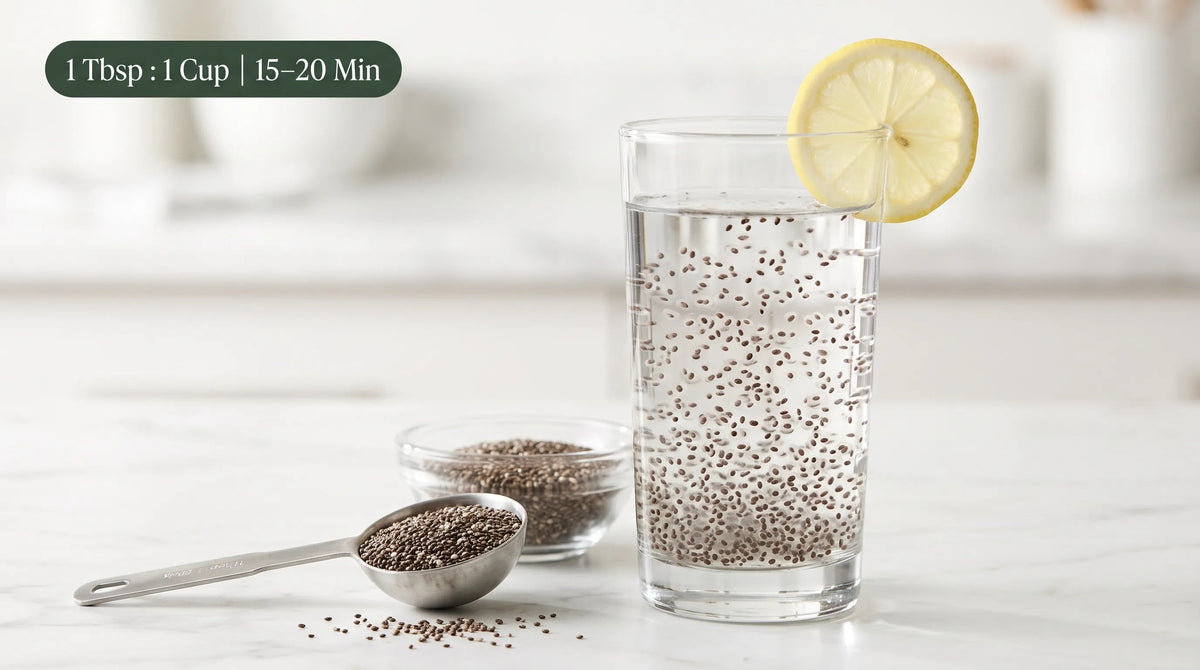
Direct Answer: To make smooth, clump-free chia seed water, mix 1 tablespoon (12 grams) of dry chia seeds into 1 to 1.25 cups (240 to 300 mL) of water and let it soak for 15 to 20 minutes at room temperature. To stop the seeds from sticking together into a solid lump, stir the mixture briskly right after adding the seeds, wait 2 to 3 minutes, and stir a second time.
- Standard Chia Seed to Water Ratio: 1 tablespoon (12 g) chia seeds per 1 to 1.25 cups (240 to 300 mL) water[cite: 1]. This creates a 1:16 to 1:20 volume ratio (or an exact 1:20 to 1:25 weight-to-volume ratio) that stays smooth and easy to drink.
- Beginner / Sensitive Stomach Ratio: Start with 1 teaspoon (4 g) chia seeds per 1 cup (240 mL) water (a 1:48 volume ratio) once daily for your first 5 to 7 days so your gut adjusts to the soluble fiber without gas or bloating.
- Minimum Safe Soaking Time (Room Temperature): 15 to 20 minutes[cite: 1]. Within this window, each seed builds a soft, slippery hydrogel capsule and hangs evenly in the glass.
- Fastest Soaking Shortcut (Warm Water): 5 to 10 minutes in warm water (40°C to 50°C / 104°F to 122°F).
- Overnight Fridge Soak: 8 to 12 hours in the refrigerator for 100% gel saturation and maximum smoothness.
- The Two-Stir Rule (Anti-Clumping Step): Stir for 30 seconds immediately after pouring the seeds on top of the water, let sit for 2 to 3 minutes, and stir a second time to break up early sticky clusters.
- Critical Safety Rule: Never swallow dry chia seeds and chase them with water. Chia seeds absorb 12 to 27 times their dry weight in liquid and must finish expanding in the glass before you drink them.
- Nutrition per 1 Tablespoon (12 g) in Water: Provides roughly 58 calories, 4.1 grams of dietary fiber, 2 grams of plant protein, and 3.7 grams of heart-healthy ALA omega-3 fatty acids[cite: 1].
Making chia seed water at home takes two basic ingredients, a spoon or lidded jar, and the right timing[cite: 1]. However, small mistakes in your seed-to-water ratio or soaking time can leave you with either watery, floating seeds or a thick, solid pudding you cannot drink. Below is the complete guide to measuring, soaking, and preparing smooth chia seed water every time, backed by food hydrocolloid science and digestive safety principles.
| Target Consistency | Chia Seeds Amount | Water Volume | Volume Ratio | Resulting Texture and Best Use |
|---|---|---|---|---|
| Beginner / Light Drink | 1 teaspoon (4 g) | 1 cup (240 mL)[cite: 1] | 1 : 48 | Thin water with lightly suspended seeds; ideal for first-time drinkers |
| Standard Chia Water | 1 tablespoon (12 g)[cite: 1] | 1 to 1.25 cups (240–300 mL)[cite: 1] | 1 : 16 to 1 : 20 | Smooth, classic drinkable gel suspension for daily hydration |
| Thick / High-Fullness | 1.5 tablespoons (18 g) | 1 to 1.25 cups (240–300 mL)[cite: 1] | 1 : 10 to 1 : 13 | Heavy, syrupy gel that you sip slowly for higher fiber and longer fullness |
| 500 mL Bottle Batch | 1.5 tablespoons (18 g) | 2 cups (500 mL) | 1 : 18 | Balanced, easy-to-drink consistency for a standard travel water bottle |
| 1-Liter Pitcher Batch | 3 tablespoons (36 g) | 4 cups (1,000 mL) | 1 : 18 | All-day refrigerator pitcher yielding 3 to 4 standard glasses |
| Spoonable Chia Gel | 2 tablespoons (24 g) | 1 cup (240 mL)[cite: 1] | 1 : 8 | Thick base for stirring into oatmeal, yogurt, or smoothies |
| Chia Pudding (Contrast) | 3 to 4 tablespoons (36–48 g) | 1 cup (240 mL)[cite: 1] | 1 : 4 to 1 : 6 | Solid, spoonable pudding (not drinkable) |
Volume Ratio (1:16) vs. Weight Ratio (1:20) Explained
When comparing recipes online, pay attention to whether a ratio measures kitchen volume (tablespoons to cups) or metric weight (grams to milliliters). Since 1 US cup equals 16 tablespoons, mixing 1 tablespoon of chia seeds into 1 cup of water gives you a 1:16 volume ratio (or 1:20 if you use 1.25 cups of water).
By weight, 1 tablespoon of dry chia seeds weighs 12 grams, while 1 cup (240 mL) of water weighs 240 grams[cite: 1]. Mixing 12 grams of seeds into 240 grams of water gives you an exact 1:20 weight-to-volume ratio (or 1:25 in 300 mL of water). Both kitchen volume and gram measurements produce the same balanced, easy-to-swallow chia drink.
If you accidentally use a 1:4 to 1:6 ratio—such as dumping 3 to 4 tablespoons of seeds into a single cup of water—there is no free water left between the expanded gel coats. Instead of a refreshing drink, the seeds lock together into a solid chia pudding that requires a spoon.
The 5-to-7-Day Beginner Fiber Ramp-Up
If your daily diet is currently low in fiber, jumping straight to 1 or 2 full tablespoons of chia seeds can cause temporary gas or abdominal fullness. Start with 1 teaspoon (4 grams) of chia seeds in 1 cup (240 mL) of water[cite: 1] once a day for your first 5 to 7 days. Once your digestive tract adapts comfortably, increase to the standard 1 tablespoon (12 grams) per glass[cite: 1].
| Soaking Time | What Happens to the Seeds | Drinkability and Safety Status |
|---|---|---|
| 0 to 2 Minutes | Water wets the dry outer seed shell (testa). Microscopic surface cells open and release sticky soluble fiber strands called mucilage. | Not ready. Seeds act like natural glue and clump at the bottom; swallowing now pulls water from your throat and gut. |
| 3 to 5 Minutes | A thin, clear halo forms around each seed, but the inner fiber core is still dry. Many seeds float at the top or sink to the bottom. | Not ready. Perform your mandatory second stir at Minute 3 to separate sticking seeds permanently. |
| 10 Minutes | The outer gel capsule is roughly halfway expanded. Seeds begin floating more evenly when stirred. | Minimum rush threshold. Safe if you are in a hurry (or fully ready if using warm water), though seeds feel slightly crunchy. |
| 15 to 20 Minutes | Each seed is wrapped in a plump, slippery hydrogel pearl and stays evenly suspended throughout the glass. | Ready to drink. The ideal daily sweet spot for smooth texture and safe digestive hydration. |
| 35 to 40 Minutes | Chia mucilage reaches roughly 80% of its maximum viscosity (thickness). The water feels velvety and slightly syrupy. | Best for fullness. Thicker gel coat slows digestion further for stronger pre-meal appetite control. |
| 2 Hours to Overnight | Between 108 minutes and 2 hours, the seeds reach 90% to 100% gel capacity and water absorption levels off. | Maximum saturation. Ideal for overnight fridge prep; stir in a splash of water before drinking if too thick. |
Can You Drink Chia Seed Water After 2 to 5 Minutes?
You should avoid drinking chia seed water after only 2 to 5 minutes of soaking. Even though some quick recipes suggest a 2-minute rest and you can see a thin clear ring forming around the seeds at 3 minutes, food hydration testing shows that 2 minutes only wets the outermost surface of the shell.
If you swallow under-soaked chia seeds at the 2-to-5-minute mark, the dry inner fiber layers continue pulling in liquid inside your esophagus and stomach. Waiting the full 15 to 20 minutes ensures the seeds finish their rapid expansion in the glass rather than inside your digestive tract.
Can You Soak Chia Seeds in Water Overnight?
Yes, soaking chia seeds in water overnight (8 to 12 hours) inside the refrigerator is completely safe and ideal for busy morning routines. Overnight soaking allows water to penetrate the outer fiber layer to 100% saturation, softening the outer seed coat and creating the silkier, smoother texture many daily drinkers prefer.
As long as you keep the standard 1 tablespoon (12 g)[cite: 1] per 1 to 1.25 cups (240 to 300 mL)[cite: 1] ratio, overnight chia water will remain liquid and drinkable. Simply give the jar a quick 5-second shake or stir in the morning—and add 2 to 4 tablespoons of fresh water if you prefer a lighter consistency.
Ingredients
- 1 tablespoon (12 grams) dry whole chia seeds (black or white seeds work identically)[cite: 1]
- 1 to 1.25 cups (240 to 300 mL) room-temperature or cool filtered water[cite: 1]
- Optional flavor add-ins (added after soaking): 1 to 2 teaspoons (5 to 10 mL) fresh lemon or lime juice, a few crushed mint leaves, or 1/2 teaspoon raw honey
Step-by-Step Instructions
- Pour the water into your glass or jar first: Fill a tall glass or Mason jar with 1 to 1.25 cups of water before adding any seeds[cite: 1]. Never drop dry chia seeds into an empty cup first; the weight of poured water presses dry seeds flat against damp bottom corners, where they trap dry air and glue themselves to the glass.
- Add the seeds and do the First Stir (30 seconds): Sprinkle 1 tablespoon of chia seeds onto the surface of the water[cite: 1]. Stir briskly with a spoon or fork for 20 to 30 seconds—or seal the jar lid and shake vigorously for 10 seconds—so water coats every individual seed.
- Rest for 2 to 3 minutes: Let the glass sit untouched on the counter. During these first 3 minutes, the outer fiber coat opens and becomes highly sticky, causing nearby settling seeds to drift together.
- Do the Second Stir (The Anti-Clumping Step): At the 3-minute mark, stir vigorously or shake the jar a second time for 15 seconds. This breaks apart early seed clusters permanently so every seed can absorb water evenly on all sides.
- Soak for 15 to 20 minutes: Leave the glass at room temperature for another 15 minutes[cite: 1] until you see a clear gel capsule around every seed and the seeds hang suspended throughout the water instead of resting on the bottom.
- Flavor and serve: Squeeze in fresh lemon or lime juice right before drinking, give one quick swirl, and enjoy.
The Screw-Top Jar Method vs. Open Glass Stirring
If you drink chia seed water regularly, mixing it inside a screw-top Mason jar or shaker bottle works noticeably better than stirring with a spoon in an open glass.
When you stir with a spoon, the swirling water creates a central whirlpool that pulls settling seeds together into the center at the bottom of the glass. Sealing a lid on a jar and shaking hard for 10 seconds, waiting 3 minutes, and shaking again for 5 seconds drives water turbulence between every single seed and prevents clumping completely.
Simple Flavor Infusions That Will Not Ruin the Gel
Plain chia seed water has a mild, slightly nutty flavor. If you want a brighter taste without heavy sugar, add any of these light infusions after the seeds finish their 15-minute soak[cite: 1]:
- Fresh Citrus: 1 to 2 teaspoons of fresh lemon, lime, or grapefruit juice.
- Cooling Cucumber and Mint: 3 to 4 thin cucumber slices and 4 to 5 lightly crushed fresh mint leaves.
- Warm Ginger Infusion: 1/2 teaspoon of freshly grated ginger root or ginger juice to soothe the stomach.
- Homemade Chia Fresca (Electrolyte Drink): 2 teaspoons of fresh lime juice, a tiny pinch (1/16 teaspoon) of sea salt or pink Himalayan salt, and 1/2 teaspoon of raw honey or maple syrup.
How Chia Mucilage Forms a Gel (Hydration Kinetics and the Weibull Curve)
The outer coat of a dry chia seed (Salvia hispanica L.) holds tightly coiled chains of soluble dietary fiber called mucilage polysaccharides. Food chemistry analyses show that chia mucilage is composed mainly of plant sugars and uronic acids—specifically xylose, glucose, and glucuronic acid—that carry a slight negative electrical charge.
The moment water touches the seed shell, epidermal cells burst open and these coiled polysaccharide chains stretch outward like microscopic sponges. Because the fiber strands stay anchored to the seed surface, they trap water molecules inside a three-dimensional web around each seed, holding 12 to 27 times the seed's dry weight in water.
Laboratory hydration research published in the Journal of the Science of Food and Agriculture modeled chia gel thickening using the Weibull hydration curve:
- First 15 to 20 minutes[cite: 1]: Water rushes into the outer shell at peak speed, building a protective hydrogel ring around every seed.
- At 37 minutes: The chia mucilage reaches 80% of its maximum viscosity (thickness) and forms a highly stable suspension.
- At 108 minutes to 2 hours: The gel reaches 90% to 100% of its maximum water-holding capacity, after which further swelling levels off into a plateau.
How Water Temperature Controls Soaking Speed
Water temperature directly changes how fast the coiled fiber strands unwind and pull in liquid:
- Warm Water (40°C to 50°C / 104°F to 122°F): Warm water speeds up molecular water diffusion into the seed coat. Food rheology testing confirms that chia mucilage expands significantly faster as water warms around 45°C (113°F), cutting your safe soaking time down to 5 to 10 minutes.
- Room-Temperature Water (20°C to 25°C / 68°F to 77°F): The easiest everyday standard, reliably hydrating chia seeds in 15 to 20 minutes[cite: 1].
- Cold or Ice Water (4°C / 40°F): Cold temperatures slow down polysaccharide uncoiling. If you mix dry chia seeds straight into ice-cold refrigerator water, allow 30 to 45 minutes for a full gel to form.
- Avoid Boiling Water (Above 60°C / 140°F): Never pour boiling water over chia seeds. Extreme heat causes the outer shell to clump unevenly, breaks down the delicate three-dimensional gel network into a slimy film, and oxidizes the heat-sensitive plant omega-3 fatty acids (alpha-linolenic acid, or ALA) inside the seed.
Does Adding Lemon Juice (Acidity) or Salt Affect Gel Thickness?
Yes—adding lemon juice, lime juice, apple cider vinegar, or salt too early slows down swelling and reduces how thick the chia gel becomes. Food hydrocolloid research demonstrates that chia mucilage expands fastest and thickest in plain, neutral filtered water (pH 6.5 to 7.5) with low mineral or salt content.
Because the glucuronic acid chains on the outside of a chia seed rely on slight negative electrical charges to repel one another and open up space for water molecules, acidic ingredients like lemon juice (pH 2 to 3), added salt, or very hard mineral water reduce that electrostatic repulsion and tighten the fiber strands. For the fastest soak and plumpest gel pearls, always soak your chia seeds in plain filtered water first for 15 to 20 minutes[cite: 1], then stir in your citrus juice or pinch of salt right before drinking.
Black vs. White Chia Seeds: Do They Require Different Ratios?
Black and white chia seeds come from the exact same plant species (Salvia hispanica L.) and use the exact same 1:16 to 1:20 water ratio and 15-to-20-minute soaking time[cite: 1]. Both seed colors have virtually identical soluble fiber content, hydration speed, and water-holding capacity.
The only practical difference is appearance: white chia seeds look brighter and cleaner in lemon or cucumber water, whereas black chia seeds make it easier to see the transparent hydrogel ring expanding around the dark center.
1. Preventing Esophageal Blockage (Choking Hazard) and Gut Dehydration
There are two medical reasons why you must let chia seeds finish expanding in a glass before swallowing them:
- Throat and Esophageal Safety: Clinical gastroenterology reports, including cases documented by the American College of Gastroenterology (ACG), warn that swallowing a spoonful of dry chia seeds followed by a glass of water can cause the seeds to swell rapidly into a dense, semi-solid hydrogel ball inside the throat, causing a painful food blockage (esophageal impaction)[cite: 1]. This risk is especially high for anyone with a history of swallowing difficulties (dysphagia) or esophageal narrowing (stricture). Pre-soaking 1 tablespoon of seeds in at least 1 cup (240 mL) of water for 15 to 20 minutes[cite: 1] ensures this rapid 12x-to-27x expansion finishes safely inside your glass before you take a sip.
- Preventing Intestinal Dehydration and Constipation: Each tablespoon (12 grams) of chia seeds delivers 4.1 grams of dietary fiber[cite: 1]. If you consume dry or barely soaked seeds, they pull moisture out of your stomach and intestines to complete their gel formation, which can trigger gas, cramping, or hard, dry stools. Drinking pre-hydrated chia water delivers fiber that is already saturated with water, keeping stool soft and supporting comfortable bowel movements.
2. How the Pre-Hydrated Gel Supports Fullness and Steady Digestion
When you drink properly soaked chia seed water, the viscous hydrogel coat mixes with stomach fluids and gently slows down gastric emptying—the rate at which food exits your stomach. Controlled human nutrition trials show that viscous soluble fibers slow the enzymatic breakdown and absorption of carbohydrates in the small intestine.
Because of this physical gel mechanism, drinking a glass of chia seed water 20 to 30 minutes before a meal can help increase short-term feelings of fullness and blunt sharp post-meal blood sugar spikes. Still, chia seed water is a supportive source of daily hydration and soluble fiber, not a standalone medical treatment or guaranteed cure for weight loss.
How to Fix Chia Water That Is Too Thick, Clumpy, Floating, or Slimy
- If your chia water turns out too thick or jelly-like: Pour in an extra 1/4 to 1/2 cup (60 to 120 mL) of plain water and stir briskly for 10 to 15 seconds. The hydrogel disperses immediately and thins out into a smooth drink.
- If the seeds formed a clump at the bottom: Press the lump against the side of the glass with the back or tines of a fork to mash the seeds apart, or transfer the mixture into a lidded jar and shake hard for 15 seconds.
- If the seeds are floating at the top: Dry chia seeds frequently trap microscopic air bubbles on their ribbed shell during the first 2 minutes in water. Performing your second stir or jar shake at the 3-minute mark knocks those tiny air bubbles loose so the seeds sink and suspend evenly.
- If the mouthfeel feels too slimy: Squeeze in fresh lemon or lime juice and drop in 2 to 3 ice cubes right before drinking. Cold temperatures and bright citrus acidity cut the slippery sensation on your tongue.
How Long Does Soaked Chia Seed Water Last in the Fridge?
If you prefer not to wait 20 minutes every morning[cite: 1], you can batch-prep a 1-liter pitcher of chia seed water in advance (3 tablespoons / 36 grams of chia seeds in 4 cups / 1,000 mL of water) and store it in the refrigerator:
- Plain Chia Seed Water (Seeds + Water Only): Stays fresh and safe for up to 5 days in a tightly sealed glass jar or pitcher in the refrigerator (4°C / 40°F or colder).
- Lemon, Lime, or Cucumber-Infused Chia Water: Best consumed within 2 to 3 days. After 48 to 72 hours, fresh citrus juice begins to oxidize and develop a slightly bitter flavor, while fresh cucumber slices turn overly soft.
- Room-Temperature Counter Safety Limit: Do not leave pre-soaked chia seed water sitting out on a warm kitchen counter for more than 3 to 4 hours, as the hydrated plant sugars and proteins can begin to spoil or ferment.
- How to Serve Chilled Fridge Chia Water: Chia seeds stored in the fridge overnight settle toward the bottom of the pitcher and reach 100% gel viscosity. Before pouring a glass, shake or stir the container vigorously for 5 to 10 seconds, and stir in 2 to 4 tablespoons of fresh water if you prefer a thinner drink.
- Can You Freeze Chia Seed Water? Yes. Pour pre-soaked chia gel (mixed at a thicker 1:10 ratio) into ice cube trays and freeze for up to 1 month. Whenever you want a quick drink, drop 1 to 2 frozen chia cubes into a glass of water and stir as they thaw.
Can I soak chia seeds in coconut water, milk, or fruit juice using the same ratio?
Yes, you can soak chia seeds in other liquids, but thicker liquids penetrate the seed coat more slowly than plain water. Coconut water and cooled herbal teas have a thin viscosity similar to water, so they use the exact same 1 tablespoon (12 g)[cite: 1] per 1 to 1.25 cups (240 to 300 mL) ratio[cite: 1] and 15-to-20-minute soaking time[cite: 1]. Dairy milk, plant milks (like almond or oat milk), and 100% fruit juices contain fats, proteins, or dissolved sugars that slow down water absorption, so allow 25 to 30 minutes (or an overnight fridge soak) and add an extra 2 to 3 tablespoons of liquid to keep the beverage pourable.
Does soaking chia seeds longer increase their calories or fiber?
No. Plain water contains zero calories and zero dietary fiber. Whether you soak 1 tablespoon (12 grams) of chia seeds[cite: 1] for 15 minutes at room temperature[cite: 1] or 12 hours overnight in the refrigerator, your glass provides the exact same 58 calories, 4.1 grams of dietary fiber, 2 grams of protein, and 3.7 grams of ALA omega-3 fats[cite: 1]—only the water volume and gel thickness change.
Should I chew chia seeds in water or swallow them whole?
You can safely swallow pre-soaked chia seeds whole, or lightly chew them if you prefer. Because the soluble fiber mucilage sits on the outside of the seed shell, your digestive tract receives the full hydration, stool-softening, and fullness benefits even when you swallow soaked seeds whole. However, the tough outer husk protects the heart-healthy ALA omega-3 fats inside the seed core, so lightly chewing a few seeds as you drink (or adding ground chia seeds to yogurt or oatmeal) helps your body absorb more of those internal omega-3 fatty acids.
Can I use ground chia seeds to make chia seed water?
You can use ground chia seeds, and they will gel in just 3 to 5 minutes, but most people strongly prefer whole chia seeds for drinking water. Grinding breaks open the seed kernel and releases inner starches and oils directly into the water, creating a cloudy, grainy, porridge-like liquid rather than a clean drink with suspended gel pearls. Save ground chia seeds for smoothies, oatmeal, or baking, and use whole seeds for chia water.
What is the best time of day to drink chia seed water?
The best time to drink chia seed water depends on your personal routine and goal:
- Morning: Drinking a glass after waking rehydrates your body and gently stimulates morning bowel regularity.
- 20 to 30 Minutes Before a Meal: Helps take the edge off hunger and slows carbohydrate digestion during your meal.
- Mid-Afternoon: Provides steady hydration and fiber fullness during an afternoon energy dip without caffeine.
Avoid drinking large glasses of chia seed water immediately before lying down to sleep if you are prone to nighttime stomach fullness or acid reflux, and do not drink chia seed water during your fasting window before a medical fasting blood glucose or lipid panel (since 1 tablespoon contains roughly 58 calories).
We rely on peer-reviewed studies and reputable medical journals.