
12 Best Online Nutrition Courses in 2026: A Guide for Beginners and Professionals
Compare 12 of the best online nutrition courses for 2026 and find the right option for beginners, coaches, students and health professionals.
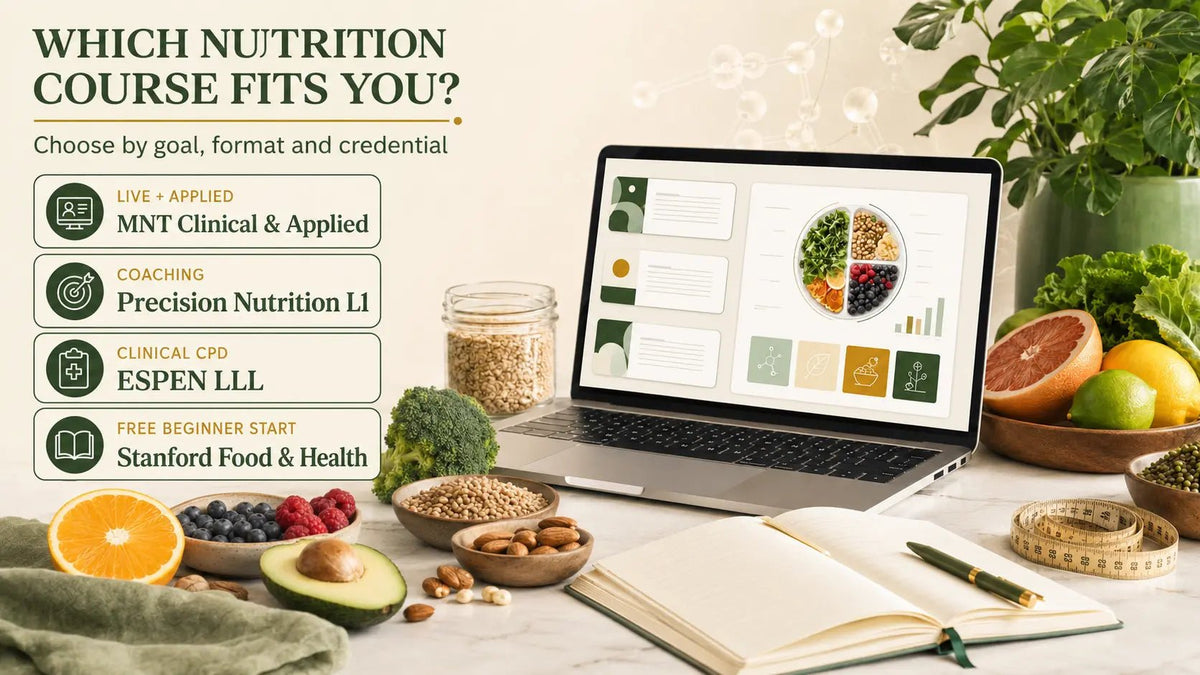
The best online nutrition course is the one that matches the work you are preparing to do. For live, affordable and broadly applied learning, our leading choice is the MNT Professional Certificate in Clinical & Applied Nutrition. For nutrition coaching and behaviour change, Precision Nutrition Level 1 is the stronger fit. For a premium university short course, consider Stanford Medicine Nutrition Science. For qualified clinicians seeking modular clinical education, ESPEN's Life Long Learning Programme stands out. Complete beginners can start with Stanford Introduction to Food and Health without making a large financial commitment.
Those recommendations are deliberately different because “best” has no useful meaning without a learner and an outcome. A fitness coach needs practical communication and habit-change tools. A dietitian, physician or nurse may need clinically focused continuing professional development. A nutrition student may value live teaching, case discussion and affordability. Someone seeking a regulated title needs an approved academic and supervised-practice pathway—not a short online certificate.
This guide compares 12 of the best nutrition courses online by audience, curriculum, learning format, duration, price, assessment and credential type. It also explains which claims matter, which do not, and how to choose without confusing a completion certificate with permission to practise.
Best online nutrition courses: quick picks
- Best live applied nutrition course: MNT Professional Certificate in Clinical & Applied Nutrition
- Best nutrition coaching course: Precision Nutrition Level 1
- Best premium university short course: Stanford Medicine Nutrition Science
- Best modular clinical nutrition education: ESPEN Life Long Learning Programme
- Best intensive course for clinicians: Duke Online Clinical Nutrition Course and Fellowship
- Best structured clinical CPD: HealthCert Professional Certificate of Clinical Nutrition
- Best specialist course for IBS and the low-FODMAP diet: Monash University Low FODMAP training
- Best for fitness professionals: NASM Certified Nutrition Coach
- Best flexible fitness-coaching alternative: ISSA Nutrition Coach
- Best free Pakistan-specific professional learning: AKU/WCEA IGNIT3 nutrition courses
- Best free nutrition course for beginners: Stanford Introduction to Food and Health
- Best short pregnancy-nutrition course: LMU Nutrition and Lifestyle in Pregnancy
How we chose the best nutrition courses
We reviewed the official provider pages available on 19 July 2026. Courses were shortlisted when their published offer addressed a clear learner need and provided enough information to make a meaningful comparison. We did not rank courses by brand recognition alone, and no provider paid for inclusion or position.
Our “best for” decisions give the most weight to:
- Learner fit: Is the intended audience clearly defined, and does the content match that audience's likely responsibilities?
- Curriculum quality: Are the topics, learning outcomes and depth visible before purchase?
- Teaching design: Does the course use live instruction, cases, practice, feedback, community or other methods suited to its purpose?
- Faculty and provider transparency: Can learners identify who teaches the material and what relevant expertise they hold?
- Assessment: Is there a meaningful way to test understanding, not merely watch videos?
- Evidence and scope: Does the provider distinguish education from diagnosis, treatment, licensure and regulated practice?
- Value and access: Are price, duration, delivery, prerequisites and access terms reasonably transparent?
We also considered important limitations. Provider pages are marketing sources and can change. We did not independently verify every learner outcome, instructor registration, assessment standard or employer's recognition of a certificate. Prices and availability below are snapshots, not guarantees. Where a provider makes an accreditation or quality-assurance statement, we attribute that statement instead of extending it beyond the exact course or organisation named.
Course, certificate, certification or degree: know the difference
These words are often used as if they mean the same thing. They do not.
When comparing nutrition certification courses online—or any online nutrition courses with certificates—look beyond the word printed on the final document. The issuing body, entry requirements, assessment, professional recognition and permitted scope matter far more than the label alone.
- Course: A structured learning experience covering a defined topic or set of skills.
- Certificate of completion: Evidence that you completed a provider's course requirements. It does not automatically indicate independent accreditation or a legal scope of practice.
- Professional certification: A credential normally tied to a defined standard, assessment and sometimes renewal or continuing-education requirements. Its market and legal value depends on the issuing body and jurisdiction.
- CPD or CME: Continuing professional development or medical education intended to maintain or extend an existing professional's knowledge. Acceptance can vary by regulator, employer and profession.
- Accredited degree and supervised practice: A much longer academic and practical route that may form part of eligibility for a regulated professional title.
Comparison of the 12 best online nutrition courses
Price and availability snapshot: 19 July 2026. Promotions, taxes, currency conversion, exam or certificate fees and cohort status can change. Follow the official course link and verify the full current cost before enrolling.
| Course | Best for | Published length | Price snapshot | Format | Credential boundary |
|---|---|---|---|---|---|
| MNT Clinical & Applied Nutrition | Live, affordable applied learning | 8 weeks; 22 modules; 30+ sessions | US$200 | Live on Google Meet; recordings | Professional-development certificate; not licensure |
| Precision Nutrition Level 1 | Nutrition coaching and behaviour change | About 20 weeks at suggested pace | US$799 regular price reported; offers vary | Online lessons, cases, tools and Q&A | Provider certification; not dietitian licensure |
| Stanford Medicine Nutrition Science | Premium university nutrition-science study | 8 weekly modules | US$2,650 | Flexible online learning | University short course; verify current award |
| ESPEN LLL Programme | Modular clinical nutrition education | 134 modules across 44 topics | Content access free; some certificates, exams and events cost extra | Self-study modules plus live events | CME credits; Diploma pathway has added requirements |
| Duke Clinical Nutrition Course | Intensive learning for clinicians | 8 months | Tiered by profession and country | Recorded lectures and live Zoom | Course/fellowship for eligible professionals; cohort-dependent |
| HealthCert Clinical Nutrition | Structured clinical CPD | 93 hours | US$1,695 | 100% online | CPD; provider states quality assurance by Bond University |
| Monash Low FODMAP training | IBS and low-FODMAP practice | 30.25 CPD hours; 9 months' access | US$490 outside Australia | Self-paced online | Specialist CPD for eligible health professionals |
| NASM Certified Nutrition Coach | Fitness and wellness coaching | Typically 4–6 weeks | Promotion-dependent | Self-paced online | Coaching certification; not RDN status |
| ISSA Nutrition Coach | Flexible fitness nutrition coaching | Self-paced | US$629 displayed | Online; open-book exam | Provider certification; check local scope |
| AKU/WCEA IGNIT3 courses | Pakistan-specific maternal, child and adolescent nutrition CPD | Short modular courses | Free | Mobile and offline-capable | AKU reports local accreditation by named professional councils |
| Stanford Introduction to Food and Health | Complete beginners | Short and on demand | Free; optional certificate may cost | Coursera/on demand | Introductory learning; not a professional qualification |
| LMU Nutrition and Lifestyle in Pregnancy | A concise pregnancy-nutrition primer | About 7 hours | Audit/enrolment terms vary | Coursera; self-paced | Course certificate option; not clinical authorisation |
The 12 best online nutrition courses in detail
1. MNT Professional Certificate in Clinical & Applied Nutrition
Best for: Live, affordable and broadly applied nutrition learning
Published format: 8 weeks, 22 modules and more than 30 live sessions, with recordings
Listed price: US$200
Official page: MNT Clinical & Applied Nutrition
MNT's eight-week program is our leading choice for learners who want the accountability of a live cohort, a broad applied syllabus and an accessible published fee. The course moves from foundational professional skills—such as the nutrition care process, calculations and diet planning—into condition-focused subjects including diabetes, cardiovascular disease, renal nutrition, gastrointestinal disorders, pregnancy, malnutrition and nutrition support. It also lists nutraceuticals, lifestyle medicine and ethics.
The structure is unusually substantial for the price: 22 modules and more than 30 sessions delivered through Google Meet, with recordings and learning material available to participants. That combination can suit nutrition students, early-career practitioners and adjacent health professionals who learn better by following a timetable and asking questions than by watching an entirely self-paced video library.
The public course page names nine instructors, including instructors displayed with RDN designations. The multi-instructor format may expose learners to more than one clinical perspective, although buyers should always verify faculty credentials, assessment requirements and the exact access period before enrolment.
The most important limitation is also clear: this is professional development. It is not an accredited dietetics degree, a regulated supervised-practice pathway or a licence. A broad clinical curriculum can improve knowledge, but knowledge alone does not authorise a learner to diagnose disease, prescribe medical nutrition therapy or use a protected professional title.
Verdict: Choose MNT Clinical & Applied Nutrition if live teaching, applied breadth, regional accessibility and value matter more to you than a university brand. It is especially compelling for learners comparing affordable nutrition courses in Pakistan with internationally available online study. Do not choose it as a substitute for the formal education and supervised practice required for regulated dietetics work.
View MNT Clinical & Applied Nutrition
2. Precision Nutrition Level 1 Nutrition Coaching Certification
Best for: Behaviour-change nutrition coaching
Published format: Three units and 21 video seminars; about 20 weeks at the suggested pace
Price snapshot: US$799 regular price reported; promotions vary
Official page: Precision Nutrition Level 1
Precision Nutrition Level 1 is designed around the gap between understanding nutrition and helping another person change. The provider describes three units, 21 video seminars, a workbook, real-world case studies, more than 40 coaching tools, a peer community and expert Q&A. Learners following the suggested pace finish in about 20 weeks, while the online format allows flexibility.
That emphasis makes PN Level 1 a better fit than a disease-focused clinical course for personal trainers, health coaches and wellness professionals who need a repeatable consultation process, client communication and habit-building techniques. The course places nutrition science inside a coaching framework rather than presenting itself as a route into medical nutrition therapy.
Verdict: Choose Precision Nutrition Level 1 when your primary goal is helping generally healthy clients make sustainable changes. Qualified clinicians who need disease-specific CPD should compare ESPEN, Duke, Monash and HealthCert instead. Always confirm what your base qualification, employer, insurer and local law permit you to offer.
3. Stanford Medicine Nutrition Science
Best for: A premium university short course in nutrition science
Published format: Eight weekly online modules
Listed price: US$2,650
Official page: Stanford Medicine Nutrition Science
Stanford Medicine's online Nutrition Science course is available beyond Stanford and uses eight weekly modules to cover nutrition guidelines, macronutrients, micronutrients, energy balance and evidence-informed decision-making. Its central appeal is academic context: learners study nutrition science through a university program that explicitly aims to improve how they evaluate nutrition information.
The flexible online structure will suit professionals and serious learners who cannot attend scheduled sessions. However, the US$2,650 listed fee makes this the premium option in our comparison. Prospective students should therefore verify the current assessment, award, faculty interaction and relevance to their employer before deciding that the university name justifies the difference in cost.
Verdict: Choose Stanford Medicine when you want an evidence-focused university learning experience and can justify the premium. It remains a short course, not a dietetics degree or professional licence.
4. ESPEN Life Long Learning Programme in Clinical Nutrition and Metabolism
Best for: Modular clinical nutrition education and CME
Published format: 134 modules across 44 topics; self-study and live components
Price snapshot: Online content access is free; certificates, examinations or live events may have fees
Official page: ESPEN LLL Programme
ESPEN's Life Long Learning Programme is the deepest modular clinical option in this guide. The official program describes 134 modules across 44 topics, generally combining scientific review, clinical cases, self-assessment and a quiz. Participation can carry CME credits, while ESPEN's Diploma pathway requires a larger credit total and a separate examination.
The design is valuable for physicians, dietitians, pharmacists, nurses and other qualified professionals who need a specific clinical topic rather than another general overview. Learners can select education relevant to their work, but they must read the current credit, attendance, certificate and Diploma rules carefully; access to content is not the same as completion of a credential pathway.
Verdict: Choose ESPEN for serious, topic-by-topic clinical nutrition education within an existing health profession. It offers greater clinical depth and CME structure than most commercial coaching certificates, but it does not replace the learner's base professional qualification or local authorisation to practise.
5. Duke Online Clinical Nutrition Course and Fellowship
Best for: Clinicians seeking an intensive, sustained program
Published format: Eight months; recorded lectures and live Zoom sessions
Price snapshot: Tiered by profession and country-income group
Official page: Duke Clinical Nutrition Course
Duke's eight-month online program is designed for physicians, advanced practice providers, registered dietitians and pharmacists. Its published format includes recorded lectures, discussions, quizzes and live Zoom sessions, with an emphasis on clinical and critical-care nutrition. Fees are tiered by profession and country-income group, which can make the course more accessible to some international professionals than a single headline price would suggest.
The full 2026 program was closed when this guide was reviewed, and Duke indicated that later cohort details would follow. That availability constraint prevents it from being an immediate choice for every reader, but the audience, duration and clinician-oriented structure make it one of the most substantial programs in this comparison.
Verdict: Choose Duke if you already hold a relevant health profession, want intensive clinical learning and can wait for an open cohort. Beginners and general wellness coaches should start elsewhere.
6. HealthCert Professional Certificate of Clinical Nutrition
Best for: Structured online CPD for degree-qualified health professionals
Published format: 93 hours, fully online
Listed price: US$1,695
Official page: HealthCert Clinical Nutrition
HealthCert lists 93 hours of online learning for medical doctors, international medical graduates, registered nurses and other degree-qualified health professionals. The provider describes the course as CPD-accredited and quality assured by Bond University. That intended audience and professional-development framing make it more suitable than a generic coaching certificate for clinicians who want structured nutrition education without entering another degree.
The listed US$1,695 fee is a significant commitment. Before paying, a prospective learner should compare the detailed curriculum with their patient population, inspect the assessment model and confirm CPD acceptance with their own employer or regulator. “Quality assured” should not be read as a new professional licence or specialist dietetics qualification.
Verdict: Choose HealthCert when you already hold a relevant degree and want a substantial clinical nutrition course with clear CPD framing. It is not a replacement for specialist dietetics education.
7. Monash University Low FODMAP Diet training
Best for: Dietitians and eligible health professionals working with IBS
Published format: 30.25 CPD hours with nine months' access
Listed price: US$490 outside Australia
Official page: Monash Low FODMAP training
Monash University's training is a specialist course rather than a broad nutrition foundation. It focuses on the evidence and practical implementation of the low-FODMAP diet, an area closely associated with Monash's research program. The provider lists 30.25 CPD hours, nine months of access and a US$490 price for learners outside Australia.
Its narrowness is the reason to choose it. A qualified practitioner supporting people with irritable bowel syndrome is likely to gain more applicable depth here than from another general nutrition course. A beginner who has not studied nutrition assessment, gastrointestinal disease, dietary restriction or referral boundaries should not treat the course as a stand-alone practice credential.
Verdict: Choose Monash when low-FODMAP practice is genuinely part of your professional role. Build a broader foundation first if you are new to nutrition.
8. NASM Certified Nutrition Coach
Best for: Fitness professionals adding general nutrition coaching
Published format: Fully online and self-paced; typically completed in 4–6 weeks
Price snapshot: Promotion-dependent
Official page: NASM Certified Nutrition Coach
NASM's Certified Nutrition Coach course is designed for practical use in fitness and wellness settings. It is fully online and self-paced, with a typical published completion time of four to six weeks. NASM describes a 100-question, 90-minute, open-book examination, a 70% passing score and three exam attempts.
This format suits personal trainers and wellness professionals who want to add food, habit and client-conversation skills to an existing service. It is less suitable for learners seeking supervised clinical practice or the authority to manage complex disease. Promotion-led pricing can make comparisons difficult, so evaluate the total payable amount, included materials, exam conditions and any renewal expectations—not only a monthly instalment headline.
Verdict: Choose NASM CNC for a fast, self-paced credential aligned with fitness nutrition coaching. Choose a clinically oriented program if your role involves patients or complex medical conditions.
9. ISSA Nutrition Coach
Best for: A flexible fitness-coaching alternative
Published format: Self-paced online study with an open-book exam
Listed price: US$629 when reviewed
Official page: ISSA Nutrition Coach
ISSA combines nutrition science, client assessment and behaviour coaching in a self-paced online format. Like NASM, it fits most naturally alongside fitness, wellness or general coaching rather than regulated clinical practice. The open-book examination may appeal to learners who prefer flexible assessment, although buyers should still ask how well the activities test applied judgment.
The choice between ISSA and NASM is less about an abstract “best certification” and more about the current syllabus, learner support, assessment conditions, continuing-education relevance, bundle pricing and recognition within the buyer's employment market. Compare the full current offer side by side before deciding.
Verdict: Choose ISSA if its self-paced structure, coaching emphasis and current package fit your fitness career better than NASM. Do not confuse a coaching certification with dietitian licensure.
10. AKU/WCEA IGNIT3 online nutrition courses
Best for: Free, Pakistan-specific professional learning
Published format: Short modular courses with mobile and offline access
Listed price: Free
Official information: Aga Khan University IGNIT3 announcement
Aga Khan University's Institute for Global Health and Development launched free online nutrition courses for doctors, dietitians, nurses and midwives in Pakistan through the IGNIT3 project and WCEA platform. The courses focus on maternal, child and adolescent nutrition, support mobile and offline study, and were designed around Pakistan's health context.
AKU states that the certificates are accredited by the Pakistan Nursing and Midwifery Council and Pakistan Medical Council. Because recognition can depend on profession, course and registration status, individual learners should confirm how the current offering applies to their own CPD requirements. Free access and local relevance make it a strong complement to broader paid courses.
Verdict: Choose AKU/WCEA IGNIT3 if you are an eligible health professional in Pakistan seeking accessible maternal, child or adolescent nutrition education. It is not intended to replace a complete nutrition qualification.
11. Stanford Introduction to Food and Health
Best for: Complete beginners who want a free starting point
Published format: Short, on-demand Coursera course
Listed price: Free access; an optional certificate may cost
Official page: Stanford Introduction to Food and Health
Stanford's Introduction to Food and Health is a low-risk way to explore nutrition before investing in a longer program. It introduces contemporary eating patterns, food choices and practical home cooking without requiring a clinical or professional background.
Its strength is accessibility, not professional depth. A short introductory course cannot prepare someone for clinical nutrition work or provide the applied practice expected from a professional certification. Use it to build vocabulary, improve personal understanding and discover which area of nutrition interests you.
Verdict: Choose this course if you are new to nutrition and want a reputable free introduction. Move to a role-specific program after you can define what you want the knowledge to help you do.
12. LMU Nutrition and Lifestyle in Pregnancy
Best for: A concise pregnancy-nutrition primer
Published format: About seven hours; self-paced on Coursera
Price snapshot: Audit, enrolment and certificate terms vary
Official page: LMU Nutrition and Lifestyle in Pregnancy
Ludwig-Maximilians-Universität München's course is labelled intermediate and covers preconception nutrition, physiological changes during pregnancy, key nutrients, food safety, obesity and gestational diabetes. Quizzes are included across the course, and the approximate seven-hour duration makes it manageable for learners seeking a focused overview.
It is useful as an introduction for someone who already understands basic nutrition, but it is not authorisation to provide antenatal clinical care or manage pregnancy complications. Coursera access, audit and certificate terms may also change by location and date.
Verdict: Choose LMU for a concise, flexible maternal-nutrition overview. Choose a longer assessed or regulated pathway if your goal involves clinical responsibility.
Which MNT nutrition course is best for you?
MNT currently offers four nutrition courses with different levels of breadth and specialisation. The Clinical & Applied Nutrition certificate is the flagship option and the MNT program included in our main global comparison because its public description contains the clearest combination of curriculum, format, faculty and price information. One of the other courses may be more suitable when the goal is narrower or more introductory.
| MNT course | Best fit | Published structure | Listed fee | Important boundary |
|---|---|---|---|---|
| Clinical & Applied Nutrition | Learners wanting MNT's broadest live applied curriculum | 8 weeks; 22 modules; 30+ sessions | US$200 | Professional development; not a degree or licence |
| Nutrition Internship | Beginners seeking a broad, guided foundation | 8 weeks; 22 syllabus chapters; live delivery | PKR 1,000 in Pakistan; US$30 international | Confirm supervised activities, hours and assessment before relying on “internship” status |
| Nutritional Dermatology | Learners exploring nutrition-related skin, hair and nail topics | 7 days; live | PKR 1,000 | Educational only; not a dermatology qualification or treatment authority |
| Maternal Nutrition | Learners focused on preconception, pregnancy, lactation and infant feeding | 7 published modules | Check current course page or contact MNT | Confirm duration, schedule, assessment and current fee before purchase |
Choose MNT Clinical & Applied Nutrition if:
- You prefer scheduled live sessions to studying entirely alone.
- You want a broad applied syllabus rather than one narrow specialty.
- You value recordings, instructor access and cohort accountability.
- The listed US$200 fee fits your budget.
- You understand that completing the course does not create a regulated professional credential.
Choose another route if:
- You need an accredited dietetics degree or supervised-practice pathway. Start with your regulator's approved-program directory.
- You are a qualified clinician seeking specialist CME or CPD. Compare ESPEN, Duke, HealthCert, Monash and the eligible AKU offerings.
- You mainly coach fitness or wellness clients. Compare Precision Nutrition, NASM and ISSA.
- You want a university-branded science course and can support a larger budget. Consider Stanford Medicine.
- You are completely new to the subject and want to explore it free. Start with Stanford Introduction to Food and Health.
Browse all MNT nutrition courses
How to choose an online nutrition course
The strongest course is not necessarily the longest, most expensive or most famous. Use this eight-step check before enrolling in any online nutrition course with a certificate.
- Start with the role, not the certificate name. Write down the work you hope to do, the people you hope to support and the country in which you plan to work. “Learn more about nutrition” and “qualify for clinical practice” are entirely different goals.
- Check legal scope and employer requirements. Ask the relevant regulator, professional association, employer or insurer which qualifications are required or accepted. A provider's certificate cannot override local law.
- Verify the provider and instructors. Look for full names, current qualifications, awarding bodies, professional registration where relevant and teaching roles. Initials after a name are useful only when you can verify what they mean.
- Read the complete syllabus. Strong course pages state learning outcomes, expected study time, cases, readings, assessments, feedback and pass criteria—not only attractive topic names.
- Separate live teaching from supervised practice. A live webinar allows questions. Supervised practice requires defined hours, observation, competency assessment and an accountable supervisor. The word “internship” alone does not establish those elements.
- Inspect the evidence standard. Prefer recent guidelines, module-level references, qualified faculty, conflicts-of-interest disclosure and honest treatment of uncertainty. Be cautious of promises to cure disease, detox the body or personalise treatment without appropriate clinical assessment.
- Compare the total cost. Include taxes, exam and certificate fees, hard-copy delivery, renewals, currency conversion and prerequisite education. A low monthly payment can hide a much larger total.
- Confirm what happens after enrolment. Ask how long recordings remain available, whether tutors provide individual feedback, how resits and refunds work, whether a certificate can be verified and what accessibility support is offered.
Best nutrition courses by learner type
| Learner | Strong starting options | Why |
|---|---|---|
| Complete beginner | Stanford Introduction to Food and Health | Free, short and low-risk before a larger commitment |
| Nutrition student or early-career learner | MNT Clinical & Applied Nutrition or MNT Nutrition Internship | Live structure and accessible applied content; credential and practice boundaries remain important |
| Fitness professional | Precision Nutrition L1, NASM CNC or ISSA | Coaching, behaviour and client communication are central |
| Dietitian, physician or qualified clinician | ESPEN, Duke, HealthCert, Monash or eligible AKU courses | Clinical or specialist CPD designed to extend an existing profession |
| IBS-focused practitioner | Monash Low FODMAP training | Focused specialist content and CPD framing |
| Maternal-nutrition learner | LMU, AKU/WCEA or MNT Maternal Nutrition | Choose by professional level, local context, depth and assessment |
| University short-course buyer | Stanford Medicine Nutrition Science | Flexible, evidence-focused university learning at a premium price |
Frequently asked questions about online nutrition courses
What is the best online nutrition course?
There is no single best course for every learner. MNT Clinical & Applied Nutrition is our leading choice for live, affordable applied learning; Precision Nutrition Level 1 is best suited to behaviour-change coaching; ESPEN stands out for modular clinical nutrition education; Stanford Medicine offers a premium university short course; and Stanford Introduction to Food and Health is a strong free starting point for beginners.
What are the best online nutrition courses for professionals?
The best nutrition courses for professionals depend on the profession. Dietitians, physicians and other qualified clinicians can compare ESPEN, Duke, HealthCert, Monash and eligible AKU courses. Fitness and wellness professionals may find Precision Nutrition, NASM or ISSA more relevant. Nutrition students and early-career learners who want a live, affordable cohort can consider MNT Clinical & Applied Nutrition. Confirm CPD acceptance and scope with the body that governs your work.
Which online nutrition courses include certificates?
Most programs in this guide offer a completion certificate, provider certification or CPD record, although an additional fee may apply. Those awards are not equivalent. Before enrolling, check who issues the credential, how learning is assessed, whether renewal is required, whether the certificate can be verified and whether your employer or regulator accepts it. A certificate confirms a defined achievement; it does not automatically grant a professional title.
Can an online nutrition course make me a dietitian or RDN?
No short online nutrition course can make someone a dietitian or RDN by itself. Regulated dietetics pathways normally require approved academic education, supervised practice and an examination or registration process. Exact requirements depend on the country. If this is your goal, consult the relevant regulator and its accredited-program directory before comparing short courses.
What is the best free online nutrition course?
Stanford Introduction to Food and Health is a strong free option for complete beginners because it is short, accessible and does not require a professional background. For eligible health professionals in Pakistan, AKU/WCEA IGNIT3 provides free, locally relevant learning in maternal, child and adolescent nutrition. ESPEN also provides free access to online clinical nutrition content, although certificates, examinations and live activities may involve fees.
What is the best online nutrition course in Pakistan?
For learners seeking a live, broad and comparatively affordable applied curriculum, MNT's Clinical & Applied Nutrition certificate is a strong option. Eligible health professionals should also consider the free, Pakistan-specific AKU/WCEA IGNIT3 courses. The best choice depends on whether you need general learning, coaching skills, CPD or a regulated qualification. A short course should never be presented as a replacement for the formal route required by your profession.
Is MNT's Clinical & Applied Nutrition certificate accredited?
MNT presents Clinical & Applied Nutrition as a professional-development certificate, not an accredited dietetics degree or licensure pathway. Before enrolling, confirm the current certificate issuer, assessment method, faculty credentials and how—if at all—your employer or professional body will recognise the course. Its value lies in live teaching, applied curriculum and accessibility, not in claiming a regulated title.
How long do online nutrition courses take?
The courses reviewed here range from about seven hours to eight months. MNT Clinical & Applied Nutrition runs for eight weeks, Precision Nutrition suggests about 20 weeks, and Duke's clinician-focused program lasts eight months. Duration alone does not establish quality. A short specialist course may be ideal for a qualified professional, while a beginner may need more foundational study, feedback and practice.
Should I choose a live or self-paced nutrition course?
Choose live learning if scheduled teaching, real-time questions and cohort accountability help you progress. Choose self-paced learning when flexibility is essential and you can study consistently without fixed sessions. In either case, ask whether sessions are recorded, how long access lasts, whether support includes individual feedback and what happens if you fall behind.
How can I tell whether a nutrition course is credible?
A credible course identifies its audience, publishes a detailed syllabus, names verifiable instructors, explains assessment, uses current evidence, states its scope limits and shows the full cost. It should distinguish course completion from professional authorisation and avoid guaranteed career or health outcomes. For clinical practice, confirm recognition directly with the relevant regulator, employer or professional association rather than relying only on a provider's marketing language.
Final recommendation
Do not buy a nutrition course because its title sounds authoritative. Choose it because the audience, curriculum, teaching method, assessment and credential are the right match for your next legitimate step.
For live and accessible applied learning, MNT Clinical & Applied Nutrition deserves a place at the top of the shortlist. It combines an eight-week cohort, 22 modules, more than 30 live sessions and a US$200 listed fee. For coaching, choose a coaching-first program such as Precision Nutrition, NASM or ISSA. For clinical CPD, choose education designed for your existing health profession, such as ESPEN, Duke, HealthCert, Monash or eligible AKU courses. For a regulated title, begin with the regulator—not a marketing page.
The right online nutrition course should leave you with clearer knowledge, better judgment and an honest understanding of what you are—and are not—qualified to do.
We rely on peer-reviewed studies and reputable medical journals.