

Hemp Seeds Nutrition: Calories, Protein and Fats
How much protein, fat and omega-3 do hemp seeds contain? Explore the nutrition facts for hemp hearts by serving size, plus their calories, fibre and minerals.
Three tablespoons (30 grams) of hulled hemp seeds provide about 166 calories, 9.5 grams of protein and 14.6 grams of fat. Most of the fat is unsaturated, including omega-3 and omega-6 fats. Hemp seeds also provide magnesium, phosphorus, iron and zinc.
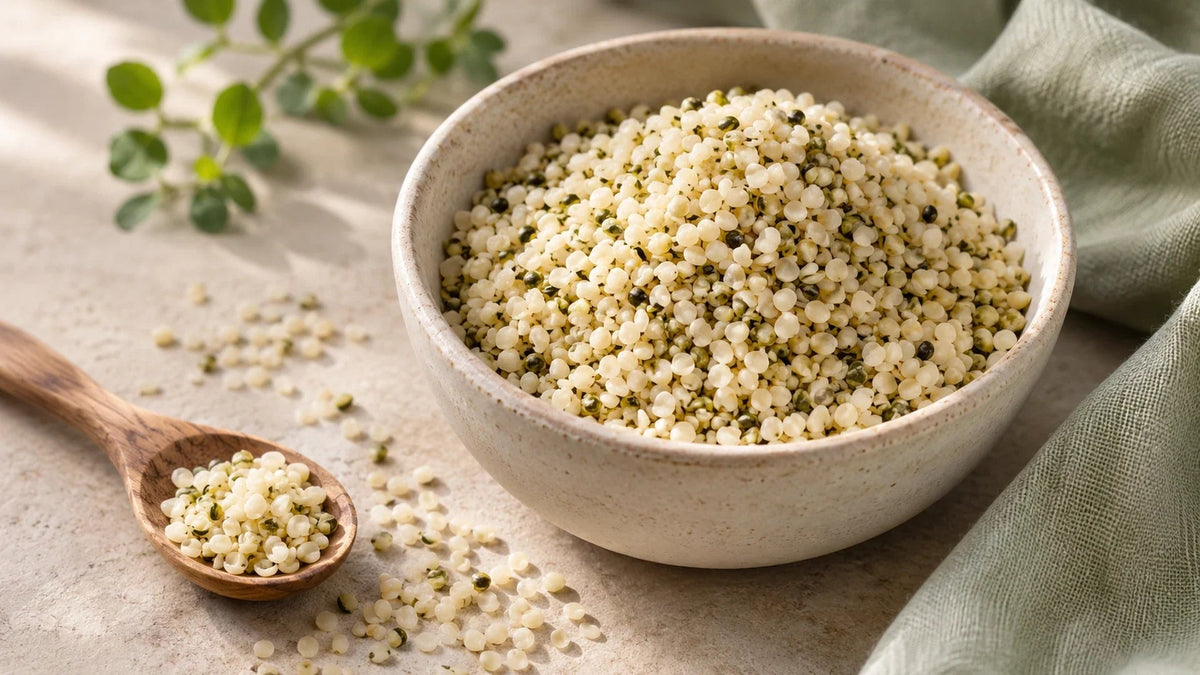
Hulled hemp seeds are also called hemp hearts. They are the soft inner part of the seed, with the outer shell removed.
The nutrition figures in this article are for plain hemp hearts, based on a USDA reference. Whole hemp seeds, hemp seed oil and hemp protein powder have different nutrition profiles. Values also vary between products. [1]
Hemp Seeds Nutrition Facts
The table below shows the approximate nutrients in hulled hemp seeds per tablespoon, per three tablespoons and per 100 grams.
| Nutrient | 1 tablespoon (about 10 g) | 3 tablespoons (30 g) | Per 100 g |
|---|---|---|---|
| Calories | 55 kcal | 166 kcal | 553 kcal |
| Protein | 3.2 g | 9.5 g | 31.6 g |
| Total fat | 4.9 g | 14.6 g | 48.8 g |
| Saturated fat | 0.5 g | 1.4 g | 4.6 g |
| Monounsaturated fat | 0.5 g | 1.6 g | 5.4 g |
| Polyunsaturated fat | 3.8 g | 11.4 g | 38.1 g |
| Total carbohydrates | 0.9 g | 2.6 g | 8.7 g |
| Fibre | 0.4 g | 1.2 g | 4.0 g |
| Magnesium | 70 mg | 210 mg | 700 mg |
| Phosphorus | 165 mg | 495 mg | 1,650 mg |
| Potassium | 120 mg | 360 mg | 1,200 mg |
| Iron | 0.8 mg | 2.4 mg | 8.0 mg |
| Zinc | 1.0 mg | 3.0 mg | 9.9 mg |
| Calcium | 7 mg | 21 mg | 70 mg |
Source: USDA National Nutrient Database, “Seeds, hemp seed, hulled.” Values are rounded. One tablespoon is estimated at 10 g, based on the USDA measure of three tablespoons per 30 g. The weight of a spoonful and the nutrition of individual products can vary. [1]
The 100-gram values are useful when comparing foods at the same weight. They are a reference amount, not a suggested serving. To estimate what you eat, use the weight of your portion and check your product’s label.
How Many Calories Are in Hemp Seeds?
Hemp hearts contain approximately 55 calories per tablespoon and 166 calories per three tablespoons.
| Amount of hemp hearts | Approximate weight | Calories |
|---|---|---|
| 1 tablespoon | 10 g | 55 |
| 2 tablespoons | 20 g | 111 |
| 3 tablespoons | 30 g | 166 |
| 100 g | 100 g | 553 |
These figures are estimates calculated from the USDA reference for hulled hemp seeds. [1]
Why Are Hemp Seeds High in Calories?
Hemp seeds are calorie-dense, which means a small amount provides a relatively large number of calories. Much of their energy comes from fat.
This does not mean hemp seeds need to be avoided. It means the amount you add matters. A light sprinkle and three full tablespoons will contribute different amounts of calories to a meal.
How Much Protein Is in Hemp Seeds?
Hemp hearts provide about 3.2 grams of protein per tablespoon. A three-tablespoon portion provides approximately 9.5 grams.
| Amount of hemp hearts | Approximate protein |
|---|---|
| 1 tablespoon (10 g) | 3.2 g |
| 2 tablespoons (20 g) | 6.3 g |
| 3 tablespoons (30 g) | 9.5 g |
| 100 g | 31.6 g |
Hemp seeds can add plant-based protein to yoghurt, oats, salads and other foods. How much protein they add depends on the portion you use.
Are Hemp Seeds a Complete Protein?
Hemp seeds contain all nine essential amino acids. Amino acids are the building blocks of protein, and essential amino acids must come from food.
However, having all nine does not mean a food provides each one in the same amount. Hemp protein is relatively low in lysine. In a study of several hemp seed products, lysine was the first limiting amino acid—that is, the one in shortest supply compared with the reference used by the researchers. Protein digestibility also differed between the products tested. [2]
Hemp hearts can contribute protein as part of a varied diet. Foods such as lentils, beans, dairy, eggs and meat can provide different amounts and types of amino acids.
Hemp Seeds vs Hemp Protein Powder
Hemp hearts and hemp protein powder have different nutrition profiles.
Hemp hearts contain both protein and a substantial amount of fat. Hemp protein powder is a processed product, and its protein, fat and fibre content depends on how it is made.
Check the label on the product you use rather than applying hemp heart values to protein powder.
What Types of Fat Are in Hemp Seeds?
A 30-gram serving of hemp hearts contains about 14.6 grams of fat. Most is unsaturated fat, especially polyunsaturated fat.
| Type of fat | Approximate amount per 30 g |
|---|---|
| Total fat | 14.6 g |
| Polyunsaturated fat | 11.4 g |
| Monounsaturated fat | 1.6 g |
| Saturated fat | 1.4 g |
Values are rounded from the USDA reference for hulled hemp seeds. [1]
Do Hemp Seeds Contain Omega-3 and Omega-6?
Yes. Hemp seeds provide both omega-3 and omega-6 fats.
The main omega-3 in hemp hearts is alpha-linolenic acid, or ALA. The main omega-6 listed here is linoleic acid, or LA.
Based on the USDA reference, 30 grams of hemp hearts provide approximately:
- ALA, an omega-3 fat: 2.6 g
- Linoleic acid, an omega-6 fat: 8.2 g
Both are essential fats, meaning the body needs to get them from food. The amounts can vary between products. [1, 3]
Hemp Seed Omega-3 vs Fish Omega-3
The omega-3 in hemp seeds is mainly ALA. Fish and seafood provide different omega-3 fats called EPA and DHA.
The body can convert some ALA into EPA and DHA, but only in small amounts. Hemp seeds provide plant-based omega-3; they do not directly provide the same omega-3 fats as fish or algae sources of EPA and DHA. [3]
What Is the Omega-6 to Omega-3 Ratio?
Using the USDA figures, the ratio of linoleic acid to ALA in hemp hearts is roughly 3:1.
This compares those two specific fats. It does not count every omega-6 or omega-3 fat in the seeds, and the ratio can vary between products. [1]
Carbohydrates and Fibre in Hemp Seeds
Three tablespoons of hemp hearts contain about 2.6 grams of total carbohydrates, including 1.2 grams of fibre. In the USDA figures, fibre is included in the total carbohydrate amount. [1]
Hemp hearts contain less carbohydrate by weight than fat or protein. They also contain less fibre than whole hemp seeds because their outer shells have been removed.
How Many Net Carbs Are in Hemp Seeds?
Some people calculate net carbs by subtracting fibre from total carbohydrates.
Using the USDA figures for hemp hearts:
2.6 g total carbohydrates − 1.2 g fibre = approximately 1.4 g net carbs per 30 g.
Food labels do not all use the same carbohydrate conventions. Check how total carbohydrates and fibre are listed on your product before using this calculation.
Vitamins and Minerals in Hemp Seeds
Hemp hearts provide several minerals in a relatively small portion. The table below uses the USDA values for three tablespoons, or 30 grams, of hulled hemp seeds. [1]
| Mineral | Approximate amount | What it helps the body do |
|---|---|---|
| Magnesium | 210 mg | Supports normal muscle and nerve function |
| Phosphorus | 495 mg | Helps build and maintain bones and teeth |
| Potassium | 360 mg | Supports normal muscle and nerve function |
| Iron | 2.4 mg | Helps make haemoglobin, which carries oxygen |
| Zinc | 3.0 mg | Supports normal immune function and wound healing |
| Calcium | 21 mg | Helps maintain bones and teeth |
The amount of each nutrient a person needs depends on factors such as age and life stage.
Are Hemp Seeds a Good Source of Magnesium?
Hemp hearts provide a notable amount of magnesium. The USDA reference lists approximately 210 mg per 30 grams. [1]
Magnesium supports many normal body functions, including muscle and nerve function. Hemp hearts can contribute to your intake alongside foods such as beans, nuts, whole grains and leafy vegetables.
Do Hemp Seeds Contain Iron and Zinc?
Yes. Three tablespoons of hemp hearts provide approximately 2.4 mg of iron and 3.0 mg of zinc, according to the USDA reference. [1]
The iron in plant foods is called non-haem iron. Eating plant sources of iron with a food containing vitamin C, such as tomatoes or citrus fruit, can help the body absorb it. [4]
The amount of a mineral listed in a food is not necessarily the amount your body absorbs. Natural compounds called phytates, found in many plant foods, can reduce the absorption of minerals such as iron and zinc. Your overall diet also affects absorption. [4, 5]
Do Hemp Seeds Contain Calcium and Vitamins?
Hemp hearts contain calcium, although the amount in a 30-gram serving is modest: approximately 21 mg.
They also provide B vitamins. The USDA reference lists about 0.38 mg of thiamin, also called vitamin B1, and 2.76 mg of niacin, also called vitamin B3, per 30 grams. [1]
Whole Hemp Seeds vs Hemp Hearts: What Is the Nutrition Difference?
The main difference is the outer shell.
| Product | Description |
|---|---|
| Whole hemp seeds | Seeds with their outer shell still present |
| Hemp hearts | Seeds with the outer shell removed; also called hulled or shelled hemp seeds |
Removing the shell changes the proportions of nutrients in the food. Whole hemp seeds retain the fibre-containing outer shell, while hemp hearts have less fibre.
Do not assume that the numbers for hemp hearts apply to whole hemp seeds. When comparing two products, check their labels and use the same serving weight.
Why Do Hemp Seed Nutrition Values Differ?
You may see different numbers for hemp seed calories, protein or fat on packets and websites. Several factors can explain the difference.
The Form of Hemp
Whole seeds, hemp hearts, hemp seed oil and hemp protein powder are different products. Each has its own nutrient profile.
For example, hemp hearts provide protein and fat, while hemp seed oil is mainly fat.
The Serving Size
One label may show values per tablespoon, another per 30 grams, and another per 100 grams. Check the weight before comparing numbers.
A tablespoon is convenient, but the weight of a spoonful can vary. A kitchen scale gives a more precise portion weight.
Product Variation and Rounding
Seed varieties, processing, testing methods and label rounding can all affect the numbers shown.
The figures in this article are general reference values. For the closest estimate of what you eat, check your product label and the amount you use.
Frequently Asked Questions
How many calories are in 2 tablespoons of hemp hearts?
Two tablespoons of hemp hearts, weighing approximately 20 grams, provide about 111 calories, based on the USDA reference. [1]
How much protein is in 1 tablespoon of hemp seeds?
One tablespoon of hulled hemp seeds, weighing about 10 grams, provides approximately 3.2 grams of protein. [1]
Are hemp seeds mostly protein or fat?
Hemp hearts contain more fat than protein by weight. Per 100 grams, they provide about 48.8 grams of fat and 31.6 grams of protein. [1]
Are hemp hearts high in fibre?
Hemp hearts provide some fibre, but they are not especially high in fibre compared with many other seeds. Three tablespoons provide about 1.2 grams. Whole hemp seeds have a different fibre profile because they retain their outer shell. [1]
Does hemp seed oil have the same nutrition as hemp seeds?
No. Hemp seed oil is mainly fat. Hemp hearts also provide protein, fibre and minerals. Check the label for the specific product you use.
Are hemp hearts and hemp seeds the same?
Hemp hearts are hulled hemp seeds. Their outer shells have been removed. Whole hemp seeds still have their shells, so their texture and nutrient proportions differ.
Key Takeaways
- Three tablespoons of hemp hearts provide about 166 calories, 9.5 g of protein and 14.6 g of fat.
- Most of their fat is unsaturated, including omega-3 ALA and omega-6 linoleic acid.
- Hemp hearts contain all nine essential amino acids, but they are relatively low in lysine.
- They provide minerals including magnesium, phosphorus, iron and zinc.
- Whole seeds, hemp hearts, hemp oil and hemp protein powder have different nutrition profiles.
- For a specific product, check the label and your portion weight.
Explore more options in the MNT seeds collection.
We rely on peer-reviewed studies and reputable medical journals.