


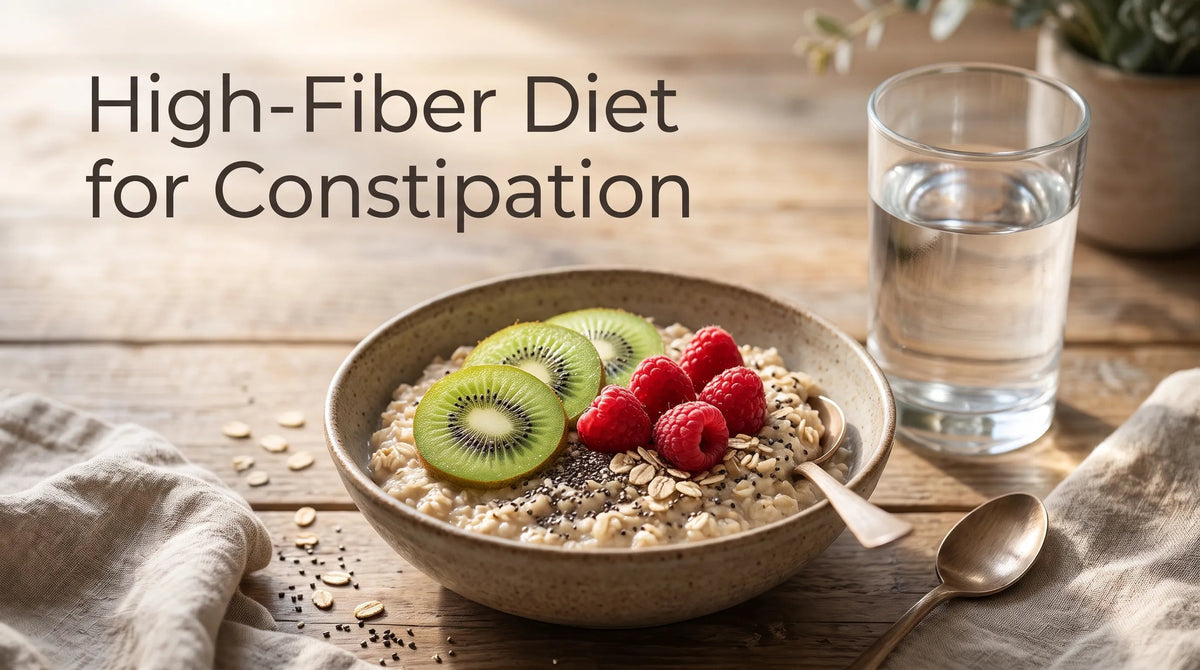
High-Fiber Diet for Constipation: Foods, Grams & Plan
Relieve chronic constipation with a science-backed, high-fiber diet. Learn your exact daily fiber targets, discover the best gel-forming foods for easy digestion, and follow a 14-day step-by-step plan to safely increase fiber without bloating.
How Much Fiber Do You Actually Need for Constipation Relief?
To stop chronic or occasional constipation, you must hit a daily fiber target based on your age and biological sex. Most adults only eat 10 to 15 grams of fiber a day, which leaves the colon without enough bulk to trigger normal bowel contractions.
Clinical nutrition guidelines calculate fiber needs using the 14-grams-per-1,000-calories rule. Aim for at least 6 to 10 grams of your daily total to come from soluble fiber, which is clinically proven to improve stool softness and frequency.
| Group | Daily Fiber Target | How to Hit Your Target |
|---|---|---|
| Adult Women (Ages 19–50) | 25 to 30 grams | Eat 8 to 10 grams per meal across 3 meals. |
| Adult Men (Ages 19–50) | 31 to 38 grams | Eat 10 to 12 grams per meal plus 1 high-fiber snack. |
| Women (Age 51+) | 21 to 25 grams | Focus on soft, cooked vegetables, oats, and berries. |
| Men (Age 51+) | 28 to 30 grams | Prioritize soluble fiber like oatmeal, chia seeds, and beans. |
| Children (Ages 4–18) | Age + 5 to 10 grams | Example: A 10-year-old needs 15 to 20 grams of fiber daily. |
The Hydration Ratio: Why Fiber Fails Without Enough Water
Eating a high-fiber diet without drinking enough water will make your constipation worse. Fiber acts like a dry sponge in your digestive tract. It needs fluid to swell up and turn into a soft gel.
When you eat 30 grams of fiber but drink very little water, your large intestine pulls moisture out of the stool to keep your body hydrated. This turns the fiber into a dry, heavy block inside your colon. Whenever you boost your fiber intake, aim for at least 1.5 to 2.0 liters (6 to 8 glasses) of fluid daily. High-mineral water (rich in magnesium and sulfates) provides an extra benefit by drawing water directly into the bowel.
Soluble vs. Insoluble Fiber: What Science Shows
You need both soluble and insoluble fiber to fix constipation, as each type performs a different job inside your digestive tract. However, gel-forming soluble fiber has the strongest medical evidence for softening hard, painful stools without causing severe gas. Modern gastroenterology guidelines now favor soluble viscous fiber over rough insoluble bran.
To understand how food fixes constipation, dietitians look at four physical traits of fiber:
- Solubility: Whether the fiber dissolves in water (soluble) or stays intact as rough particles (insoluble).
- Viscosity (Gel-Formation): Whether the dissolved fiber thickens into a slippery, jelly-like mass.
- Water-Holding Capacity: How well the fiber holds onto water all the way to the end of the large intestine without letting the colon dry it out.
- Fermentability: How fast your gut bacteria eat and break down the fiber. Fast fermentation creates gas; slow or moderate fermentation feeds healthy bacteria gently.
Soluble Fiber (The Stool Softener)
How It Works: Dissolves in water to create a slick, gel-like sponge in your intestines. Traps water inside the stool matrix.
Main Benefit: Softens hard, dry, pebble-like stools (Bristol Types 1 and 2) so they slide out without straining.
Best Food Sources: Oats, psyllium husk, chia seeds, peeled apples, beans, lentils, green kiwifruit, and avocado.
Gas & Bloating Risk: Low (ferments slowly), though fast-fermenting types (like inulin) can cause gas.
Insoluble Fiber (The Gut Mover)
How It Works: Does not dissolve in water; acts like a mechanical broom to gently irritate the colon lining and push waste forward.
Main Benefit: Adds physical weight and bulk to your stool to speed up slow digestion.
Best Food Sources: Whole wheat bran, fruit and vegetable skins, leafy greens, nuts, seeds, and popcorn.
Gas & Bloating Risk: Moderate (can irritate sensitive nerves). Eating too much without water makes stools bulky, dry, and harder to pass.
Why Soluble Beats Insoluble for IBS-C and Bloating
If you have Irritable Bowel Syndrome with Constipation (IBS-C) or a sensitive gut, rough insoluble fiber can trigger cramping, while fast-fermenting fibers (like inulin, polydextrose, or galacto-oligosaccharides) feed gut bacteria very quickly—producing heavy gas and bloating—without actually increasing how often you poop. In contrast, psyllium and green kiwifruit ferment very slowly. They hold water all the way through the colon, giving you full constipation relief with minimal bloating.
Quick-Action Relief Matrix: Top Clinical Interventions
| Functional Food / Fiber | Daily Clinical Dose | Primary Mechanism | Expected Relief Timeline | Best For |
|---|---|---|---|---|
| Green Kiwifruit | 2 medium fruits (peeled) | Holds 3x its weight in water; actinidin enzyme speeds up gut motility. | 3 to 7 days (peak results at 4 weeks) | IBS-C, bloating, sensitive stomachs |
| Psyllium Husk | 10g to 20g (1 to 2 tbsp in water) | Forms a thick, slippery gel that resists drying out in the colon. | 12 to 72 hours (full effect in 2–4 weeks) | Hard, pellet-like stools (Bristol Type 1–2) |
| Dried Prunes (Plums) | 50g to 100g (5 to 10 prunes) | Sorbitol pulls water into the gut; soluble pectin softens stool. | 24 to 48 hours (sustained relief in 3 weeks) | Slow bowel movements, straining |
| Chia or Ground Flaxseeds | 15g to 20g (1.5 to 2 tbsp soaked) | Mucilage gel lubricates the colon wall and adds soft bulk. | 24 to 72 hours | Daily maintenance, dry stools |
How Fiber Relieves Constipation: The Gut Science Explained Simply
When you eat a high-fiber diet for constipation, biological changes happen inside your colon through three main pathways:
- Water Retention & Osmotic Plant Compounds: Normally, your large intestine pulls water out of your waste. Soluble fiber traps water molecules inside the stool, keeping it soft. Whole high-fiber foods contain natural laxative helpers beyond fiber itself. Prunes, pears, and apples are rich in sorbitol, a natural sugar alcohol that acts like an osmotic magnet, drawing water directly into the bowel. Green kiwifruit contains a natural enzyme called actinidin, which stimulates motility receptors to speed up transit time.
- The Stretch-and-Push Reflex (Peristalsis): Your colon wall is lined with tiny motion sensors called mechanoreceptors (stretch receptors). When insoluble and soluble fibers bulk up your stool, the wider stool gently presses against the inside of the colon wall. This stretch sends an instant signal to your gut's nervous system, telling the muscles behind the stool to squeeze and the muscles in front of it to relax. This wave-like push is called peristalsis.
- Short-Chain Fatty Acids (SCFAs) and Serotonin Signaling: As healthy bacteria in your colon ferment soluble fibers (like oat beta-glucan and pectin), they produce healing compounds called Short-Chain Fatty Acids (butyrate, propionate, and acetate). Butyrate gives energy to the cells lining your colon and stimulates specialized gut cells to release serotonin (5-HT)—the chemical messenger that keeps your bowel contractions moving at a healthy speed.
The Definitive High-Fiber Foods Chart for Constipation
The best foods for constipation combine soluble gel-forming fiber with natural water-pulling compounds. Use this chart to build meals that balance both soluble and insoluble fiber without overloading your stomach.
| Food Item | Standard Serving Size | Total Fiber | Soluble / Insoluble | Special Gut-Moving Compound | Bloating / FODMAP Note |
|---|---|---|---|---|---|
| Chia Seeds | 2 tablespoons (28g) | 9.8 g | 1.5g / 8.3g | Mucilage gel (absorbs 12x weight in water) | Low FODMAP; gentle on IBS-C |
| Navy Beans (Cooked) | 1/2 cup (90g) | 9.6 g | 2.2g / 7.4g | Resistant starch for butyrate production | High GOS; rinse canned beans well |
| Green Peas (Cooked) | 1 cup (160g) | 8.8 g | 2.6g / 6.2g | Balanced bulk and prebiotic starch | Moderate FODMAP in large servings |
| Raspberries / Blackberries | 1 cup (125g) | 8.0 g | 1.8g / 6.2g | High water content + tiny insoluble seeds | Low FODMAP up to 1/2–1 cup |
| Lentils (Cooked) | 1/2 cup (100g) | 7.8 g | 1.2g / 6.6g | Prebiotic fiber + plant magnesium | Soak and pressure-cook to cut gas |
| Black Beans / Chickpeas | 1/2 cup (90g) | 7.5 g | 2.0g / 5.5g | High soluble pectin + resistant starch | Canned & rinsed has 50% less gas |
| Psyllium Husk (Whole) | 1 tablespoon (10g) | 7.0 g | 6.0g / 1.0g | Arabinoxylan non-fermenting gel | Zero FODMAP; gold standard |
| Avocado | 1/2 medium (100g) | 6.7 g | 2.1g / 4.6g | Healthy monounsaturated fats lubricate stool | Contains perseitol (polyol) in large doses |
| Sweet Potato (Cooked, w/ skin) | 1 cup (200g) | 6.3 g | 2.8g / 3.5g | High soluble pectin softens stool gently | Very easy to digest when cooked |
| Flaxseeds (Ground) | 2 tablespoons (20g) | 5.6 g | 1.8g / 3.8g | Mucilage gel + Omega-3 oil lubrication | Low FODMAP at 1–2 tbsp |
| Pear (Medium, with skin) | 1 medium (180g) | 5.5 g | 2.2g / 3.3g | Sorbitol + Fructose osmotic water pull | High FODMAP; great for slow stools |
| Pumpkin Seeds (Pepitas) | 1 ounce / 2 tbsp (28g) | 5.2 g | 0.8g / 4.4g | Rich in Magnesium (relaxes bowel muscles) | Low FODMAP; crunchier whole-seed option |
| Whole-Grain Rye Bread | 2 thick slices (80g) | 5.0 g | 2.0g / 3.0g | Arabinoxylan speeds transit by 23% vs white bread | High fructans; avoid in strict low-FODMAP |
| Apple (Medium, with skin) | 1 medium (180g) | 4.8 g | 1.5g / 3.3g | Pectin in flesh + insoluble cellulose in peel | Cook/stew apples for easier digestion |
| Green Kiwifruit | 2 medium fruits (150g) | 4.5 g | 1.8g / 2.7g | Actinidin enzyme + high water-swelling cell walls | Low FODMAP; beats psyllium for bloating |
| Prunes (Dried Plums) | 6–7 prunes (60g) | 4.3 g | 2.3g / 2.0g | Sorbitol (14.7g/100g) + chlorogenic acid | High FODMAP; start with 3 prunes |
| Oats (Rolled, Dry) | 1/2 cup (40g) | 4.0 g | 2.0g / 2.0g | Beta-glucan soothing viscous gel | Low FODMAP; ideal morning starter |
The 14-Day Stepwise Fiber Titration Protocol (How to Add Fiber Without Bloating)
Never jump from a low-fiber diet (10g/day) to a high-fiber diet (35g/day) overnight. Adding 20 grams of fiber in a single day overwhelms your gut bacteria, traps gas pockets behind hard stool, and causes severe stomach cramps. Follow the 3-to-5 Gram Rule: Increase your daily fiber by only 3 to 5 grams every 3 to 5 days so your gut microbes and digestive enzymes can adjust comfortably.
Days 1–4: The Hydration & Soluble Gel Foundation (+5g Fiber/Day)
- Goal: Soften existing hard stool without producing gas.
- Action: Drink one large glass (300 ml) of warm water right when you wake up to trigger your gastrocolic reflex (the morning signal that tells your colon to empty). Add 2 green kiwifruits or 1 tablespoon of soaked chia seeds (or 1 tsp psyllium husk in water) to your breakfast.
Days 5–9: The Midday Whole-Grain & Fruit Upgrade (+10g Fiber/Day Total)
- Goal: Increase water-holding bulk across two meals.
- Action: Keep your Day 1 habit. Swap refined white bread, white rice, or sugary cereal for 1/2 cup of rolled oats or 2 slices of whole-grain bread at breakfast/lunch, plus 1 medium pear or 4–5 prunes as an afternoon snack. Ensure fluid intake reaches 1.5 liters.
Days 10–14: The Dinner Legume & Seed Integration (+15g to 20g Fiber/Day Total)
- Goal: Reach your full 28g to 35g daily target and lock in effortless daily bowel movements.
- Action: Keep your morning and midday habits. Add 1/2 cup of cooked lentils, chickpeas, or black beans and 1 cup of cooked vegetables (like broccoli, spinach, or sweet potato) to dinner, topped with 1 tablespoon of pumpkin seeds or ground flaxseeds. Drink 2.0 liters of water daily.
- Soak and Rinse Beans and Lentils: Dry beans and lentils contain galacto-oligosaccharides (GOS)—sugars that cause heavy gas. Soak dry legumes overnight, or buy canned beans and rinse them under running water for 30 seconds to wash away up to 50% of the gas-causing sugars.
- Cook Your Vegetables Instead of Eating Raw Salads: Raw broccoli, cauliflower, and kale are tough for a sluggish gut. Steaming, roasting, or sautéing softens stiff insoluble cellulose walls without destroying the fiber gram count, making them much gentler on a bloated stomach.
- Pre-Hydrate Dry Seeds: Always let chia seeds, ground flaxseeds, basil seeds, and psyllium husk swell in liquid for 5 to 15 minutes before swallowing so they enter your stomach as a ready-made hydrating gel. Whole flaxseeds pass straight through your gut undigested, so always grind them first.
7-Day High-Fiber Meal Plan for Constipation (30g–35g/Day)
Spreading 8 to 10 grams of fiber evenly across breakfast, lunch, dinner, and snacks keeps stool consistently soft from start to finish.
| Day | Breakfast (~9–10g Fiber) | Lunch (~9–10g Fiber) | Afternoon Snack (~5g Fiber) | Dinner (~8–10g Fiber) | Daily Total |
|---|---|---|---|---|---|
| Day 1 | Oatmeal (1/2 cup oats) + 1 tbsp chia seeds + 1/2 cup raspberries | Whole-wheat wrap + 1/2 cup black beans + avocado + spinach | 2 Green Kiwifruits + 1 glass water | Grilled chicken/tofu + 1 cup baked sweet potato (with skin) + steamed broccoli | 34.5 g |
| Day 2 | 2 slices whole-grain rye toast + 1/2 mashed avocado + 2 eggs + 1 tbsp ground flaxseed | Lentil soup (1 cup cooked lentils + carrots + celery) | 1 medium Pear (with skin) + 10 almonds | Baked salmon/fish + 1/2 cup quinoa + 1 cup roasted Brussels sprouts | 33.0 g |
| Day 3 | Greek yogurt bowl + 1 tbsp chia seeds + 1 tbsp pumpkin seeds + 1/2 cup blackberries | Chickpea & quinoa Mediterranean bowl (1/2 cup chickpeas + cucumbers + olive oil) | 5–6 Dried Prunes + herbal tea | Whole-wheat pasta + turkey/lentil marinara sauce + 1 cup sautéed spinach | 32.0 g |
| Day 4 | Warm oat bran porridge (1/2 cup) + 1 chopped apple (with skin) + cinnamon + walnuts | Whole-grain pita + hummus (1/3 cup) + grilled veggies + side green pea salad | 2 Green Kiwifruits | Stir-fry with brown rice (1/2 cup) + edamame/tofu + broccoli + carrots | 31.5 g |
| Day 5 | Chia pudding (2 tbsp chia seeds soaked in milk) topped with 1/2 sliced ripe banana | Kidney bean & barley chili (1/2 cup kidney beans + 1/2 cup barley + tomatoes) | 3 cups air-popped Popcorn + 1 orange | Baked chicken/paneer + 1 medium baked potato (with skin) + sautéed green beans | 34.0 g |
| Day 6 | Smoothie: 1 cup spinach + 1/2 cup berries + 2 tbsp ground flaxseed + 1/3 cup oats | 2 slices whole-grain rye bread sandwich + turkey/cheese + 1 cup carrot sticks | 1/4 cup Prunes + 1 tbsp pumpkin seeds | Red lentil dal (3/4 cup) + 1 whole-wheat chapati/flatbread + cooked kale | 33.5 g |
| Day 7 | Oatmeal (1/2 cup) + 1 tbsp flaxseed + 2 diced green kiwifruits on the side | Burrito bowl: 1/2 cup pinto beans + 1/2 cup brown rice + salsa + 1/2 avocado | 1 medium Apple (with skin) + 1 tbsp almond butter | Roasted fish or grilled meat + 1 cup cooked green peas + roasted sweet potato wedges | 35.0 g |
Easy High-Fiber Swaps for Everyday Meals
| Low-Fiber Habit (1g–2g Fiber) | High-Fiber Clinical Upgrade | Extra Fiber Gained |
|---|---|---|
| 2 slices of white bread (~1.5g) | 2 slices of whole-grain rye or sprouted wheat bread (5g–6g) | +4.0 g |
| 1 glass of clear apple or orange juice (0g) | 1 whole pear or apple with skin or 2 green kiwifruits (5g) | +5.0 g |
| Potato chips or crackers (1g) | 3 cups air-popped popcorn or 1 oz pumpkin seeds (5.2g–5.8g) | +4.5 g |
| 1 cup cooked white rice (0.6g) | 1/2 cup cooked lentils mixed with 1/2 cup brown rice (9.5g) | +8.9 g |
| Plain cornflakes cereal (1g) | 1/2 cup oatmeal + 1 tbsp chia seeds (8.1g) | +7.1 g |
Low-Fiber Foods to Avoid When You Are Constipated
While building up your fiber intake, temporarily cut back on foods that have zero fiber and slow down gut movement:
- Clinical Warning on Bananas & Persimmons: Never eat unripe (greenish) bananas or persimmons when constipated. Unripe bananas are packed with tannins and amylase-resistant starch that slow down bowel movements and harden stools. Persimmons also contain high levels of tannins that paralyze bowel contractions. (Only eat fully ripe, yellow-spotted bananas, which contain soluble fiber).
- White Flour Products: White bread, white pasta, regular crackers, and pastries have had their outer fiber bran stripped away.
- Fried and Greasy Fast Foods: High-fat meals take much longer for your stomach to empty, slowing down your entire digestive tract.
- Large Amounts of Cheese and Full-Fat Dairy: Cheese contains zero fiber and high fat, which frequently binds stool in constipated adults and children.
- Processed Meats and Frozen Dinners: Hot dogs, sausage, and packaged meals are high in salt (which pulls water away from your colon) and have almost no dietary fiber.
When a High-Fiber Diet Makes Constipation WORSE (Crucial Clinical Exceptions)
Adding extra fiber does not fix every type of constipation—and in specific medical conditions, eating more bulk-forming fiber will actually make your symptoms much worse. If you eat 30 grams of fiber and drink 2 liters of water daily but feel more bloated and backed up, look at these clinical scenarios:
1. Severe Fecal Loading or Impaction
If you have not had a full bowel movement in 5 to 7+ days and your lower belly feels hard, your rectum is likely plugged with dry, compacted stool. Dumping 30 grams of bulky fiber on top of a blocked bowel is like sending 500 more cars into a highway pile-up.
The Fix: Clear the blockage first using a gentle osmotic laxative (like Polyethylene Glycol / Miralax or Magnesium Oxide) or a doctor-recommended suppository. Once moving, introduce soluble fiber slowly.
2. Pelvic Floor Dyssynergia
Your colon moves stool down on time, but the muscles at the bottom of your pelvis accidentally squeeze shut instead of relaxing when you push. You strain hard but feel like you never empty completely.
The Fix: Bulking up the stool with heavy insoluble fiber makes it harder to squeeze through a tight pelvic floor. You need soft, slippery stools (soluble gel fibers) alongside Pelvic Floor Physical Therapy and a toilet footstool.
3. Slow-Transit Constipation
The nerves and pacemaker cells inside the colon wall are sluggish and do not fire normal muscle contractions. You rarely feel the urge to poop, and high-fiber diets just sit in your belly fermenting into painful gas.
The Fix: Avoid heavy insoluble wheat bran and gas-producing legumes. Use low-fermenting soluble liquids, magnesium oxide, or prokinetic treatments prescribed by a gastroenterologist.
4. IBS-C (Irritable Bowel Syndrome)
High-FODMAP fibers (like apples, pears, prunes, black beans, and wheat) ferment rapidly in your gut and trigger painful bowel spasms, bloating, gas, and cramping.
The Fix: Use low-FODMAP soluble fibers that do not ferment quickly. The best options are 2 green kiwifruits daily, psyllium, chia, flax, oats, and cooked carrots. Avoid inulin and chicory root.
Whole Foods vs. Fiber Supplements: How to Choose
Whole foods should always be your first choice because they provide water, natural enzymes, polyphenols, and magnesium alongside fiber. However, when busy schedules make hitting 30 grams difficult, targeted supplements can bridge the gap.
- Psyllium Husk (Metamucil, Ispaghula): Soluble, viscous, gel-forming, low-fermenting. Strongest clinical evidence. Softens hard stool and speeds frequency; take with 250ml+ water.
- Methylcellulose (Citrucel): Synthetic soluble, non-fermenting, gel-forming. Moderate evidence. Zero gas (cannot be fermented by bacteria); great for severe bloaters.
- Calcium Polycarbophil (FiberCon): Synthetic insoluble water-absorbing polymer. Moderate evidence. Absorbs 60x its weight in water.
- Wheat Dextrin (Benefiber): Soluble, non-viscous (does not form a gel). Weak evidence for constipation; dissolves thin like water. Can actually dry out stools in high doses.
- Inulin / Chicory Root / GOS (Most fiber gummies): Soluble, rapidly fermenting prebiotic. Not recommended for stool frequency. High risk of gas and flatulence without moving the bowel.
Critical Medication Timing Rule: Viscous fibers like psyllium husk, chia seeds, and flaxseeds can trap oral medications inside their gel matrix and block them from absorbing into your bloodstream. Always take fiber supplements at least 1 to 2 hours before or after taking thyroid medication (levothyroxine), iron supplements, antidepressants, diabetes drugs, or heart medications.
Dietary changes work safely for simple, chronic functional constipation. However, you should consult a doctor immediately if your constipation lasts longer than 3 weeks despite diet changes, or if you experience any of these warning signs:
- Blood in your stool (bright red blood on the toilet paper or dark, black, tarry stools).
- Unexplained weight loss of more than 5% of your body weight over 6 months.
- Iron-deficiency anemia or extreme, unexplained fatigue.
- Sudden, new constipation starting after age 50.
- Pencil-thin stools that stay narrow for several weeks.
- Severe abdominal pain, vomiting, fever, or an inability to pass gas.
- A family history of colon cancer or Inflammatory Bowel Disease.
Frequently Asked Questions (FAQs)
Can eating too much fiber cause constipation?
Yes. Eating more than 40 to 50 grams of fiber a day—or increasing your fiber intake without drinking enough water—causes the fiber to absorb all available moisture in your intestines. This leaves your stool dry, hard, and packed tightly in your colon like a cement mass, which worsens constipation and causes painful cramping. If you feel backed up after adding fiber, cut your fiber dose in half, drink 2 liters of water daily, and switch from dry grains/bran to wet, soluble foods like kiwifruit and soaked chia seeds.
Which works better: 2 kiwifruits, prunes, or psyllium husk?
All three are clinically proven to relieve chronic constipation, but 2 green kiwifruits per day cause the fewest side effects. In head-to-head randomized controlled trials, prunes (100g/day) and green kiwifruit (2 fruits/day) matched or beat psyllium husk for increasing weekly bowel movements and softening stool consistency. However, patients eating green kiwifruit reported significantly less bloating, gas, and abdominal cramping than those taking psyllium or prunes.
Why am I still constipated on a high-fiber diet?
If you eat plenty of fiber and still cannot poop, the four most common culprits are low water intake, eating the wrong type of fiber (too much dry insoluble bran or inulin), lack of physical movement, or pelvic floor dysfunction. Check your thyroid function (hypothyroidism slows the gut), add a 20-minute brisk walk after meals, drink a warm beverage at breakfast to trigger your gastrocolic reflex, and use a footstool on the toilet to relax your pelvic floor muscles.
Does blending or cooking fruits and vegetables ruin their fiber for constipation?
No, blending a smoothie or cooking vegetables does not destroy dietary fiber. The total grams of soluble and insoluble fiber stay intact in the pot or blender. In fact, cooking vegetables and blending seeds breaks down tough plant cell walls, making the fiber much easier for a sluggish digestive system to hydrate and process without causing gas. However, juicing (which throws away the pulp) strips out almost 100% of the fiber and should be avoided—except for prune juice, which still works because its liquid holds natural sorbitol.
Need Personalized Guidance for Your Gut Health?
Chronic constipation requires an individualized approach. Work with our Registered Dietitian Nutritionists at Medical Nutrition Therapy to build an evidence-based clinical diet plan tailored to your body's specific needs, tolerances, and metabolic health.
Book a Clinical Nutrition ConsultationWe rely on peer-reviewed studies and reputable medical journals.