

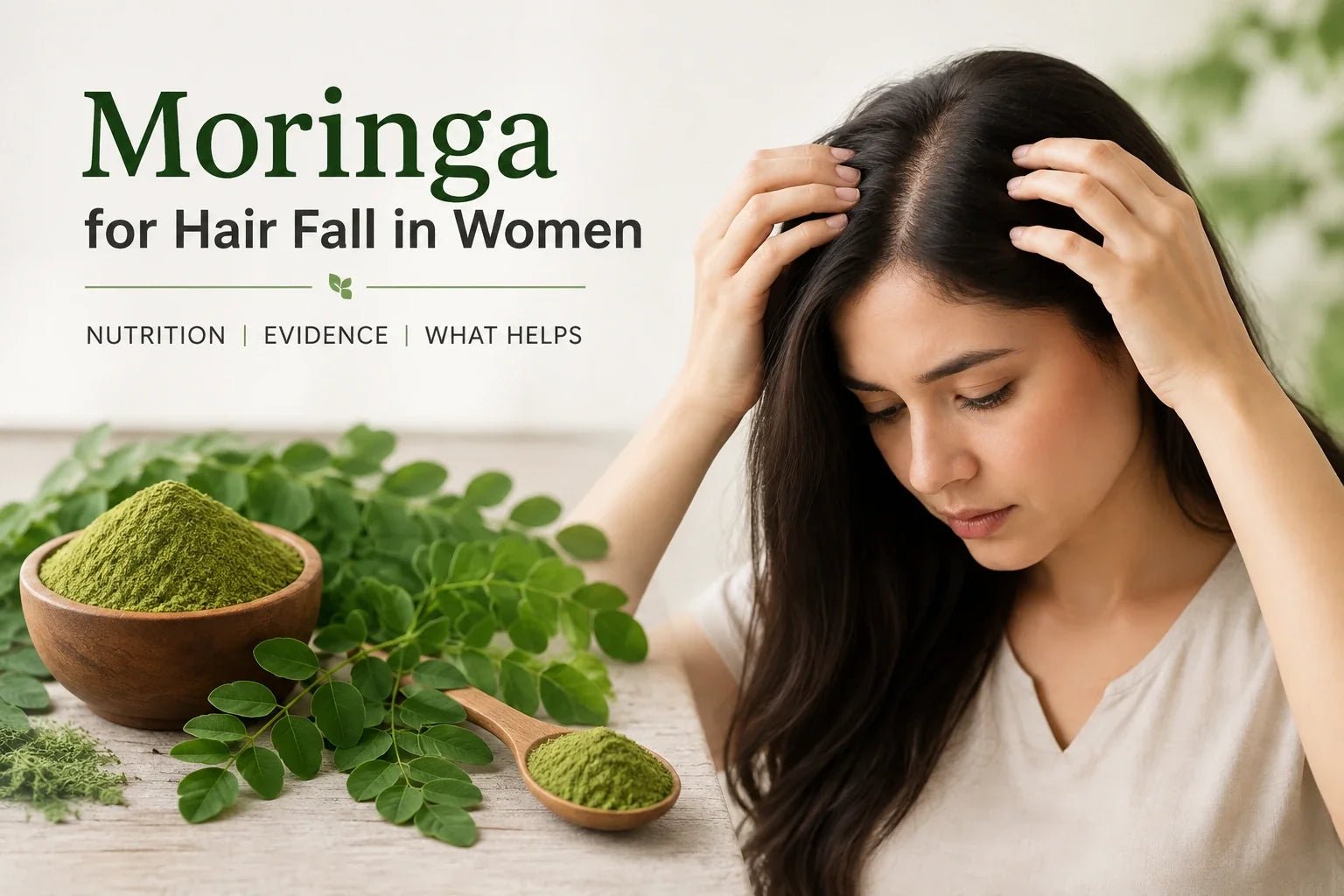
Moringa for Hair Fall in Women: Nutrition, Evidence & What Helps
Can moringa help with hair fall in women? Explore its links with iron, ferritin, protein and other nutrients, what the research actually shows, and when hair loss may need medical assessment.
Moringa may support hair health by adding useful nutrients to the diet, but it is not a proven treatment for hair loss in women. Moringa leaves contain iron, protein, zinc, beta-carotene and other nutrients involved in normal body and hair function. It may be useful when poor nutrition is part of the problem. However, female hair fall can also be caused by iron deficiency, rapid weight loss, childbirth, thyroid problems, PCOS, illness, stress or female-pattern hair loss. Finding the real cause matters more than adding one “hair growth” food.
Moringa and Hair Fall in Women: The Evidence at a Glance
| Question | Current evidence |
|---|---|
| Does moringa contain nutrients linked with healthy hair? | Yes. Moringa leaves contain protein, iron, zinc, beta-carotene and other micronutrients. |
| Is moringa proven to stop hair fall in women? | No. Human evidence is still limited. |
| Could moringa help if your diet is poor? | Possibly. It can add useful nutrients as part of a balanced diet. |
| Can moringa treat iron-deficiency hair loss by itself? | Do not rely on it as treatment. Confirmed iron deficiency may need targeted treatment and investigation. |
| Can moringa increase ferritin enough to replace iron tablets? | Not established. |
| Does moringa regrow hair in female-pattern hair loss? | Not proven. |
| Is moringa powder better than moringa oil for nutrition-related shedding? | Yes, in the nutritional sense. Powder is eaten; oil cannot correct a nutrient deficiency. |
| Is there a proven moringa dose for hair growth? | No. |
| How quickly does moringa stop hair fall? | No scientifically established timeframe exists. |
A 2026 systematic review of moringa-derived formulations reported promising findings, including improved hair measures in animal studies and reduced shedding in limited human research. However, the authors concluded that randomized controlled trials are still needed before moringa can be considered an established treatment for hair growth or hair loss. (pubmed.ncbi.nlm.nih.gov)
The most accurate conclusion is therefore:
Moringa is a nutrient-rich food with possible hair-health relevance, not a proven medicine for female hair loss.
Why Does Hair Fall Happen in Women?
Before asking whether moringa will help, first ask:
Why is the hair falling?
Hair fall is not one condition. Some women have excessive shedding. Others develop gradual thinning, bald patches or hair breakage.
These patterns can point toward very different causes.
| What you notice | What it may suggest |
|---|---|
| More hair in the shower, brush or on the pillow | Excessive shedding or telogen effluvium |
| Hair becoming thinner across the scalp | Diffuse hair loss |
| Central part becoming wider | Female-pattern hair loss |
| Hair breaking along the shaft | Hair damage rather than loss from the root |
| Round or oval bald areas | Alopecia areata or another condition needing assessment |
| Hair loss with heavy periods, tiredness or weakness | Iron deficiency may need investigation |
| Hair thinning with irregular periods, acne or facial hair | PCOS or another hormonal issue may be relevant |
Telogen effluvium is a common form of increased shedding. It can appear after childbirth, major illness, surgery, marked weight loss, extreme dieting, major stress or medication changes. The shedding often begins a few months after the trigger. (bad.org.uk)
Female-pattern hair loss is different. It commonly causes gradual thinning over the top of the scalp and a wider central part. It is linked with genetic and hormonal factors and may progress over time. (bad.org.uk)
This distinction matters because adding moringa to the diet will not correct every cause of hair loss.
How Is Nutrition Linked to Hair Fall in Women?
Hair follicles are active tissues. They depend on adequate energy, protein and micronutrients.
Hair shedding may occur when the body is under nutritional stress. Possible situations include:
- severe calorie restriction;
- rapid weight loss;
- very low protein intake;
- iron deficiency;
- restrictive diets;
- poor appetite;
- malabsorption or digestive disease;
- prolonged illness.
Iron deficiency is often considered during the assessment of diffuse hair shedding in women, although the relationship between iron stores and different types of nonscarring hair loss is complex and researchers have not established one universal ferritin target for hair growth. A systematic review found lower ferritin levels in women with nonscarring alopecia overall, while also noting that the evidence is not simple enough to define iron deficiency as the cause in every case. (pubmed.ncbi.nlm.nih.gov)
The key nutrition principle is:
Correct a real deficiency when one exists. Do not assume that more vitamins or minerals will make healthy hair grow faster.
What Nutrients Does Moringa Provide That May Be Relevant to Hair?
Moringa oleifera leaves contain protein, minerals, beta-carotene and a range of plant compounds. Nutrient levels vary depending on the plant variety, soil, climate, maturity, drying process and preparation method. Dried leaves can be particularly nutrient-dense because water has been removed. (pmc.ncbi.nlm.nih.gov)
However, there is an important difference between:
a food containing a nutrient
and
that food being proven to treat a deficiency or disease.
The following nutrients explain why moringa is nutritionally interesting for women with hair fall.
1. Iron: The Strongest Nutritional Link
Moringa leaves contain iron. (pmc.ncbi.nlm.nih.gov)
Iron matters because women who menstruate lose iron through blood loss, and heavy menstrual bleeding can increase the risk of low iron stores. Ferritin is commonly used as a marker of stored iron, although inflammation and other factors can affect its interpretation. (ods.od.nih.gov)
But moringa iron is plant-based non-heme iron.
Plant foods contain non-heme iron, while meat and seafood can provide heme iron. Heme iron generally has higher bioavailability. Vitamin C can improve the absorption of non-heme iron from plant foods. (ods.od.nih.gov)
So moringa can contribute to dietary iron intake, but that does not mean a spoonful of moringa powder will reliably correct iron deficiency.
2. Protein
Hair fibres are largely made from keratin, a protein.
Severe dietary restriction and marked weight loss are recognized triggers of telogen effluvium, and dermatology guidance recommends a balanced diet that includes protein-rich foods during recovery. (bad.org.uk)
Moringa leaves contain protein, but the amount actually consumed matters. Dried leaves can be protein-rich by weight, yet most people eat far less than 100 grams of moringa powder at a time. (pmc.ncbi.nlm.nih.gov)
A teaspoon or small serving of moringa should therefore not replace normal protein foods such as:
- eggs;
- milk or yogurt;
- fish;
- chicken;
- meat;
- lentils;
- beans;
- chickpeas;
- tofu or soy foods;
- nuts and seeds.
3. Zinc
Moringa leaves contain zinc and other minerals. (pmc.ncbi.nlm.nih.gov)
Zinc is needed for normal cell and tissue function. But the important issue is whether a person actually has inadequate intake or deficiency.
Taking more of a nutrient when intake is already adequate does not automatically produce faster hair growth.
4. Beta-Carotene and Vitamin A
Moringa leaves contain beta-carotene, which the body can convert into vitamin A. (pmc.ncbi.nlm.nih.gov)
Vitamin A is needed for normal cell function, but this does not mean high-dose vitamin A supplements should be taken for hair growth.
Nutrition works best in balance.
5. Vitamin C and Iron Absorption
Vitamin C helps improve the absorption of non-heme iron from plant foods. (ods.od.nih.gov)
Fresh moringa leaves may provide vitamin C, but processing and drying can change the nutrient content. For that reason, it can be useful to combine plant-based iron foods with a reliable vitamin-C-rich food.
Examples include:
- lentils + lemon;
- chickpeas + tomatoes;
- beans + bell peppers;
- leafy vegetables + citrus fruit;
- moringa-containing meals + guava, lemon, orange or another vitamin-C-rich food.
6. Antioxidants and Plant Compounds
Moringa contains flavonoids, phenolic compounds and other phytochemicals that show biological activity in laboratory research. (pmc.ncbi.nlm.nih.gov)
These findings are interesting, but laboratory antioxidant activity does not prove that eating moringa powder will stop female hair loss.
Mechanism and clinical outcome are not the same thing.
Can Moringa Help Hair Fall Caused by Iron Deficiency?
This is one of the most important questions around moringa for hair fall in women.
The answer is:
Moringa may contribute some iron to the diet, but it should not be relied on to treat diagnosed iron deficiency.
Imagine two women.
The first has a poor-quality diet and eats very few iron-rich foods. Improving her total diet—including lentils, beans, eggs, meat if eaten, vegetables, fortified foods, fruit and perhaps moringa—may improve her overall nutrient intake.
The second has significant iron deficiency because of heavy menstrual bleeding.
For the second woman, simply adding moringa powder is unlikely to solve the full problem.
She may need:
- confirmation of iron deficiency;
- assessment of its cause;
- appropriate iron treatment;
- monitoring of response.
Dermatology guidance for telogen effluvium notes that blood tests may be used to look for possible causes such as iron deficiency and thyroid disease. (bad.org.uk)
Food support and treatment of diagnosed deficiency are not the same thing.
Can Moringa Increase Ferritin?
Moringa contains iron, so it can contribute to total dietary iron intake.
But there is no established dose of moringa powder that has been shown to reliably raise ferritin to a therapeutic target in women with hair loss.
Ferritin reflects iron stores, but interpretation can be affected by inflammation and other health factors. Iron status is usually assessed using more than one piece of information rather than hair symptoms alone. (ods.od.nih.gov)
Whether ferritin improves depends on factors such as:
- the degree of iron deficiency;
- total iron intake;
- iron absorption;
- menstrual blood loss;
- pregnancy;
- gastrointestinal health;
- inflammation;
- ongoing bleeding;
- whether medical iron treatment is required.
Do not use moringa as a substitute for proper evaluation when low ferritin or iron-deficiency anemia is suspected.
Moringa vs Iron Supplements for Hair Fall
Moringa and iron supplements have different purposes.
| Moringa | Iron supplement |
|---|---|
| A food or plant product | Concentrated iron |
| Provides several nutrients | Mainly intended to provide iron |
| Can contribute to normal dietary intake | May be used to correct diagnosed deficiency |
| Contains non-heme iron | Dose can be selected according to clinical need |
| No established dose for female hair loss | Used according to iron status and medical guidance |
| Cannot diagnose iron deficiency | Usually taken after the need for iron has been identified |
| Does not guarantee hair regrowth | May help when iron deficiency is contributing to shedding |
Iron supplements are not something every woman with hair loss needs.
Too much iron can also be harmful, so treatment should be based on clinical need rather than hair shedding alone.
Does Moringa Actually Stop Hair Fall or Grow New Hair?
At present, moringa should not be described as a proven hair-loss treatment.
A 2026 systematic review examined moringa-derived formulations for hair growth, preservation and hair loss. It reported increased hair length and hair weight in animal models and reduced shedding in human participants. However, the authors concluded that proper randomized controlled trials are still needed. (pubmed.ncbi.nlm.nih.gov)
This evidence needs to be interpreted carefully.
Research on a specific moringa-derived formulation does not automatically prove that:
- eating fresh moringa leaves;
- taking moringa powder;
- drinking moringa tea;
- swallowing a moringa capsule;
- or applying moringa oil
will produce the same result.
Different products may contain different parts of the plant, concentrations, extracts and doses.
Moringa Hair Claims: What Is Supported?
| Claim | Evidence status |
|---|---|
| Moringa contains nutrients involved in normal body and hair function | Supported |
| Moringa may improve the nutrient quality of a poor diet | Reasonable |
| Moringa deserves more research for hair growth | Yes |
| Moringa reliably stops female hair fall | Not proven |
| Moringa cures iron-deficiency hair loss | Not proven |
| Moringa reliably raises ferritin enough to replace iron treatment | Not established |
| Moringa cures female-pattern hair loss | Not supported |
| Moringa regrows bald patches | Not established |
| Moringa oil corrects nutritional hair loss | No |
Who May Benefit Most From Improving Nutrition?
The question is not really, “Who needs moringa?”
A better question is:
Who may have hair shedding partly related to poor nutrition?
Women Following Very Low-Calorie Diets
Marked weight loss and extreme dieting are recognized triggers for telogen effluvium. (bad.org.uk)
If hair shedding began after aggressive dieting, the larger issue may be insufficient:
- energy;
- protein;
- iron;
- essential fats;
- or overall food variety.
Adding moringa without correcting the diet itself may have little effect.
Women With Low Protein Intake
Women who regularly skip meals or eat very little protein may benefit from improving their total protein intake.
Moringa can contribute some plant protein, but it should not become the main protein source.
Women With Heavy Periods
Because menstruation increases iron losses, women with heavy bleeding may be at greater risk of low iron stores. (ods.od.nih.gov)
Hair shedding together with heavy periods, weakness, tiredness, pale skin or shortness of breath deserves proper medical assessment.
Vegetarian and Vegan Women
Plant-based diets can provide enough iron when well planned.
However, plant iron is non-heme iron and has lower average bioavailability than heme iron. NIH guidance estimates lower overall iron bioavailability from vegetarian diets compared with mixed diets. (ods.od.nih.gov)
Useful plant foods include:
- lentils;
- beans;
- chickpeas;
- tofu;
- seeds;
- nuts;
- fortified foods;
- leafy vegetables;
- moringa;
- vitamin-C-rich fruit and vegetables.
The full diet matters more than one ingredient.
Women Recovering From Illness or Surgery
Illness, high fever, surgery and other major physical stressors can trigger telogen effluvium, often with a delay of a few months. (bad.org.uk)
Nutrition supports recovery, but that does not mean moringa itself is responsible when hair shedding later improves.
When Moringa Is Unlikely to Fix the Hair Loss
This is one of the most important parts of the article.
Many women assume their hair loss must be caused by a vitamin deficiency.
That is not always true.
Female-Pattern Hair Loss
Female-pattern hair loss is the most common type of hair loss in women. It often causes diffuse thinning over the top of the scalp and widening of the midline part. It is linked with genetic and hormonal factors. (bad.org.uk)
Moringa is not an established treatment for female-pattern hair loss.
Nutrition still matters, but eating a nutrient-rich food does not correct the follicle changes responsible for this condition.
PCOS-Related Hair Thinning
Female-pattern hair loss can occur with conditions involving increased androgen activity, including PCOS. PCOS may also involve irregular periods, acne, increased facial hair and fertility problems. (bad.org.uk)
Moringa is not a proven treatment for PCOS-related scalp hair loss.
A healthy diet may support overall health, but the underlying hormonal and hair-loss condition still needs appropriate assessment.
Thyroid-Related Hair Loss
Thyroid disease can be considered when investigating unexplained diffuse shedding, and dermatology guidance notes that thyroid testing may sometimes be used during assessment of telogen effluvium. (bad.org.uk)
Moringa cannot replace thyroid testing or treatment.
Alopecia Areata
Alopecia areata is a form of nonscarring hair loss that often produces distinct areas of hair loss rather than simple dietary shedding. (bad.org.uk)
Unexplained round or oval bald patches should be assessed rather than treated only with food or supplements.
Scarring Hair Loss
Some inflammatory scalp diseases can permanently damage follicles.
Persistent scalp inflammation, pain, burning, sores, scaling or shiny areas of hair loss should be assessed promptly.
Moringa is not a substitute for diagnosis.
Moringa for Postpartum Hair Fall
Increased hair shedding several months after childbirth is common.
Falling estrogen levels after delivery can cause more hairs to enter the shedding phase. Dermatologists describe this postpartum shedding as a type of telogen effluvium. Hair usually recovers with time rather than because of a specific hair supplement. (aad.org)
A nutritious postpartum diet remains important.
However, moringa has not been established as a treatment for postpartum hair shedding.
Moringa has also been studied separately for possible effects on breast-milk production. Results across studies vary, and this research should not be confused with evidence that moringa treats postpartum hair loss. (ncbi.nlm.nih.gov)
Women who are pregnant or breastfeeding should discuss concentrated herbal products with an appropriate healthcare professional rather than taking them specifically to treat hair loss.
How Can You Tell If Hair Fall May Be Nutrition-Related?
You cannot diagnose a nutrient deficiency by looking at the hair alone.
However, nutrition may deserve closer attention if hair shedding occurs with:
- crash dieting;
- rapid or major weight loss;
- very low calorie intake;
- poor appetite;
- low protein intake;
- heavy menstrual bleeding;
- previous iron deficiency or anemia;
- a poorly planned restrictive diet;
- gastrointestinal disease;
- problems absorbing nutrients;
- prolonged illness;
- very limited food variety.
A key clue is timing.
Telogen effluvium can begin around three months after a major trigger, which means the event that started the shedding may have happened long before you notice extra hair in the shower. (bad.org.uk)
What Blood Tests May Be Considered for Hair Fall in Women?
There is no single blood test that explains every case of female hair loss.
Testing depends on:
- the pattern of hair loss;
- menstrual history;
- diet;
- symptoms;
- medicines;
- recent illness;
- weight changes;
- physical examination.
Depending on the situation, a clinician may consider tests such as:
- complete blood count;
- ferritin and other iron studies;
- thyroid testing;
- or other nutrient and hormonal tests when symptoms suggest they are needed.
The British Association of Dermatologists notes that blood tests may be used in telogen effluvium to exclude conditions including iron deficiency and thyroid disease. (bad.org.uk)
Ferritin is useful in the assessment of iron stores, but it should be interpreted in clinical context because inflammation can affect the result. (ods.od.nih.gov)
The goal is not to test every vitamin. The goal is to identify a real cause that can be corrected.
How to Use Moringa in a Hair-Supportive Diet
If you enjoy moringa, it can be included like other nutritious plant foods.
Fresh Moringa Leaves
Fresh leaves can be added to:
- curries;
- soups;
- lentil dishes;
- vegetable dishes;
- omelets;
- stews.
Moringa Leaf Powder
Dried moringa powder can be mixed in small amounts into foods such as:
- yogurt;
- soups;
- lentils;
- smoothies;
- sauces;
- savory doughs or flatbreads.
There is currently no established evidence-based dose of moringa powder for treating female hair loss. The 2026 hair review does not establish a standard oral moringa dose that women can use to reliably stop shedding or regrow hair. (pubmed.ncbi.nlm.nih.gov)
For that reason, claims such as:
“Take one spoon daily and your hair will regrow in 30 days”
should not be treated as evidence-based advice.
Why 100-Gram Moringa Nutrition Comparisons Can Be Misleading
Moringa is often marketed using dramatic statements such as:
- “more iron than spinach”;
- “very high protein”;
- “loaded with vitamins.”
The problem is that these comparisons may use 100 grams of dried moringa leaves or powder.
Most people do not eat 100 grams of dried moringa powder every day.
Dried moringa can contain substantial amounts of nutrients per 100 grams, including protein and minerals, but the amount you actually receive depends on the serving you consume. (pmc.ncbi.nlm.nih.gov)
So the useful question is not:
“How much iron is in 100 g of moringa?”
It is:
“How much moringa am I actually eating, how much of that nutrient is absorbable, and what does the rest of my diet provide?”
This is a much better way to judge any so-called superfood.
How to Improve Iron Absorption From Plant Foods
If most of your iron comes from plants, meal combinations can matter.
Vitamin C improves non-heme iron absorption. (ods.od.nih.gov)
Try combinations such as:
- lentils + lemon;
- chickpeas + tomatoes;
- beans + bell peppers;
- spinach or other greens + citrus fruit;
- moringa dishes + guava or lemon.
Phytates and certain polyphenols can reduce non-heme iron absorption, while vitamin C can improve it. (ods.od.nih.gov)
However, there is no need to turn every meal into a complicated calculation.
A varied, adequate diet remains the main goal.
Moringa Powder vs Moringa Oil for Hair Fall
These products are often confused.
They work through completely different routes.
Moringa Leaf Powder
Moringa leaf powder is eaten.
Its possible link with hair health is mainly nutritional because it provides protein, minerals, carotenoids and plant compounds.
Moringa Oil
Moringa oil is generally used topically.
An oil may:
- lubricate hair;
- reduce dryness;
- add shine;
- make hair feel softer;
- reduce friction between damaged strands.
But putting oil on the scalp cannot correct:
- iron deficiency;
- low ferritin;
- inadequate protein intake;
- thyroid disease;
- anemia;
- or another internal nutritional problem.
So if the question is specifically about nutrition-related hair shedding, eating nutrient-containing foods is more relevant than applying oil.
How Long Does Nutritional Hair Fall Take to Improve?
Hair does not respond overnight.
In telogen effluvium, the shedding phase often lasts around three to six months. New hair then starts growing, but it can take additional months for normal volume and thickness to return. (bad.org.uk)
This means even when a trigger has been corrected, improvement is slow.
If someone:
- improves her diet,
- begins iron treatment,
- starts taking moringa,
- and reduces stress
all at the same time, later improvement cannot automatically be credited to moringa.
Be cautious with promises such as:
- “7-day hair growth”;
- “stop shedding in two weeks”;
- “regrow your hair in one month.”
Current moringa research does not support those guarantees. (pubmed.ncbi.nlm.nih.gov)
What Should a Hair-Supportive Diet Actually Look Like?
Instead of building your entire diet around moringa, start with the basics.
1. Eat Enough Food
Extreme calorie restriction can trigger hair shedding. (bad.org.uk)
A sustainable eating pattern is better for both health and hair than repeated crash diets.
2. Include Protein in Main Meals
Useful sources include:
- eggs;
- dairy;
- chicken;
- fish;
- meat;
- lentils;
- chickpeas;
- beans;
- soy foods.
3. Include Iron-Rich Foods
Depending on your dietary preferences, these can include:
- meat;
- seafood;
- lentils;
- beans;
- chickpeas;
- leafy vegetables;
- fortified grains;
- moringa.
Animal and plant foods provide different forms of iron, and non-heme iron from plant foods has lower average bioavailability. (ods.od.nih.gov)
4. Add Vitamin-C-Rich Foods
Examples include:
- guava;
- citrus fruit;
- lemon;
- tomatoes;
- bell peppers;
- other fresh fruit and vegetables.
5. Avoid Unnecessary High-Dose “Hair Supplements”
Do not assume every case of hair fall means you need iron, zinc, vitamin D, biotin or another supplement.
Testing and treatment should be based on the suspected cause.
6. Think About the Whole Diet
No single food contains everything needed for normal hair growth.
Moringa can be part of a good diet. It does not need to be the centre of it.
When Should You See a Doctor or Dermatologist for Hair Fall?
Seek professional assessment if you notice:
- sudden or severe hair loss;
- round or patchy bald areas;
- a rapidly widening part;
- progressive scalp thinning;
- scalp pain, redness or inflammation;
- scarring or shiny bald areas;
- eyebrow or body-hair loss;
- heavy menstrual bleeding with weakness or tiredness;
- major unexplained weight change;
- symptoms suggesting a thyroid problem;
- significant hormonal symptoms;
- persistent shedding without a clear trigger;
- hair loss that continues for months.
Different hair-loss conditions can look similar. Dermatology guidance therefore stresses proper diagnosis rather than assuming every case is simple shedding. (bad.org.uk)
Moringa for Hair Fall in Women: Final Verdict
Moringa can support good nutrition, but it is not a proven cure for hair fall in women.
Moringa leaves contain iron, protein, zinc, beta-carotene and other nutrients. These nutrients may be useful when a woman's overall diet is inadequate. (pmc.ncbi.nlm.nih.gov)
The strongest nutritional connection is iron.
Women with heavy periods, restrictive diets, previous anemia or other risk factors may develop low iron stores, and iron deficiency can be relevant in some cases of diffuse hair shedding. But eating moringa is not the same as treating diagnosed iron deficiency. (pubmed.ncbi.nlm.nih.gov)
Moringa is also unlikely to correct hair loss mainly caused by:
- female-pattern hair loss;
- PCOS-related androgen effects;
- thyroid disease;
- alopecia areata;
- scarring scalp disease;
- postpartum hormone changes.
Early moringa research for hair growth is interesting, but the evidence is not yet strong enough to recommend moringa as an established treatment. (pubmed.ncbi.nlm.nih.gov)
So rather than asking only:
“What should I take to stop my hair fall?”
ask:
“Why is my hair falling, and is there a nutritional problem that actually needs correcting?”
That question is much more likely to lead to the right solution.
Frequently Asked Questions About Moringa for Hair Fall in Women
Does moringa stop hair fall in women?
Moringa has not been proven to reliably stop female hair fall. It provides useful nutrients and may support the diet when nutritional intake is poor, but female hair loss has many possible causes. The latest systematic-review evidence remains preliminary. (pubmed.ncbi.nlm.nih.gov)
Is moringa good for hair growth?
Moringa contains nutrients involved in normal body and hair function, including protein, iron, minerals and carotenoids. However, nutrient content alone does not prove that moringa directly stimulates hair growth. (pmc.ncbi.nlm.nih.gov)
Can moringa regrow lost hair?
There is not enough high-quality clinical evidence to say that eating moringa regrows hair lost from female-pattern hair loss, alopecia areata or other established hair-loss disorders. (pubmed.ncbi.nlm.nih.gov)
Is moringa good for iron-deficiency hair loss?
Moringa contains plant-based iron and may contribute to dietary iron intake. But confirmed iron deficiency may need targeted treatment and investigation of the cause. Moringa should not automatically replace iron therapy. (ods.od.nih.gov)
Can moringa increase ferritin?
Because moringa contains iron, it may contribute to total iron intake. However, there is no established dose of moringa proven to reliably raise ferritin to a specific therapeutic target in women with hair loss.
Is moringa better than iron tablets for hair fall?
They serve different purposes. Moringa is a food. Iron tablets provide concentrated iron and may be used when iron deficiency has been identified. Neither is a universal treatment for all female hair loss.
How much moringa should I take for hair growth?
There is currently no established therapeutic dose of moringa for female hair growth or hair loss. Claims that a specific spoonful, capsule or dose will reliably regrow hair are not supported by strong clinical evidence. (pubmed.ncbi.nlm.nih.gov)
How long does moringa take to work for hair fall?
There is no proven timeframe. Research has not established a number of days or weeks in which oral moringa should stop female hair shedding.
Is moringa powder or moringa oil better for hair fall?
For nutrition-related concerns, moringa leaf powder is more relevant because it is eaten and provides nutrients. Moringa oil is a topical product and cannot correct an internal nutrient deficiency.
Can moringa help PCOS hair loss?
Moringa is not an established treatment for PCOS-related hair thinning. Female-pattern hair loss can occur alongside PCOS because of hormonal factors, and the underlying condition should be assessed. (bad.org.uk)
Can moringa help postpartum hair loss?
Postpartum shedding is usually linked to changes in the hair cycle after childbirth and often improves naturally with time. Moringa may be eaten as part of a nutritious diet, but it has not been proven to stop postpartum telogen effluvium. (aad.org)
Does moringa contain iron for hair growth?
Yes. Moringa leaves contain iron, but it is plant-based non-heme iron. Non-heme iron is generally less bioavailable than heme iron, and vitamin C can improve its absorption. (ods.od.nih.gov)
Should I check ferritin if my hair is falling?
Ferritin may be considered when there are signs or risk factors for iron deficiency, such as heavy menstrual bleeding, previous anemia or a restrictive diet. The appropriate tests depend on the person's history and type of hair loss. (ods.od.nih.gov)
What nutrient deficiencies can cause hair fall in women?
Iron deficiency is one important nutritional issue to consider. In selected people, poor protein intake and other nutrient problems may also be relevant. Testing should be guided by symptoms, diet, history and the type of hair loss rather than automatically taking multiple supplements.
Key Takeaway
Moringa is a nutritious food—not a proven hair-loss medicine.
If poor nutrition is contributing to hair shedding, improving the complete diet may help. Moringa can be one part of that diet.
If the cause is iron deficiency, female-pattern hair loss, PCOS, thyroid disease, postpartum changes, alopecia areata or another medical problem, the underlying cause needs to be addressed.
For persistent hair fall, identify the cause first. Then correct the nutritional or medical problem that is actually present.
We rely on peer-reviewed studies and reputable medical journals.