


Flaxseed Nutrition: Calories, Fibre, Protein and Omega-3
How many calories, how much fibre and how much omega-3 are in flaxseed? Explore the nutrition facts for common serving sizes and learn how whole, ground and flaxseed oil compare.
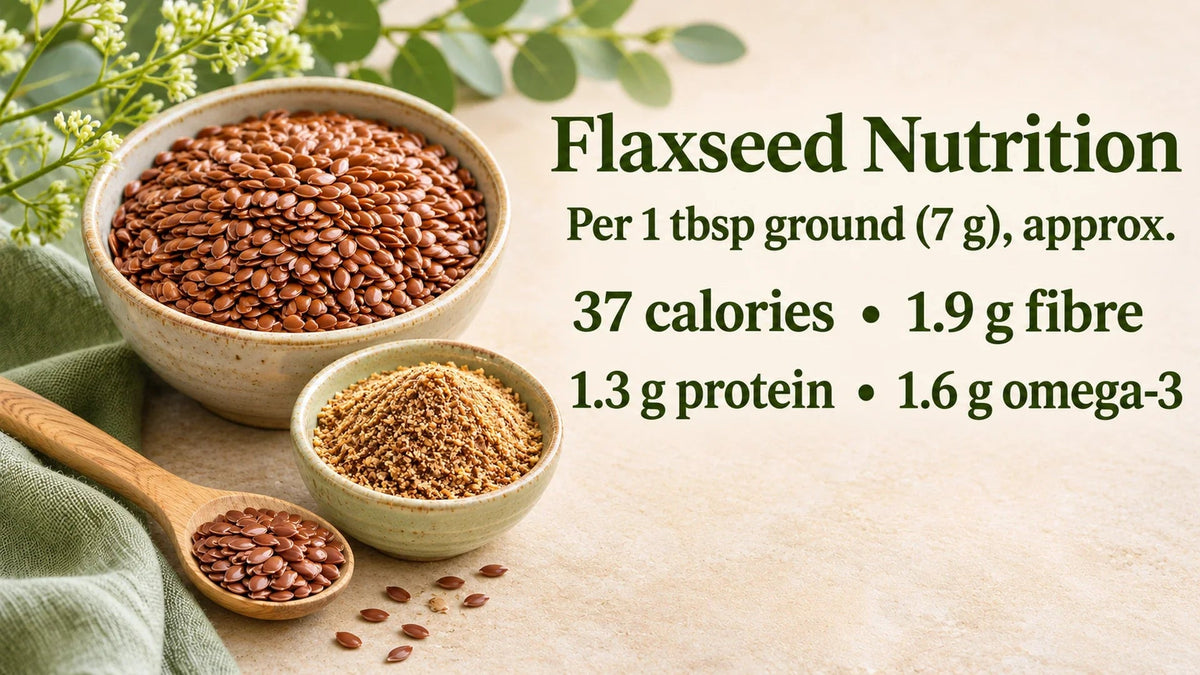
One tablespoon of ground flaxseed, weighing about 7 grams, provides approximately 37 calories, 1.9 grams of fibre, 1.3 grams of protein and 1.6 grams of omega-3 fat. Its main omega-3 is alpha-linolenic acid, also called ALA.
Flaxseed also contains minerals such as magnesium and phosphorus, along with plant compounds called lignans. You may also know flaxseed as flax seeds, linseed or alsi.
The nutrition in your serving depends on its weight and the product you use. A tablespoon of whole seeds can weigh more than a tablespoon of ground flaxseed, so their numbers may differ even when both are measured with the same spoon.
Flaxseed nutrition facts
The table below shows estimated nutrition for one tablespoon of ground flaxseed and 100 grams of flaxseed.
| Nutrient | 1 tbsp ground flaxseed, about 7 g | Per 100 g |
|---|---|---|
| Calories | 37 kcal | 534 kcal |
| Protein | 1.3 g | 18.3 g |
| Total fat | 3.0 g | 42.2 g |
| Omega-3, mainly ALA* | About 1.6 g | About 22.8 g |
| Total carbohydrate | 2.0 g | 28.9 g |
| Dietary fibre | 1.9 g | 27.3 g |
| Total sugars | 0.1 g | 1.6 g |
| Calcium | 18 mg | 255 mg |
| Iron | 0.4 mg | 5.7 mg |
| Magnesium | 27 mg | 392 mg |
| Phosphorus | 45 mg | 642 mg |
| Potassium | 57 mg | 813 mg |
| Zinc | 0.3 mg | 4.3 mg |
| Thiamin, vitamin B1 | 0.11 mg | 1.64 mg |
*Source: USDA flaxseed reference data. Values are rounded. The 7 g values are calculated from the amounts per 100 g and are estimates for ground, full-fat flaxseed. The USDA fatty-acid value used for the omega-3 estimate is listed as “18:3 undifferentiated”; flaxseed’s main omega-3 is ALA. Actual amounts vary by product, seed variety, processing and serving weight. Source
The 100-gram column is useful for comparing foods, but it is much more flaxseed than most people eat in one serving. For a practical estimate, look at the tablespoon column or use the serving weight on your product’s label.
How to read the table: Fibre is included in total carbohydrate, and omega-3 is included in total fat. You do not need to add them again.
How many calories are in flaxseed?
One tablespoon of ground flaxseed contains about 37 calories, based on a weight of 7 grams. Two tablespoons contain approximately 75 calories.
| Amount of ground flaxseed | Approximate weight | Calories |
|---|---|---|
| 1 teaspoon | 2.3 g | 12 |
| 1 tablespoon | 7 g | 37 |
| 2 tablespoons | 14 g | 75 |
| 100 grams | 100 g | 534 |
These numbers are estimates. A spoonful may weigh more or less depending on the grind and how it is filled. Mayo Clinic also lists approximately 37 calories for a 7-gram tablespoon of ground flaxseed. Source
Much of flaxseed’s energy comes from its fat. A small spoonful adds a modest number of calories, while a larger serving adds more.
Why can whole flaxseed have more calories per tablespoon?
A tablespoon measures volume, not weight. A tablespoon of whole flaxseed can weigh more than a tablespoon of ground flaxseed.
For example, USDA reference data uses approximately 10.3 grams for one tablespoon of whole flaxseed. That serving contains about 55 calories. A 7-gram tablespoon of ground flaxseed contains about 37 calories. Source
The difference is mainly due to the amount of seed in the spoon. Grinding does not automatically remove calories. To compare whole and ground flaxseed fairly, compare the same weight of each.
How much fibre is in flaxseed?
One tablespoon of ground flaxseed provides about 1.9 grams of fibre. Two tablespoons provide approximately 3.8 grams, based on a combined weight of 14 grams.
Flaxseed contains both main types of dietary fibre:
- Soluble fibre absorbs water and can form a gel.
- Insoluble fibre helps add bulk to stool.
Both types can be part of a balanced diet. The nutrition table shows total fibre, rather than a separate amount for each type.
How much of your daily fibre needs does flaxseed provide?
The US Daily Value for fibre is 28 grams per day. One tablespoon of ground flaxseed provides approximately 7% of that amount.
Daily Values are general guides used on US nutrition labels. Your individual fibre needs may differ. Source
Flaxseed can contribute to your fibre intake alongside foods such as beans, lentils, fruit, vegetables and whole grains.
If you are not used to eating much fibre, increase it gradually and drink enough fluids. Adding a lot of fibre at once may cause gas or bloating.
How much protein is in flaxseed?
One tablespoon of ground flaxseed provides about 1.3 grams of protein. Two tablespoons provide about 2.6 grams.
Per 100 grams, flaxseed contains approximately 18.3 grams of protein. But a typical spoonful weighs much less than 100 grams, so it provides a smaller amount.
Is flaxseed a good source of protein?
Flaxseed adds some plant protein to a meal, but a spoonful is unlikely to be its main protein source.
For example, adding ground flaxseed to yogurt contributes fibre and ALA as well as a little protein. The yogurt supplies much of the protein in that combination.
How much omega-3 is in flaxseed?
One tablespoon of ground flaxseed provides an estimated 1.6 grams of omega-3 fat, mainly ALA. Two tablespoons provide about 3.2 grams, based on a total weight of 14 grams.
The exact amount can vary by product and serving weight. For comparison, the US National Institutes of Health lists about 2.35 grams of ALA in one tablespoon of whole flaxseed. That whole-seed spoonful is heavier than the 7-gram ground-seed serving used in this article. Source
What type of omega-3 is in flaxseed?
The main omega-3 in flaxseed is alpha-linolenic acid, or ALA. It is an essential fat, which means your body cannot make it and you need to get it from food.
Two other omega-3 fats are EPA and DHA. These are found in fish and some algae products.
Your body can convert some ALA into EPA and DHA, but the conversion is limited. Flaxseed is therefore a source of ALA; it does not directly provide meaningful amounts of EPA or DHA. Source
Does one tablespoon of flaxseed provide enough omega-3?
A tablespoon of ground flaxseed may provide around 1.6 grams of ALA, depending on the product and serving weight. That is around the US adequate intake for ALA for many adults.
| Adult group | US adequate intake for ALA per day |
|---|---|
| Women aged 19 and over | 1.1 g |
| Men aged 19 and over | 1.6 g |
| During pregnancy | 1.4 g |
| During breastfeeding | 1.3 g |
These figures refer specifically to ALA. Meeting an ALA intake does not mean flaxseed directly supplies EPA or DHA. The amounts also reflect US reference intakes; individual needs may differ. Source
How many carbs are in flaxseed?
One tablespoon of ground flaxseed contains about 2 grams of total carbohydrate, including approximately 1.9 grams of fibre.
Fibre makes up most of the carbohydrate in flaxseed. A tablespoon also contains only about 0.1 gram of naturally occurring sugar.
How many net carbs are in flaxseed?
Using the common calculation of total carbohydrate minus fibre, one tablespoon of ground flaxseed contains approximately 0.1 gram of net carbs.
This is an estimate calculated from unrounded reference values. Products and labels may differ, and “net carbs” can be calculated or displayed differently across labels.
What vitamins and minerals are in flaxseed?
Flaxseed contains several minerals, including magnesium, phosphorus, calcium, iron, potassium and zinc. It also provides thiamin, or vitamin B1.
One tablespoon of ground flaxseed provides approximately:
| Mineral or vitamin | Amount per 7 g tablespoon |
|---|---|
| Magnesium | 27 mg |
| Phosphorus | 45 mg |
| Potassium | 57 mg |
| Calcium | 18 mg |
| Iron | 0.4 mg |
| Zinc | 0.3 mg |
| Thiamin, vitamin B1 | 0.11 mg |
These amounts contribute to your overall intake. A spoonful provides much less than the amounts listed for 100 grams, so serving size matters when comparing foods.
How much magnesium is in flaxseed?
One tablespoon of ground flaxseed provides about 27 milligrams of magnesium. That is approximately 6% of the US Daily Value of 420 milligrams.
Magnesium supports normal muscle and nerve function, among other roles. Flaxseed can add some magnesium to meals alongside foods such as beans, nuts and whole grains. Source
Does flaxseed contain iron, calcium and zinc?
Yes. A 7-gram tablespoon of ground flaxseed provides approximately 0.4 mg of iron, 18 mg of calcium and 0.3 mg of zinc.
Flaxseed also contains phytate, a plant compound that can reduce the absorption of some minerals from a meal. The amount listed in a food is therefore not always the same as the amount your body absorbs.
What are lignans in flaxseed?
Flaxseed contains plant compounds called lignans. They are different from the fibre, protein and omega-3 fat listed in the nutrition table.
After you eat flaxseed, bacteria in your gut can change some of its lignans into other compounds. Researchers have studied these compounds for their possible health effects, but lignan amounts can vary between products and are not always shown on nutrition labels.
Flaxseed oil products can also differ. Some oils are sold with added seed particles, so their lignan content depends on the product.
Ground vs whole flaxseed: Is the nutrition different?
Whole and ground flaxseed come from the same seed and contain the same types of nutrients, including fibre, protein and ALA. When you compare the same weight of the same full-fat seed, grinding does not automatically create more of these nutrients.
The practical difference is how easily your body can access them.
Ground flaxseed is generally easier to digest. Whole seeds may pass through your digestive system without being fully broken down, which can reduce the nutrients your body accesses. Source
Nutrition figures can also look different per tablespoon because a spoonful of whole seed may weigh more than a spoonful of ground seed. Check the weight in grams when comparing labels.
Is flaxseed meal the same as ground flaxseed?
“Flaxseed meal” often means flaxseed that has been ground or milled. However, products can be processed differently.
Some flaxseed meal is partially defatted, meaning that some oil has been removed. Its fat and omega-3 values may differ from those of full-fat ground flaxseed.
For the most accurate comparison, check the ingredient list and nutrition label.
Brown vs golden flaxseed: Is there a nutrition difference?
Brown and golden flaxseed both provide fibre, plant protein and fat, including omega-3 ALA.
Nutrient amounts can vary with the seed variety, growing conditions and processing. Some varieties have a different fat composition, so colour alone cannot tell you the exact amount of omega-3 in a product.
If you are comparing two products, check their labels and use the same serving weight.
Flaxseed vs flaxseed oil: What is the difference?
Flaxseed oil is made from the fat in flaxseed. It provides ALA, but its overall nutrition differs from that of whole or ground seeds.
| Nutrient or compound | Whole or ground flaxseed | Flaxseed oil |
|---|---|---|
| Omega-3 ALA | Contains ALA | Contains ALA |
| Fibre | Contains fibre | Does not provide the seed’s fibre |
| Protein | Contains protein | Does not provide the seed’s protein |
| Lignans | Contains lignans | Amount depends on the product |
Oil is concentrated fat, so a tablespoon of oil and a tablespoon of ground flaxseed are not nutritionally equivalent servings.
The NIH lists approximately 7.3 grams of ALA in one tablespoon of flaxseed oil, compared with an estimated 1.6 grams in a 7-gram tablespoon of ground flaxseed. The oil does not provide the fibre found in the seeds. Source
How to calculate flaxseed nutrition for your serving
The estimates in this article use 7 grams for one tablespoon of ground flaxseed. Your spoonful or product may have a different weight.
To estimate a nutrient for any serving, use this formula:
Nutrient per serving = nutrient per 100 g × serving weight in grams ÷ 100
For example, if flaxseed contains 27.3 grams of fibre per 100 grams, a 10-gram serving provides:
27.3 × 10 ÷ 100 = approximately 2.7 grams of fibre
For the most accurate estimate for your food, use its nutrition label and weigh your serving.
Frequently asked questions
How many calories are in a teaspoon of flaxseed?
One teaspoon of ground flaxseed contains approximately 12 calories, assuming it weighs about 2.3 grams. The amount can vary depending on the grind and how the spoon is filled.
How much fibre is in 2 tablespoons of flaxseed?
Two tablespoons of ground flaxseed provide about 3.8 grams of fibre, based on a total weight of 14 grams.
How much protein is in 100 grams of flaxseed?
According to USDA reference data, 100 grams of flaxseed contains about 18.3 grams of protein. A typical tablespoon provides much less because it weighs only a few grams.
Does flaxseed contain omega-3 and omega-6?
Yes. Flaxseed contains both omega-3 and omega-6 fats. Its best-known omega-3 is ALA.
Does ground flaxseed contain more omega-3 than whole flaxseed?
Not necessarily. When comparing the same weight of the same seed, grinding does not automatically create more omega-3. However, ground flaxseed is easier to digest, which can help your body access nutrients inside the seed.
A tablespoon of whole seeds may appear to contain more omega-3 simply because it can weigh more than a tablespoon of ground seeds.
Does roasting flaxseed change its nutrition?
Heating and roasting can affect food components, but the extent depends on the temperature, cooking time and product. Do not assume that every roasted product has exactly the same values as the reference data in this article. Check the product label when available.
Key takeaways
- One tablespoon of ground flaxseed, weighing about 7 grams, provides approximately 37 calories, 1.9 g of fibre and 1.3 g of protein.
- The same serving provides an estimated 1.6 g of omega-3 fat, mainly ALA.
- Flaxseed also contains minerals such as magnesium, phosphorus, calcium and iron, plus plant compounds called lignans.
- Ground flaxseed is generally easier to digest than whole seeds.
- Compare products by weight, since tablespoons of whole and ground seeds may weigh different amounts.
- Flaxseed oil provides ALA but does not provide the fibre and protein found in the seeds.
We rely on peer-reviewed studies and reputable medical journals.