

How to Gain Weight Without Belly Fat: Science-Based Guide
Learn how to gain weight slowly with a small calorie surplus, enough protein, resistance training, and nutritious Pakistani foods—while monitoring waist gain, strength, and digestion.
Key points
- Start with a small calorie surplus instead of suddenly overeating.
- Aim for approximately 1.4–2.0 grams of protein per kilogram of body weight daily if you are resistance training.
- Train all major muscle groups at least twice per week.
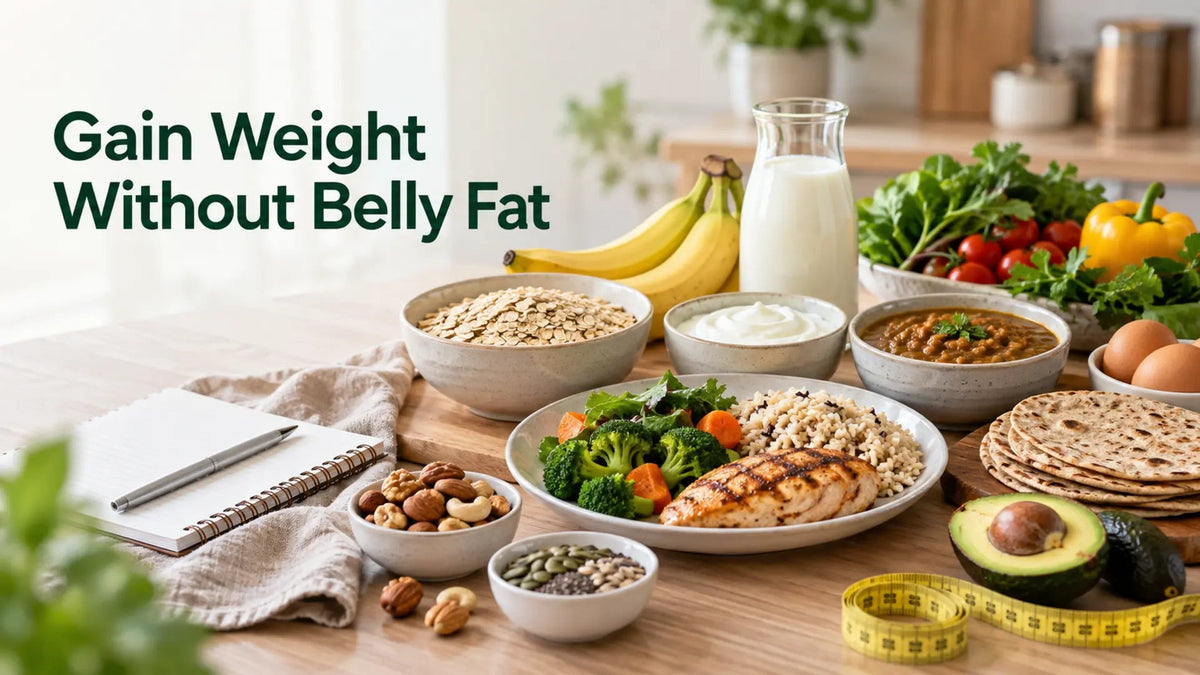
- Choose calories from protein foods, carbohydrates, healthy fats, fruits, vegetables, and dairy or alternatives.
- Track your weekly average weight, waist measurement, strength, appetite, and digestion.
- Reduce your calorie surplus if your waist is growing faster than your strength or overall progress.
- Speak with a doctor or registered dietitian if you have unexplained weight loss, digestive symptoms, or a medical condition.
Can you gain weight without getting belly fat?
You can reduce unnecessary belly-fat gain, but you cannot completely control where your body stores fat.
Weight gain can include:
- Muscle tissue
- Body fat
- Water
- Muscle glycogen
- Food and fluid still being digested
Your genetics, age, sex, hormones, activity level, sleep, health status, and total calorie intake all influence your body shape and fat distribution.
Some people gain fat around their stomach first. Others notice changes in their hips, thighs, face, chest, or arms. A larger waist can be relevant to health even when total body weight or BMI does not seem high. The NIDDK explains that BMI and waist size provide different information, and some people with Asian ancestry may store more fat around the waist even at a lower BMI. (NIDDK guidance on BMI and waist size)
A stomach that looks larger after eating may also be caused by food volume, gas, constipation, or water retention. This is different from gradual fat gain over several weeks.
The goal should not be “zero fat gain.” A more realistic goal is:
Gain weight slowly, build strength and muscle, and keep waist gain as low as reasonably possible.
What causes belly fat during weight gain?
The most common cause is a calorie surplus that is larger than your body can use for muscle growth.
When you consistently eat more energy than you use, your body stores some of the extra energy. A small surplus combined with resistance training may support muscle gain. A much larger surplus usually makes it easier to gain body fat.
Other factors can contribute to increased waist size:
- Eating large amounts of processed, fried, or sugary foods
- Drinking frequent sugary beverages
- Stopping normal daily movement
- Poor sleep
- High stress
- Limited resistance training
- Genetics and natural fat distribution
- Constipation, gas, or food intolerance
- Certain medicines or medical conditions
The NIDDK notes that food intake, physical activity, sleep, medicines, health problems, family history, and genetics can all affect body weight and fat storage. (NIDDK factors affecting weight and health)
Step 1: Find your maintenance calories
Your maintenance calories are the approximate number of calories you need to keep your body weight stable.
Your maintenance needs depend on:
- Age
- Sex
- Height
- Current body weight
- Daily movement
- Exercise
- Occupation
- Appetite
- Muscle mass
- Health status
Online calorie calculators can provide a starting estimate, but your real-world weight trend is more useful.
A simple way to estimate maintenance
- Track your usual food intake for 10–14 days.
- Weigh yourself under similar conditions each morning.
- Calculate your average body weight for the first and second week.
- If your average weight remains almost unchanged, your average calorie intake is close to maintenance.
After estimating maintenance, begin with a controlled surplus.
How many extra calories should you eat?
For a belly-fat-conscious approach, start with approximately:
This is a starting point, not a fixed prescription.
The NHS commonly advises adults to add around 300–500 calories per day for gradual weight gain, along with balanced meals, protein-rich foods, healthy snacks, and strength training. (NHS healthy weight-gain guidance)
Starting at the lower end may be more suitable if:
- You are fairly sedentary.
- You already carry excess belly fat.
- You gain weight easily.
- You are worried about rapid waist gain.
- You are unsure of your maintenance calories.
Avoid suddenly adding 700–1,000 calories. A large surplus may move the scale faster, but it can also increase fat gain, bloating, and digestive discomfort.
A small study in resistance-trained adults found that a larger energy surplus increased fat gain more clearly than muscle size or most strength outcomes. The study was small and short, so it should not be treated as a universal rule, but it supports avoiding aggressive bulking. (Energy surplus study on PubMed)
Step 2: Choose a slow rate of weight gain
The faster your body weight increases, the greater the chance that some of the gain will be body fat.
A sports-nutrition review commonly uses approximately 0.25–0.5% of body weight per week as a reference for novice and intermediate bodybuilders. This is not a medical rule for every person. If limiting belly fat is your priority, begin near the lower end and adjust according to your waist and strength progress. (Off-season bodybuilding nutrition review)
For example:
- A 60 kg person may gain roughly 0.15–0.30 kg per week.
- A 70 kg person may gain roughly 0.18–0.35 kg per week.
Some people should progress more slowly, especially if they are not training consistently or already have a higher body-fat level.
Do not judge your progress from one day of scale weight. Carbohydrates, sodium, bowel movements, water, and food volume can change body weight temporarily.
Step 3: Eat enough protein
Protein provides amino acids that support muscle repair and growth. However, eating excessive protein does not force every extra calorie into muscle.
For most exercising adults, a practical daily range is:
For example, a person weighing 60 kg may need approximately 84–120 grams of protein per day when training regularly.
The International Society of Sports Nutrition supports a daily protein intake of approximately 1.4–2.0 g/kg for most exercising individuals. (ISSN protein position stand)
Good protein sources
Include a protein source in each main meal, such as:
- Eggs
- Milk
- Yogurt
- Chicken
- Fish
- Lean meat
- Daal
- Chana
- Beans
- Lentils
- Paneer
- Tofu
- Soy foods
- Nuts and seeds
Try to spread protein across three or four meals instead of eating almost all of it in one meal.
If you have kidney disease, liver disease, or another medical condition, ask a doctor or dietitian about your protein needs before following a high-protein diet.
Step 4: Build meals around nutritious calorie-dense foods
No single food can prevent belly fat. Your total calorie intake, food pattern, activity, genetics, and training all matter.
The best weight-gain foods provide calories along with protein, fiber, vitamins, minerals, or healthy fats.
| Food group | Practical choices |
|---|---|
| Protein foods | Eggs, chicken, fish, milk, yogurt, daal, beans, chana, paneer, tofu |
| Carbohydrates | Rice, roti, oats, potatoes, sweet potatoes, whole-grain bread, fruit |
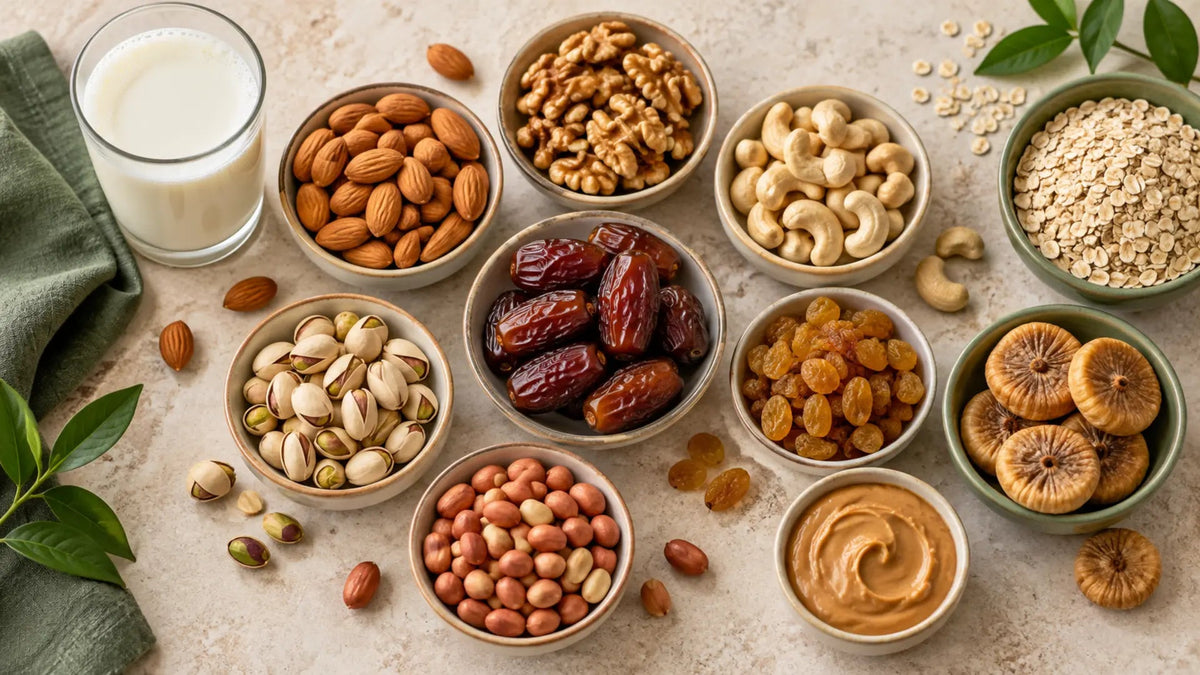
| Healthy fats | Peanuts, almonds, walnuts, seeds, peanut butter, avocado, olive oil |
| Calorie boosters | Milk powder, yogurt, cheese, nut butter, seeds, measured cooking oil |
| Fruit and vegetables | Bananas, dates, mangoes, oranges, vegetables, leafy greens |
Pakistani foods for healthy weight gain
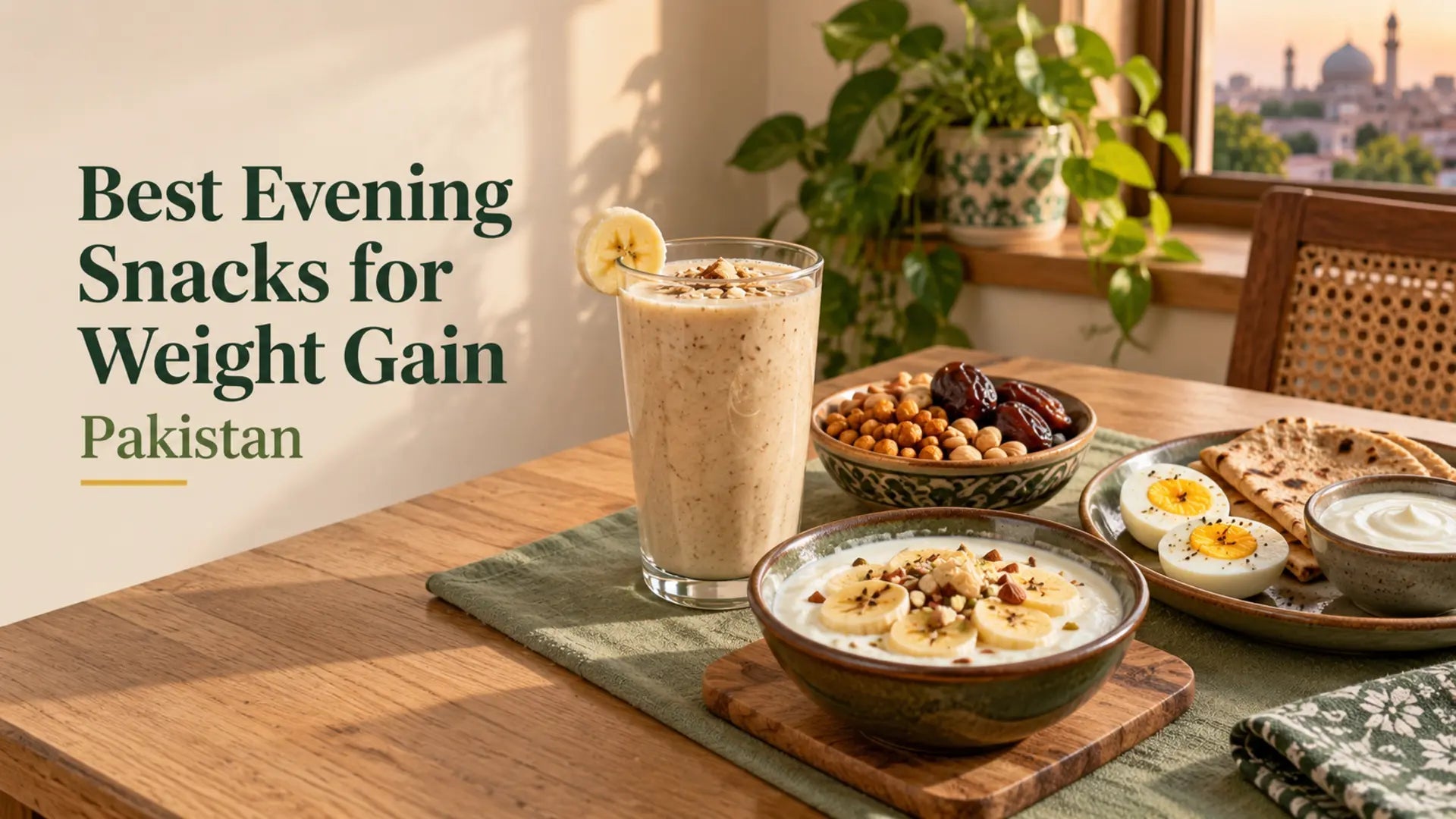
Useful Pakistan-friendly combinations include:
- Eggs with roti and yogurt
- Daal with rice and salad
- Chicken pulao with raita
- Chana chaat with yogurt
- Chicken or egg sandwich
- Aloo with eggs and roti
- Homemade banana and milk shake
- Yogurt with fruit and nuts
- Rice with chicken, fish, or beans
- Oats prepared with milk, banana, and peanut butter
These foods can support healthy weight gain without making fried foods, sweets, soft drinks, or bakery products the main source of calories.
Do carbohydrates cause belly fat?
No. Rice, roti, potatoes, oats, and fruit do not automatically cause belly fat.
Carbohydrates can be useful for training performance and recovery. The larger concern is consistently eating more total energy than your body needs, especially through foods that are easy to overconsume.
Do dietary fats cause belly fat?
Dietary fat is not automatically unhealthy. However, fats contain more calories per gram than protein or carbohydrates, so large portions can increase total calorie intake quickly.
Use measured amounts of:
- Peanut butter
- Nuts
- Seeds
- Olive oil
- Canola oil
- Avocado
- Tahini
You do not need to remove all fats from your diet. You need enough fat for a balanced eating pattern while keeping total calories appropriate.
Step 5: Use resistance training to build muscle
Food supplies energy and nutrients, but resistance training gives your body a reason to build muscle.
The American College of Sports Medicine’s updated guidance emphasizes training all major muscle groups at least twice per week. It also recognizes that barbells, machines, resistance bands, and body-weight exercises can all be effective. (ACSM resistance-training guidance)
Focus on progressive overload
Progressive overload means gradually making an exercise more challenging over time.
You can progress by:
- Adding a small amount of weight
- Completing more repetitions
- Adding a set
- Improving your technique
- Using a harder variation
- Increasing your range of motion
Beginner full-body workout structure
A beginner may perform two or three full-body sessions per week.
Each session can include:
- Squats or leg press
- Lunges or split squats
- Hip hinges or Romanian deadlifts
- Push-ups or chest press
- Rows or lat pulldowns
- Shoulder press
- Calf raises
- Planks or another core exercise
Begin with a manageable workload and focus on safe technique. You do not need to train to complete failure in every set.
Can you gain weight without going to the gym?
Yes. You can build strength at home with:
- Push-ups
- Squats
- Split squats
- Lunges
- Resistance bands
- Dumbbells
- Pull-ups
- Safely used household objects
The important factor is that the muscles experience a gradually increasing challenge.
Should you do cardio while gaining weight?
You do not need to stop cardio completely.
Walking, cycling, swimming, and other moderate activities support heart health and daily fitness. If you perform a large amount of cardio, you may need additional calories to maintain your surplus.
Ab exercises can strengthen your core, but they cannot selectively remove belly fat. Fat loss cannot be directed to only one part of the body.
Step 6: Sleep well and maintain normal daily movement
Adults aged 18–64 generally need 7–9 hours of sleep per night. Not getting enough sleep may affect appetite, food choices, energy, and weight regulation. (NIDDK guidance on sleep and weight)
Aim to:
- Keep a regular sleep and wake schedule.
- Sleep for 7–9 hours when possible.
- Keep walking and performing normal daily activities.
- Avoid using stress, poor sleep, or exhaustion as a reason to change calories every day.
You do not need to eliminate all stress to gain weight. Focus on habits that support recovery and consistency.
Step 7: Track weight, waist, strength, and digestion
The scale alone cannot tell you whether you are gaining muscle, fat, water, or food weight.
Track four areas.
1. Weekly average weight
Weigh yourself three to seven mornings per week:
- After using the bathroom
- Before breakfast
- In similar clothing
- Under similar conditions
Calculate the weekly average instead of reacting to one reading.
2. Waist measurement
Measure your waist once per week under similar conditions.
Keep the tape level and comfortable. Do not pull it tightly or hold your stomach in.
A single increase does not prove that you gained belly fat. Constipation, bloating, water retention, food volume, and the menstrual cycle can affect waist size temporarily.
3. Strength
Record your exercises, repetitions, and resistance.
Improving strength is a useful sign that your training and nutrition are supporting muscle development. It is not proof of muscle gain by itself, but it gives helpful context.
4. Digestion and appetite
Monitor:
- Bloating
- Constipation
- Diarrhea
- Reflux
- Appetite
- Food tolerance
- Abdominal pain
How to adjust your calories
| Progress pattern | What it may mean | What to do |
|---|---|---|
| Weight rises slowly, strength improves, waist is stable | The plan is working | Continue |
| Weight does not rise for 2–3 weeks | Intake may be close to maintenance | Add a small snack or 100–150 calories |
| Weight rises quickly and waist increases rapidly | Surplus may be too large | Reduce 100–200 calories |
| Stomach looks larger immediately after meals | Food volume, gas, constipation, or water may be involved | Review digestion before changing calories |
| Weight rises but strength does not improve | Training, protein, recovery, or calorie quality may need review | Check the complete plan |
Make one change at a time and wait long enough to observe a trend.
One-day Pakistan-friendly meal framework
This is a flexible structure, not a fixed prescription. Adjust portions according to your calorie needs, appetite, activity, health, and progress.
Breakfast
- Eggs with roti or whole-grain bread
- Yogurt or milk
- One serving of fruit, such as a banana
Mid-morning snack
- Milk with a banana
- Or yogurt with nuts
- Or peanut butter toast
Lunch
- Rice or roti
- Chicken, fish, daal, beans, or chana
- Vegetables
- Raita or yogurt
Pre-workout snack
- Banana with peanut butter
- Or oats with milk
- Or toast with eggs
- Or yogurt with fruit
Post-workout meal
- Rice, potatoes, or roti
- Chicken, eggs, fish, daal, or another protein source
- Vegetables or salad
Dinner
- Protein-rich food
- Rice or roti
- Cooked vegetables
- Yogurt or a small serving of healthy fat
Bedtime snack
- Milk
- Yogurt
- Cottage cheese
- Fruit with nuts
How to eat more without feeling too full
Some people struggle to gain weight because they feel full quickly. Eating very large meals is not the only solution.
Try:
- Eating three moderate meals with one to three snacks.
- Adding milk or yogurt to oats.
- Adding peanut butter to toast or smoothies.
- Adding nuts or seeds to yogurt.
- Adding a measured amount of oil to rice or vegetables.
- Using homemade smoothies between meals.
- Eating slowly and chewing well.
- Drinking large amounts of fluid between meals instead of immediately before eating.
A homemade smoothie can include milk, yogurt, oats, banana, peanut butter, and protein powder if needed.
You do not need a commercial mass gainer. Mass gainers can make it easy to consume excessive calories, but they do not automatically cause belly fat. The important factor is the total calorie content and how the product fits into your diet.
What if your stomach looks bigger after eating more?
A larger-looking stomach does not always mean belly-fat gain.
Possible causes include:
- Larger meals
- Increased fiber
- Constipation
- Gas
- Carbonated drinks
- Eating quickly
- Lactose intolerance
- Food sensitivities
- Water retention
- Increased carbohydrate intake
Fat gain usually develops gradually over weeks. If your stomach appears larger immediately after eating, first review meal size and digestion.
Speak with a healthcare professional if bloating is severe, persistent, painful, or associated with weight loss, diarrhea, vomiting, blood in the stool, or difficulty eating.
Common mistakes that cause unnecessary belly-fat gain
Avoid these common mistakes:
- Adding too many calories too quickly
- Treating weight gain as permission to eat unlimited junk food
- Drinking frequent sugary beverages
- Using mass gainers without counting their calories
- Eating a high-calorie diet without resistance training
- Stopping all daily movement
- Avoiding carbohydrates unnecessarily
- Eating excessive protein while ignoring total calories
- Changing the plan every few days
- Panicking over temporary water weight or bloating
- Trying to avoid every gram of body fat
A sustainable plan can include occasional treats. The main pattern should still provide enough protein, fiber, micronutrients, and balanced calories.
When should you see a doctor or dietitian?
Speak with a doctor or registered dietitian before starting a weight-gain plan if you:
- Have lost weight suddenly or without trying
- Continue losing weight despite eating more
- Have a very low appetite
- Have persistent diarrhea, constipation, vomiting, or abdominal pain
- Have rapid abdominal swelling
- Have unusual thirst or frequent urination
- Have diabetes or prediabetes
- Have thyroid, kidney, liver, or digestive disease
- Are pregnant or breastfeeding
- Are under 18
- Have a history of restrictive eating or an eating disorder
- Recently had an illness, surgery, or major change in medication
Unintentional weight loss can sometimes be linked to stress or an underlying illness. The NHS recommends medical assessment when weight loss occurs without a change in diet or exercise. (NHS guidance on unintentional weight loss)
Supplements for weight gain without belly fat
Supplements are optional. Your foundation should be food, resistance training, sleep, and consistency.
Protein powder
Protein powder may help when you cannot meet your protein needs through regular meals. Choose a product with a clear ingredient label and count its calories as part of your daily intake.
Creatine
Creatine may support high-intensity exercise performance and training adaptations. It is not a fat burner and does not replace balanced nutrition.
Ask a healthcare professional before using creatine if you have kidney disease, are pregnant, take regular medicines, or have another medical condition.
Weight-gain pills and steroids
Avoid unverified weight-gain pills, hormone products, and anabolic steroids. Some products may contain hidden medicines or harmful ingredients.
Frequently asked questions
Can I gain weight without gaining any fat?
Some beginners, people returning to training, and people with higher body-fat levels may gain muscle with little fat gain. However, zero fat gain cannot be guaranteed during intentional weight gain.
A small calorie surplus, adequate protein, resistance training, and regular tracking can help limit unnecessary fat gain.
Is a 500-calorie surplus too much?
Not necessarily. Some underweight adults may need 300–500 extra calories for gradual weight gain. However, if minimizing belly fat is your priority, beginning with a smaller surplus and adjusting according to your results may be more suitable.
Does rice cause belly fat?
No. Rice can be part of a healthy weight-gain diet. Belly-fat gain is more closely related to overall calorie intake, activity, genetics, food choices, and the length of time you remain in a surplus.
Can protein shakes cause belly fat?
A protein shake does not automatically cause belly fat. It may contribute to fat gain if it adds more calories than your body needs, especially when it contains large amounts of sugar and fat.
Does eating before bed cause belly fat?
Eating at night does not automatically cause belly fat. Your total daily calorie intake matters more.
However, a very large meal before bed may cause reflux, bloating, or poor sleep. If you are hungry at night, choose a small, comfortable snack.
Can I gain weight without going to the gym?
Yes. Body-weight exercises, resistance bands, dumbbells, and safe home workouts can support muscle gain when the exercises become gradually more challenging.
What if I am skinny-fat?
If you have relatively thin limbs but carry more fat around your waist, a large calorie surplus may not be the best starting point.
A more suitable approach may include:
- Eating around maintenance calories initially
- Consuming adequate protein
- Performing progressive resistance training
- Maintaining regular walking
- Tracking waist and strength
- Adding calories only when your training and measurements support it
Body recomposition is possible for some people, but it is not guaranteed.
Why is my belly getting bigger but my muscles are not?
Possible reasons include:
- The calorie surplus is too large.
- Resistance training is inconsistent.
- Protein intake is low.
- Training does not become more challenging.
- Sleep and recovery are poor.
- Most extra calories come from liquid or processed foods.
- Bloating or constipation is being mistaken for fat gain.
- An underlying medical problem is present.
If the change is rapid, painful, persistent, or associated with other symptoms, speak with a healthcare professional.
A simple action plan
To gain weight with less unnecessary belly fat:
- Estimate your maintenance calories.
- Add approximately 200–300 calories per day.
- Eat protein with each main meal.
- Choose rice, roti, oats, potatoes, fruit, dairy, daal, beans, eggs, chicken, fish, nuts, and seeds.
- Perform resistance training at least twice weekly.
- Sleep approximately 7–9 hours per night.
- Weigh yourself several mornings each week and calculate the average.
- Measure your waist once per week.
- Reduce calories slightly if your waist increases rapidly.
- Seek professional advice if you have unexplained weight loss or medical symptoms.
For individualized calorie, meal, and training guidance, consider speaking with a registered dietitian who can account for your body size, health history, activity level, appetite, and goals. MNT provides online nutrition support through mnt.com.pk.
Book an online nutrition consultationFinal takeaway
The best way to gain weight without getting excessive belly fat is to gain slowly and monitor your results.
Use a small calorie surplus, eat enough protein, choose nutritious calorie-dense foods, train your major muscle groups, sleep well, and maintain normal daily movement. Track your weekly average weight, waist, strength, and digestion rather than reacting to one day of change.
You cannot fully control where your body stores fat, but you can control how quickly you gain weight and the quality of your plan.
We rely on peer-reviewed studies and reputable medical journals.