



Weight Loss Differences Between Men and Women: The Biological Truth
Introduction
You follow the exact same diet plan as your male partner. You both exercise three times a week. After a month, he has dropped 8 pounds, while the scale barely moved for you. This common scenario isn't a failure of willpower; it is a result of distinct physiological programming. Biological disparities in body composition, hormonal fluctuations, and metabolic rates create an uneven playing field for weight management.
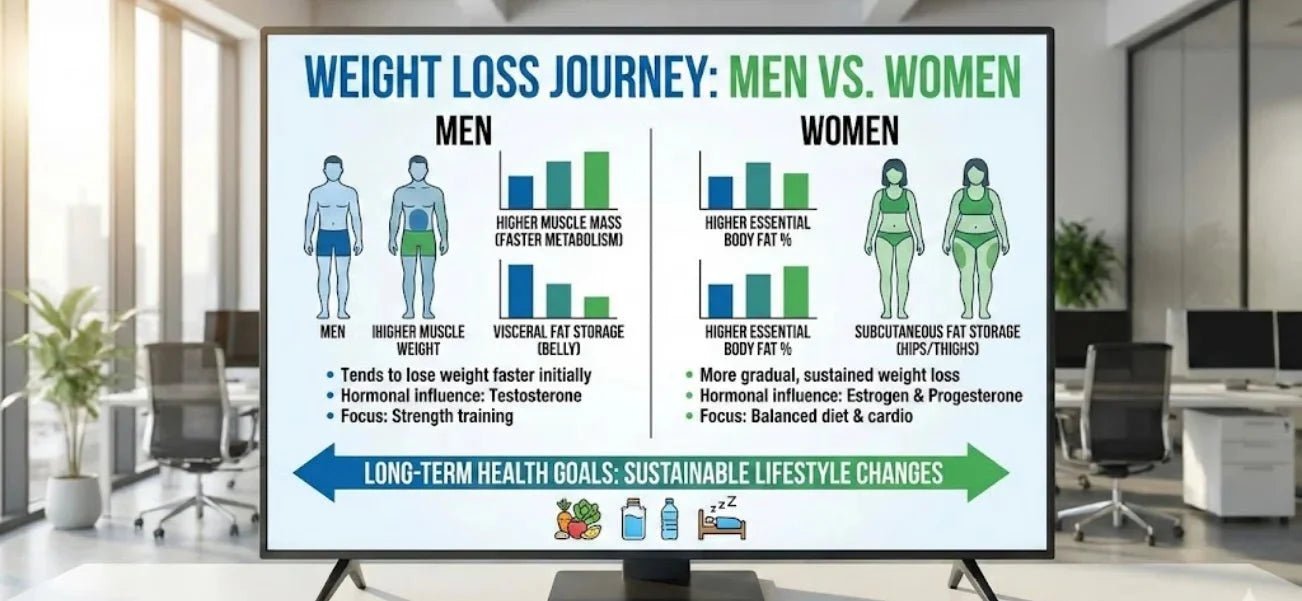
The primary weight loss differences between men and women stem from body composition and hormones. Men naturally possess higher lean muscle mass and testosterone, driving a faster Basal Metabolic Rate (BMR). Conversely, women have higher essential body fat levels for reproductive health and experience estrogen-driven fat storage, making weight reduction metabolically more challenging.
The Metabolic Advantage: Lean Mass and BMR
The most significant factor creating a disparity in weight loss rates is lean muscle mass. Men generally carry more muscle tissue than women due to higher testosterone levels. Muscle tissue is metabolically expensive; it requires more energy to maintain than fat tissue, even at rest.
This elevates the male Basal Metabolic Rate (BMR)—the number of calories the body burns to perform basic life-sustaining functions. Research indicates that men typically have a BMR 5-10% higher than women of the same height and weight. Consequently, a man creates a larger calorie deficit than a woman while consuming the same amount of food and performing the same activity.
Clinical Strategy: Women must prioritize muscle preservation to counteract this lower BMR. Prioritizing resistance training twice weekly and ensuring adequate protein intake (1.2g to 1.6g per kg of body weight) is essential to stimulate muscle protein synthesis.
The Hormonal Equation: Estrogen, Testosterone, and Ghrelin
Hormones dictate not just how much weight we lose, but where we lose it from.
Testosterone vs. Estrogen: Testosterone promotes muscle growth and inhibits fat storage. Women have significantly lower levels of testosterone and higher levels of estrogen. While estrogen is vital for reproductive function, it also promotes fat storage in the gluteal-femoral region (hips and thighs). This subcutaneous fat is physiologically stubborn and less responsive to lipolysis (fat breakdown) than other fat stores.
Menstrual Cycle Fluctuations: Women face a cyclic metabolic variable men do not: the menstrual cycle. During the luteal phase (the week before menstruation), progesterone levels rise, often leading to water retention and a temporary stall in scale weight. Furthermore, fluctuations in ghrelin (the hunger hormone) can induce cravings for carbohydrate-rich foods.
Menopause and Metabolic Shift: As women enter menopause, estrogen levels plummet. This causes a redistribution of fat from the hips to the abdomen (visceral fat), increasing the risk of insulin resistance.
Expert Guidance: If you suspect hormonal imbalances (such as PCOS or hypothyroidism) are hindering your progress, generic advice will fail. We recommend booking a MNT Clinical Nutrition Consultation (Telemedicine). Our registered dietitians analyze your hormonal profile to build a medical nutrition therapy plan tailored to your specific physiology.
Fat Distribution: Visceral vs. Subcutaneous
The location of fat storage differs by sex and impacts how quickly it is mobilized.
-
Android Obesity (Apple Shape): Men tend to store visceral fat around the abdominal organs. While visceral fat is dangerous for cardiovascular health, it is metabolically active and breaks down quickly in response to exercise and caloric restriction. This explains why men often see rapid initial changes in their waistlines.
-
Gynoid Obesity (Pear Shape): Women tend to store subcutaneous fat under the skin of the hips and thighs. This fat is designed for long-term energy storage (pregnancy and lactation) and has a lower blood flow rate, making it resistant to mobilization.
A 2022 study published in the Journal of Physiology highlights that women oxidize (burn) more lipids during exercise than men, yet rely more on carbohydrates post-exercise, whereas men continue to burn fat after the workout ends.
Behavioral and Neural Responses to Food
Neurological differences influence how men and women respond to hunger cues. Neuroimaging studies suggest that female brains may show higher activation in regions associated with reward and emotion when presented with palatable foods, particularly during times of stress. This biological drive can make adherence to strict caloric deficits more psychologically taxing for women.
Emotional eating is not a character flaw; it is often a physiological response to stress hormones like cortisol, which women may be more sensitive to regarding appetite regulation.
Educational Opportunity: Understanding the biochemistry of metabolism changes how you approach nutrition. For healthcare professionals or enthusiasts wanting to deepen their knowledge, our MNT Nutrition Education Courses offer advanced modules on metabolic science and endocrinology.
Weight Loss Outcomes Table (Expanded)
|
Factor |
Men |
Women |
|
Basal Metabolic Rate |
Higher (faster calorie burn) |
Lower (slower burn) |
|
Hormones |
Testosterone aids fat loss |
Estrogen may promote fat storage |
|
Fat Distribution |
Visceral (belly) – risky |
Subcutaneous (hips/thighs) |
|
Initial Weight Loss |
Rapid at first |
Gradual, more steady |
|
Menopause Effect |
Minimal |
Shifts fat to abdomen |
|
Emotional Eating |
Lower tendency |
Higher tendency |
|
Long-Term Success |
Risk of regain if inactive |
Steady with lifestyle changes |
Bridging the Gap: Evidence-Based Solutions
While biology creates differences, it does not prevent success. The following strategies level the playing field:
-
Implement Resistance Training: Cardio alone is insufficient. Heavy compound movements (squats, deadlifts, presses) increase testosterone response and build metabolic tissue.
-
Cycle Nutrition: Women may benefit from adjusting macronutrients according to their menstrual cycle—increasing complex carbohydrates during the luteal phase to manage cravings and energy dips.
-
Manage Cortisol: High stress halts weight loss. Sleep hygiene (7-9 hours) and stress-reduction techniques are as critical as diet.
-
Protein Pacing: Distribute protein intake evenly across 3-4 meals to maximize satiety and muscle repair.
Conclusion
Comparing your weight loss journey to that of the opposite sex is biologically inaccurate and counterproductive. Men may lose weight faster initially due to higher muscle mass and visceral fat mobilization, but women can achieve sustainable results by manipulating their specific hormonal and metabolic levers. Success requires a strategy that respects your physiology, not one that fights against it.
Ready to stop guessing and start transforming? Book a consultation with MNT specialists today for a personalized, science-backed nutrition plan.
FAQ Section
Why do men lose weight faster than women?
Men typically have more lean muscle mass and higher testosterone levels, resulting in a higher resting metabolic rate. Additionally, men store more visceral fat, which is metabolically active and easier to mobilize than the subcutaneous fat women tend to store.
Does the menstrual cycle affect weight loss?
Yes. Hormonal fluctuations, specifically rising progesterone in the luteal phase, can cause water retention and increased appetite. While fat loss may continue, scale weight often stalls or increases temporarily due to fluid shifts during this time.
Is belly fat harder to lose for women?
Before menopause, women primarily store fat in the hips and thighs (subcutaneous fat). However, after menopause, dropping estrogen levels cause a shift toward abdominal (visceral) fat storage. This visceral fat responds well to diet and exercise but poses higher health risks.
How much protein should women eat for weight loss?
Current evidence suggests women aiming for weight loss while preserving muscle should consume between 1.2g to 1.6g of protein per kilogram of body weight daily. This supports satiety and muscle protein synthesis, countering a naturally lower metabolic rate.
Do women need to exercise differently than men to lose weight?
While the fundamentals are similar, women benefit significantly from heavy resistance training to offset lower testosterone levels and build muscle. Women also oxidize more fat during low-intensity steady-state exercise compared to men, making a combination of lifting and cardio effective.
We rely on peer-reviewed studies and reputable medical journals.