

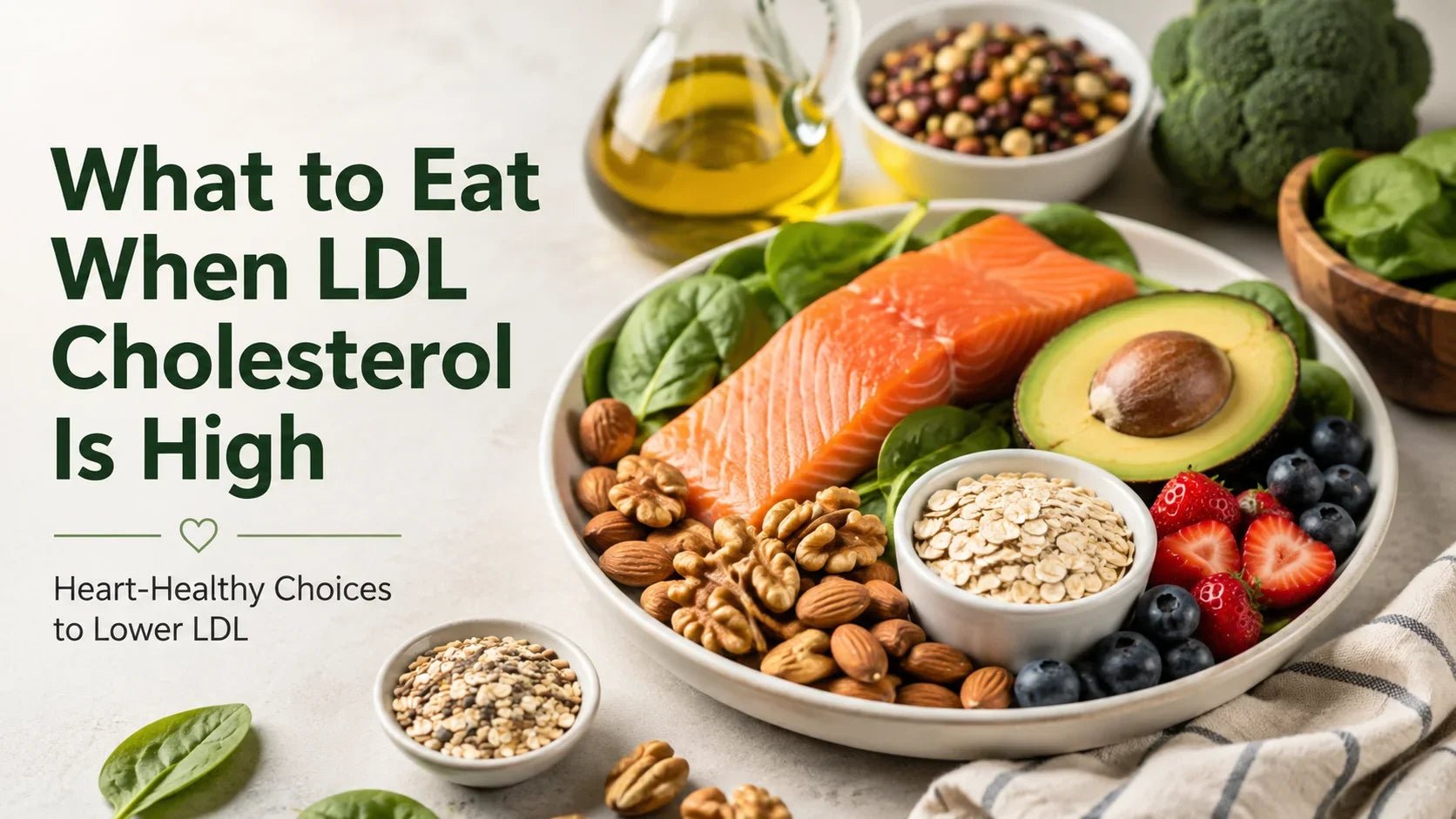
What to Eat When LDL Cholesterol Is High
If your LDL cholesterol is high, focus on fiber-rich foods and replace saturated fats with healthier unsaturated fats. Learn what to eat, what to limit, and the best food swaps to help lower LDL.
If your LDL cholesterol is high, eat more oats and barley, beans and lentils, vegetables, whole fruits, nuts and seeds, whole grains, soy foods, and other high-fiber plant foods. Choose olive oil and other unsaturated fats instead of butter, ghee, coconut oil, and other fats high in saturated fat. For protein, choose beans, lentils, soy, fish, and lean poultry more often and limit fatty and processed meats.
The most effective food strategy is not adding one “cholesterol-lowering superfood.” It is replacing foods high in saturated fat with foods rich in soluble fiber, plant protein, and unsaturated fat. Current American College of Cardiology guidance specifically recommends fiber-rich plant foods and replacing saturated-fat-rich foods with foods higher in unsaturated fats and/or fiber for people with elevated LDL cholesterol. (acc.org)
Quick Answer: What Should You Eat When LDL Is High?
| Eat more often | Choose instead of | Limit more often |
|---|---|---|
| Oats and barley | Olive or canola oil instead of butter or ghee | Fatty red meat |
| Beans, lentils and chickpeas | Beans, fish or tofu instead of processed meat | Sausages and processed meats |
| Vegetables | Whole grains instead of refined grains | Butter, ghee and cream |
| Whole fruits | Fruit and nuts instead of pastries | Full-fat dairy in large amounts |
| Nuts and seeds | Low-fat dairy instead of higher-fat dairy | Coconut and palm oil |
| Soy foods | Oatmeal instead of low-fiber breakfast foods | Fried foods high in saturated fat |
| Whole grains | Avocado or hummus instead of butter-based spreads | Pastries and high-saturated-fat baked foods |
| Fish and lean poultry | Plant proteins instead of some meat meals | Highly processed foods high in saturated fat |
The key word is replace. Adding oatmeal, chia seeds, or olive oil helps less if the rest of your diet remains very high in saturated fat.
Best Foods to Eat to Help Lower LDL Cholesterol
1. Oats and Barley
Oats and barley are among the most useful foods for high LDL because they contain soluble fiber, including beta-glucan.
Soluble fiber forms a gel-like material in the digestive tract. This can reduce cholesterol absorption and help the body remove more cholesterol through digestion. NHLBI includes increasing soluble fiber as one of the main dietary changes used to help lower LDL cholesterol. (nhlbi.nih.gov)
Easy ways to eat more oats and barley include:
- Oatmeal with fruit and nuts
- Overnight oats
- Oats mixed into low-fat yogurt
- Barley in soups
- Barley or oats in grain bowls
- Oat bran added to suitable meals
Best swap: Choose oatmeal with fruit and nuts instead of pastries, buttery toast, or a breakfast that is low in fiber.
2. Beans, Lentils and Chickpeas
Beans, lentils and chickpeas are especially useful when LDL cholesterol is high because they provide:
- Soluble and other dietary fiber
- Plant protein
- Very little saturated fat
- A filling alternative to fatty meats
Their benefit becomes even greater when they replace foods high in saturated fat.
Try:
- Lentil curry instead of a fatty meat curry
- Chickpeas in salads
- Beans in soups
- Lentil or bean bowls with vegetables
- Replacing part of ground meat with lentils or beans
Current ACC guidance emphasizes legumes as part of fiber-rich, plant-predominant dietary patterns for elevated LDL. (acc.org)
Best swap: Replace some fatty or processed meat meals with lentils, beans, or chickpeas.
3. Soy Foods
Soy foods give you plant protein without the saturated-fat load found in many fatty animal foods.
Good options include:
- Tofu
- Tempeh
- Soybeans
- Edamame
- Unsweetened soy milk
Soy is most useful when it replaces foods such as fatty meat or higher-saturated-fat dairy.
Best swap: Use tofu, soybeans, or another soy food instead of fatty meat in some meals.
4. Vegetables
Vegetables should make up a large part of your meals when LDL cholesterol is high.
Good choices include:
- Leafy greens
- Broccoli
- Carrots
- Tomatoes
- Okra
- Eggplant
- Cauliflower
- Cabbage
- Peppers
- Green beans
Vegetables do not work like cholesterol medication. Their value is that they help create an eating pattern that is high in fiber and whole plant foods while being naturally low in saturated fat.
ACC guidance recommends diets rich in fiber from vegetables and other plant foods for people with elevated LDL. (acc.org)
5. Whole Fruits
Fruit can be part of an LDL-lowering diet because it provides fiber and other nutrients without much saturated fat.
Useful choices include:
- Apples
- Pears
- Oranges and other citrus fruits
- Berries
- Peaches
- Plums
- Bananas
There is no need to search for one special “cholesterol-lowering fruit.”
Whole fruit is generally a better everyday choice than fruit juice because it keeps its fiber and is more filling.
Best swap: Choose whole fruit instead of pastries, biscuits, or other snacks high in saturated fat.
6. Nuts
Nuts provide unsaturated fats, fiber, and plant protein.
Good options include:
- Walnuts
- Almonds
- Pistachios
- Peanuts
- Pecans
A small handful can work well as a snack or as a topping for oatmeal, yogurt, or salads.
Nuts are particularly useful when they replace foods such as pastries, fried snacks, or other high-saturated-fat foods.
Because nuts are energy-dense, more is not always better. Normal portions are enough.
7. Seeds
Seeds can also fit well into a cholesterol-friendly diet.
Useful choices include:
- Chia seeds
- Flaxseeds
- Sesame seeds
- Pumpkin seeds
- Sunflower seeds
Seeds provide varying amounts of fiber, plant protein, and unsaturated fats.
Try adding chia or ground flaxseed to:
- Oatmeal
- Yogurt
- Smoothies
- Whole-grain cereal
Seeds can support an LDL-lowering eating pattern, but no single seed is a treatment for high cholesterol.
8. Olive Oil and Other Unsaturated Plant Oils
If your LDL is high, you do not need to avoid all fat.
The type of fat matters.
Better everyday choices include:
- Olive oil
- Canola oil
- Soybean oil
- Sunflower oil
- Corn oil
- Other suitable liquid non-tropical plant oils
Unsaturated fats can help lower LDL when they replace saturated fats. Current cardiovascular guidance continues to emphasize limiting saturated fat and choosing unsaturated fats in its place. (acc.org)
Think:
Simply adding olive oil to a diet that still contains large amounts of butter, ghee, cream, and fatty meat misses the main point.
9. Avocado
Avocado provides fiber and unsaturated fat.
It works best when used instead of foods that are higher in saturated fat.
For example:
- Avocado instead of butter on toast
- Avocado in a whole-grain sandwich
- Avocado added to a bean salad
- Avocado instead of cream-based spreads
The benefit comes from the overall diet and what the avocado replaces.
10. Fish and Leaner Proteins
If you eat animal foods, fish can be a useful replacement for fatty red meat or processed meat.
Other better protein choices include:
- Beans
- Lentils
- Chickpeas
- Tofu and other soy foods
- Fish
- Skinless poultry
- Leaner cuts of meat in moderate portions
A heart-healthy eating pattern generally prioritizes plant proteins, seafood, and leaner animal proteins over high-fat meats. (newsroom.heart.org)
Fish should still be viewed as part of an overall healthy diet—not as a food that directly “cleans cholesterol” from your blood.
11. Lower-Fat Dairy
If dairy is part of your diet, choosing lower-fat options can help reduce saturated fat intake.
Options may include:
- Low-fat milk
- Fat-free or low-fat yogurt
- Lower-fat dairy products
The goal is not necessarily to eliminate dairy. It is to reduce the amount of saturated fat coming from your overall diet.
The 3 Most Important Diet Changes for Lowering LDL
You do not need to change everything at once.
If you want to focus on what matters most, start with these three changes.
Replace Saturated Fat With Unsaturated Fat
This is one of the most important dietary steps for lowering LDL cholesterol.
Foods that can provide significant saturated fat include:
- Butter
- Ghee
- Fatty red meat
- Processed meat
- Cream
- Some high-fat cheeses
- Coconut oil
- Palm and palm-kernel oils
- Some fried foods
- Some pastries and baked foods
Better replacements include:
- Olive or canola oil
- Nuts
- Seeds
- Avocado
- Fish
- Beans
- Lentils
- Soy foods
The American Heart Association recommends aiming for less than 6% of total daily calories from saturated fat for people who need to lower cholesterol. On a 2,000-calorie diet, that is about 13 grams or less per day. (heart.org)
You do not have to calculate every gram perfectly. A practical first step is to identify the biggest sources of saturated fat in your current diet and replace them.
Eat More Soluble Fiber
Not all fiber affects cholesterol in exactly the same way.
Soluble fiber is particularly useful for lowering LDL.
Good sources include:
- Oats
- Barley
- Beans
- Lentils
- Chickpeas
- Fruits
- Vegetables
NHLBI specifically includes increased soluble fiber in its Therapeutic Lifestyle Changes approach for lowering LDL cholesterol. (nhlbi.nih.gov)
A simple pattern might look like this:
Breakfast: oats
Lunch: beans or chickpeas
Snack: whole fruit
Dinner: lentils and vegetables
If your current diet is low in fiber, increase it gradually. A sudden large increase can cause gas or bloating.
Replace Some Animal Protein With Plant Protein
You do not need to become vegan to improve your diet for LDL.
Replacing some meat-based meals with plant proteins can improve both the fat quality and fiber content of the diet.
Try:
Plant-predominant dietary patterns rich in whole plant foods and fiber are among the dietary approaches associated with the greatest LDL reductions. (acc.org)
What Foods Should You Limit When LDL Is High?
You usually do not need to ban every food.
Instead, reduce the foods that contribute the most saturated fat to your diet and replace them with better choices.
Fatty and Processed Meat
Limit frequent intake of foods such as:
- Sausages
- Bacon
- Salami
- Hot dogs
- Fatty cuts of beef
- Fatty lamb
- Other processed or high-fat meats
Choose beans, lentils, soy, fish, or lean poultry more often.
Butter, Ghee and Cream
Butter, ghee, and cream are concentrated sources of saturated fat.
A small amount occasionally is different from using them as your main everyday fat.
When the goal is lowering LDL, use unsaturated liquid plant oils more often.
Coconut Oil
Coconut oil has a healthy reputation in some circles, but it is high in saturated fat.
If your main goal is lowering LDL cholesterol, olive, canola, or another suitable non-tropical unsaturated plant oil is generally a better everyday choice.
The AHA recommends replacing saturated fats with unsaturated fats rather than treating coconut oil as a preferred heart-healthy oil. (heart.org)
Palm and Palm-Kernel Oils
Palm and palm-kernel oils can also contribute significant saturated fat.
They may be found in:
- Packaged snacks
- Biscuits
- Bakery foods
- Desserts
- Processed foods
Check food labels and compare saturated fat between products.
Fried Foods, Pastries and Highly Processed Foods
Not every processed food is automatically harmful for LDL.
The bigger concern is frequent intake of products high in:
- Saturated fat
- Trans fat
- Refined carbohydrates
- Added sugars
- Excess calories
The 2026 cholesterol guideline's patient guidance recommends limiting ultraprocessed foods high in saturated fat, added sugars, and sodium. (professional.heart.org)
Best Food Swaps for High LDL Cholesterol
Instead of asking only, “What should I stop eating?”, ask:
“What should I eat instead?”
| Instead of | Choose more often | Why it helps |
|---|---|---|
| Butter or ghee | Olive or canola oil | Replaces saturated fat with unsaturated fat |
| Fatty red meat | Beans, lentils, fish or lean poultry | Reduces saturated fat and may add fiber |
| Sausages and processed meat | Beans, tofu, fish or lean poultry | Replaces high-fat processed protein |
| Full-fat dairy | Lower-fat options | Reduces saturated fat |
| Pastries for breakfast | Oatmeal with fruit and nuts | Adds soluble fiber |
| Chips or biscuits | Whole fruit with nuts or seeds | Adds fiber and unsaturated fat |
| Refined grains | Oats, barley and other whole grains | Increases fiber |
| Butter-based spread | Hummus or avocado | Adds plant foods and unsaturated fat |
| Coconut oil | Olive, canola or another suitable liquid plant oil | Reduces saturated-fat exposure |
These swaps are often more important than simply adding a “healthy” food to an otherwise unchanged diet.
What Should an LDL-Lowering Plate Look Like?
You do not need a complicated cholesterol meal plan.
A simple meal can look like this:
Examples:
Meal 1
Lentil curry + whole-grain roti or brown rice + mixed vegetables + lower-fat yogurt
Meal 2
Grilled fish + barley or brown rice + large vegetable salad
Meal 3
Chickpea and vegetable bowl + whole grain + olive-oil-based dressing
Meal 4
Tofu with vegetables + whole grain + whole fruit
Your exact foods can change with culture, budget, preferences, and medical needs.
The core pattern stays the same:
more fiber-rich whole plant foods + less saturated fat + better fat replacements.
What to Eat for Breakfast When LDL Is High
A good breakfast for high LDL should provide fiber and should not depend heavily on foods rich in saturated fat.
Good options include:
Oatmeal With Fruit and Nuts
Combine:
- Plain oats
- Berries, apple, pear, or banana
- A small serving of walnuts or almonds
- Chia or ground flaxseed if desired
Whole-Grain Toast With Avocado or Hummus
Add tomato, vegetables, or beans if you want a larger meal.
Lower-Fat Yogurt With Oats and Fruit
Choose unsweetened or lower-added-sugar options when possible.
Oats With Chia or Ground Flaxseed
This combines whole grains with additional fiber and unsaturated fats.
Try not to turn a healthy breakfast into a dessert by adding large amounts of sugar, syrups, cream, or high-saturated-fat toppings.
One-Day Meal Plan for High LDL Cholesterol
Here is one example of how these recommendations can work together.
Breakfast
Oatmeal topped with:
- Berries, apple, or another fruit
- Chia or ground flaxseed
- A small serving of walnuts
Mid-Morning Snack
One whole fruit
Lunch
Lentil or chickpea bowl with:
- Mixed vegetables
- A whole grain
- Olive-oil-based dressing
Afternoon Snack
A small handful of nuts or lower-fat unsweetened yogurt
Dinner
Choose grilled fish, tofu, beans, or skinless chicken with:
- A large serving of vegetables
- Barley, brown rice, or whole-grain roti
Cooking Fat
Use a sensible amount of olive, canola, or another suitable unsaturated plant oil instead of butter, ghee, or coconut oil.
This is an example, not a prescription. Portion sizes and food choices should be adjusted to your energy needs, culture, preferences, medications, and medical conditions.
How Does Food Help Lower LDL Cholesterol?
Understanding the basic science can make the food choices easier to remember.
Soluble Fiber Can Reduce Cholesterol Absorption
Soluble fiber forms a gel-like material after mixing with fluid in the digestive tract.
It can reduce the absorption of cholesterol and related compounds, helping the body eliminate more cholesterol through digestion.
That is why foods such as:
- Oats
- Barley
- Beans
- Lentils
- Fruits
- Vegetables
appear repeatedly in LDL-lowering dietary recommendations. NHLBI specifically includes soluble fiber as a dietary tool for LDL reduction. (nhlbi.nih.gov)
Replacing Saturated Fat With Unsaturated Fat Can Lower LDL
Saturated fat can raise LDL cholesterol.
Replacing it with monounsaturated and polyunsaturated fats is more useful than simply reducing all fat without considering what replaces it. (heart.org)
For example:
is usually more useful for LDL than simply adding olive oil while continuing to eat the same amount of butter.
Plant Sterols and Stanols Can Reduce Cholesterol Absorption
Plant sterols and stanols have structures similar to cholesterol and can interfere with cholesterol absorption in the digestive tract.
NHLBI includes plant sterols and stanols, along with soluble fiber and reduced saturated fat intake, among dietary tools that can help lower LDL. (nhlbi.nih.gov)
Some occur naturally in plant foods, while certain foods are fortified with larger amounts.
The Whole Diet Matters More Than One Superfood
Eating oatmeal once does not cancel out a diet that is consistently high in saturated fat.
Adding chia seeds does not make the rest of the diet irrelevant.
And adding olive oil without reducing butter, ghee, fatty meats, or other major saturated-fat sources misses the most important dietary principle.
The strongest LDL-lowering eating patterns generally combine:
- Plenty of fiber-rich plant foods
- Soluble fiber
- Plant protein
- Unsaturated fats
- Low intake of saturated fat
ACC identifies plant-predominant, high-fiber diets as among the dietary patterns with the largest potential LDL reductions. (acc.org)
Is There a Best Diet for Lowering LDL?
You do not need to follow one named diet.
The most important features are:
- High intake of fiber-rich plant foods
- Regular legumes and whole grains
- Nuts and seeds
- More plant protein
- Unsaturated fats
- Less saturated fat
One well-studied example is the Portfolio diet, which combines several LDL-lowering dietary components, including viscous fiber, plant proteins, nuts, plant sterols, and unsaturated fats.
ACC notes that intensive Portfolio-style dietary approaches have produced LDL reductions of up to about 35% in some studies, although the result varies and the versions used in research can be more intensive than most people follow in everyday life. (acc.org)
You do not need to follow the Portfolio diet perfectly to use its main lesson:
combine several proven dietary changes instead of relying on one food.
Can You Eat Eggs When LDL Cholesterol Is High?
Eggs do not automatically need to be banned.
However, if your LDL is high, the overall dietary pattern and your cardiovascular risk matter.
Also look at what comes with the eggs.
Eggs with vegetables and whole-grain toast create a very different meal from eggs regularly served with bacon, sausages, butter, and fried foods.
If you have very high LDL, cardiovascular disease, diabetes, familial hypercholesterolemia, or another condition that affects your cardiovascular risk, your clinician or dietitian can help determine how dietary cholesterol should fit into your individual plan.
Can You Eat Chicken With High LDL?
Yes.
Choose:
- Skinless chicken
- Leaner cuts
- Grilled, baked, or roasted preparations
Fried chicken, chicken skin, creamy sauces, and processed chicken products can provide much more saturated fat.
Also remember that beans, lentils, tofu, and fish can replace chicken at some meals.
Can You Eat Dairy When LDL Is High?
Yes.
But if your goal is reducing saturated fat, lower-fat dairy choices may be easier to fit into the diet regularly.
Examples include:
- Lower-fat milk
- Lower-fat or fat-free yogurt
- Other lower-saturated-fat dairy options
The goal is your total saturated fat intake, not labeling every dairy food as “good” or “bad.”
Can You Eat Rice and Bread With High LDL?
Yes.
You do not need to stop eating rice, bread, or all carbohydrates because your LDL is high.
When possible, choose higher-fiber options such as:
- Brown rice
- Barley
- Oats
- Whole-grain bread
- Other whole grains
White rice or refined bread can still fit into an overall balanced diet.
The bigger issue is the entire meal.
For example:
Refined bread + large amounts of butter + processed meat.
Are Chia Seeds Good for LDL Cholesterol?
Chia seeds provide fiber and unsaturated fats, so they can fit well into an LDL-friendly diet.
You can add them to:
- Oatmeal
- Yogurt
- Smoothies
- Whole-grain foods
But chia seeds should not be presented as a treatment or quick fix.
They are most useful as one part of an eating pattern that also includes more fiber and less saturated fat.
Is Peanut Butter Good for High LDL?
Peanuts and peanut butter can fit into a cholesterol-friendly diet because they provide unsaturated fats and plant protein.
Choose products with little or no added saturated fat and keep portions sensible because nut butters are calorie-dense.
Peanut butter is especially useful when it replaces butter or another spread high in saturated fat.
How Quickly Can Diet Lower LDL Cholesterol?
There is no single timeline that applies to everyone.
Your response depends on factors such as:
- Your starting LDL level
- Genetics
- Your current saturated-fat intake
- How much fiber you eat
- Weight changes
- How consistently you make dietary changes
- Medications
- Other medical conditions
Dietary changes can affect LDL, but do not judge their success after only a few days.
Follow the treatment and repeat-testing schedule recommended by your healthcare professional.
When Diet Alone May Not Be Enough
A healthy diet is an important part of treating high LDL cholesterol, but high LDL is not always caused mainly by food.
Genetics can have a major effect. Some people have LDL levels that remain high even when their diet is excellent.
The 2026 ACC/AHA dyslipidemia guideline recommends treatment based on LDL level and overall cardiovascular risk and makes clear that some people need cholesterol-lowering medication in addition to healthy lifestyle changes. (acc.org)
Talk with a healthcare professional if:
- Your LDL is very high
- High cholesterol or early heart disease runs in your family
- You may have familial hypercholesterolemia
- You have diabetes
- You have chronic kidney disease
- You have already had a heart attack or stroke
- You have known cardiovascular disease
- You are unsure whether diet alone is enough
If you already take a statin or another cholesterol-lowering medicine, do not stop or reduce it because you improved your diet unless your prescriber tells you to.
Lifestyle changes remain important even when medication is needed. (heart.org)
Frequently Asked Questions
What is the best food to eat when LDL cholesterol is high?
There is no single best food. Oats and barley are especially useful because they provide soluble fiber. Beans, lentils, vegetables, whole fruits, nuts, seeds, soy foods, and unsaturated fats are also important. The strongest approach combines several LDL-friendly foods while reducing saturated fat.
What should I eat every day to help lower LDL?
Try to eat vegetables, whole fruit, whole grains, and beans or another plant protein regularly. Include nuts or seeds in sensible portions and choose unsaturated plant oils instead of butter, ghee, or other fats high in saturated fat.
What is the best breakfast for high LDL cholesterol?
One of the simplest options is oatmeal with whole fruit and a small serving of nuts or seeds. It provides soluble fiber and can replace breakfasts that are high in saturated fat or low in fiber.
What foods lower LDL cholesterol the most?
No single food produces the strongest effect. Dietary patterns combining soluble fiber, plant foods, plant protein, unsaturated fats, and low saturated-fat intake have the best overall evidence for dietary LDL reduction. (acc.org)
What foods should I stop eating if my LDL is high?
You usually do not need to completely ban individual foods. Start by reducing your major sources of saturated fat, such as fatty and processed meats, butter, ghee, cream, coconut oil, palm oil, and foods made with large amounts of these fats.
More importantly, replace them with beans, lentils, fish, nuts, seeds, avocado, and unsaturated plant oils.
What foods lower LDL the fastest?
There is no food that can safely guarantee a rapid reduction in LDL.
If you want the greatest dietary effect, focus on the changes with the strongest evidence: reduce saturated fat, replace it with unsaturated fat, and increase soluble fiber and other fiber-rich plant foods.
Should I avoid all fat if my LDL is high?
No.
The goal is not a fat-free diet.
Reduce saturated fat and favor unsaturated fats from foods such as nuts, seeds, avocado, fish, and suitable liquid plant oils.
Are carbohydrates bad for LDL cholesterol?
Not all carbohydrates are the same.
Oats, barley, beans, fruits, vegetables, and whole grains provide fiber and can be useful in an LDL-lowering diet.
Highly refined foods that contain little fiber should make up a smaller part of the diet, especially when they are also high in saturated fat or added sugar.
Can LDL cholesterol go down with diet alone?
Yes, diet can meaningfully lower LDL in many people.
But the response varies because genetics, starting LDL level, cardiovascular risk, health conditions, and medications all matter.
Some people still need medication even when their diet is excellent.
Is high LDL caused only by food?
No.
Diet affects LDL, particularly saturated-fat intake, but genetics, body weight, physical activity, certain medical conditions, and other factors can also influence cholesterol levels.
Bottom Line
If your LDL cholesterol is high, focus on what you replace, not just what you add.
Eat more:
- Oats and barley
- Beans, lentils and chickpeas
- Vegetables
- Whole fruits
- Whole grains
- Nuts and seeds
- Soy foods
- Fish and other lean proteins
Choose olive oil and other unsaturated fats more often.
At the same time, reduce frequent intake of butter, ghee, fatty and processed meats, cream, coconut oil, palm oil, and other major sources of saturated fat.
The two most useful dietary principles are simple:
1. Eat more soluble fiber and fiber-rich whole plant foods.
2. Replace saturated fat with unsaturated fat rather than simply adding “healthy” foods to the same diet.
Most importantly, do not depend on one miracle food.
The overall eating pattern you follow consistently matters much more.
We rely on peer-reviewed studies and reputable medical journals.