


Moringa Powder Nutrition Facts: Macro & Micronutrient Composition
Moringa powder nutrition explained in simple terms, including protein, fiber, calcium, iron, vitamins, serving sizes, bioavailability, safety notes, and how to use it for daily nutrition.
Quick Answer: What Nutrients Are in Moringa Powder?
Moringa powder is made from dried and ground Moringa oleifera leaves. It contains macronutrients such as plant protein, carbohydrates, dietary fiber, and small amounts of fat, along with micronutrients such as calcium, iron, potassium, magnesium, phosphorus, zinc, manganese, beta-carotene, vitamin C, vitamin E, vitamin K, and some B vitamins. It also contains plant compounds such as polyphenols, flavonoids, carotenoids, glucosinolates, and isothiocyanate-related compounds. Reviews and food-composition studies consistently describe moringa leaves as nutrient-dense, but the exact values vary by growing region, soil, harvest stage, drying method, storage, and testing method.
The most important point is serving size. Per 100 g, moringa powder can look very rich in nutrients. In real use, most people take only 2–10 g per day, such as 1 teaspoon, 1 tablespoon, or a small scoop. Therefore, moringa powder should be understood as a nutrient-dense whole-leaf food powder, not as a complete meal replacement, medicine, protein powder, or guaranteed treatment for deficiencies.
| Nutrient category | Main nutrients in moringa powder |
|---|---|
| Macronutrients | Protein, carbohydrates, fiber, fat, calories |
| Major minerals | Calcium, potassium, magnesium, phosphorus |
| Trace minerals | Iron, zinc, manganese, copper |
| Vitamins | Beta-carotene/provitamin A, vitamin C, vitamin E, vitamin K, B vitamins |
| Plant compounds | Polyphenols, flavonoids, carotenoids, glucosinolates, isothiocyanate-related compounds |
Key Facts About Moringa Powder Nutrition
Moringa powder is nutritionally valuable because drying removes much of the water from fresh leaves, concentrating many nutrients by weight. However, drying can also reduce heat- and oxygen-sensitive nutrients, especially vitamin C. Studies on moringa drying show that drying methods can significantly alter vitamin C, phenolics, flavonoids, tannins, saponins, phytates, oxalates, and antioxidant activity.
Key nutrition facts:
| Question | Direct answer |
|---|---|
| Is moringa powder high in protein? | It is relatively high in protein for a dried leaf powder, often reported around 23–29 g protein per 100 g dry leaf powder, but a normal serving provides only a few grams of protein. |
| Does moringa powder contain iron? | Yes. It contains plant-based non-heme iron, but absorption depends on vitamin C, phytates, polyphenols, calcium, and the overall meal. |
| Is moringa powder rich in calcium? | It can contain meaningful calcium on a dry-weight basis, but calcium values vary widely by sample and source. |
| Does moringa powder contain vitamin C? | Fresh leaves can contain vitamin C, but dried powder may contain less because vitamin C is sensitive to drying, heat, oxygen, light, and storage. |
| Does moringa powder contain vitamin B12? | It should not be considered a reliable B12 source unless a specific product is fortified or lab-tested for B12. NIH notes that vitamin B12 is not naturally present in plant foods, though some plant foods are fortified. |
| Can moringa powder treat anemia? | No. It can contribute iron and other nutrients, but anemia needs proper testing and medical guidance. |
| Is moringa powder a multivitamin replacement? | No. It is a whole-food powder with variable nutrient levels, not a standardized supplement. |
What Is Moringa Powder?
Moringa powder is a green food powder made by drying and grinding the leaves of the Moringa oleifera tree. It is different from moringa seed powder, moringa oil, moringa capsules, and moringa extracts.
The nutrition profile of moringa leaf powder comes from the whole leaf. That means it contains fiber, protein, minerals, vitamins, pigments, and naturally occurring plant compounds. Extracts may concentrate selected compounds, but they are not nutritionally the same as whole-leaf moringa powder.
Fresh moringa leaves contain a high amount of water. When leaves are dried, much of that water is removed, making many nutrients more concentrated per gram. This is why 100 g of dried moringa powder is not nutritionally equal to 100 g of fresh moringa leaves. The powder is more concentrated by dry weight, but some vitamins and phytochemicals can decline during drying and storage.
Moringa Powder Nutrition Facts: Per 100 g vs Per Serving
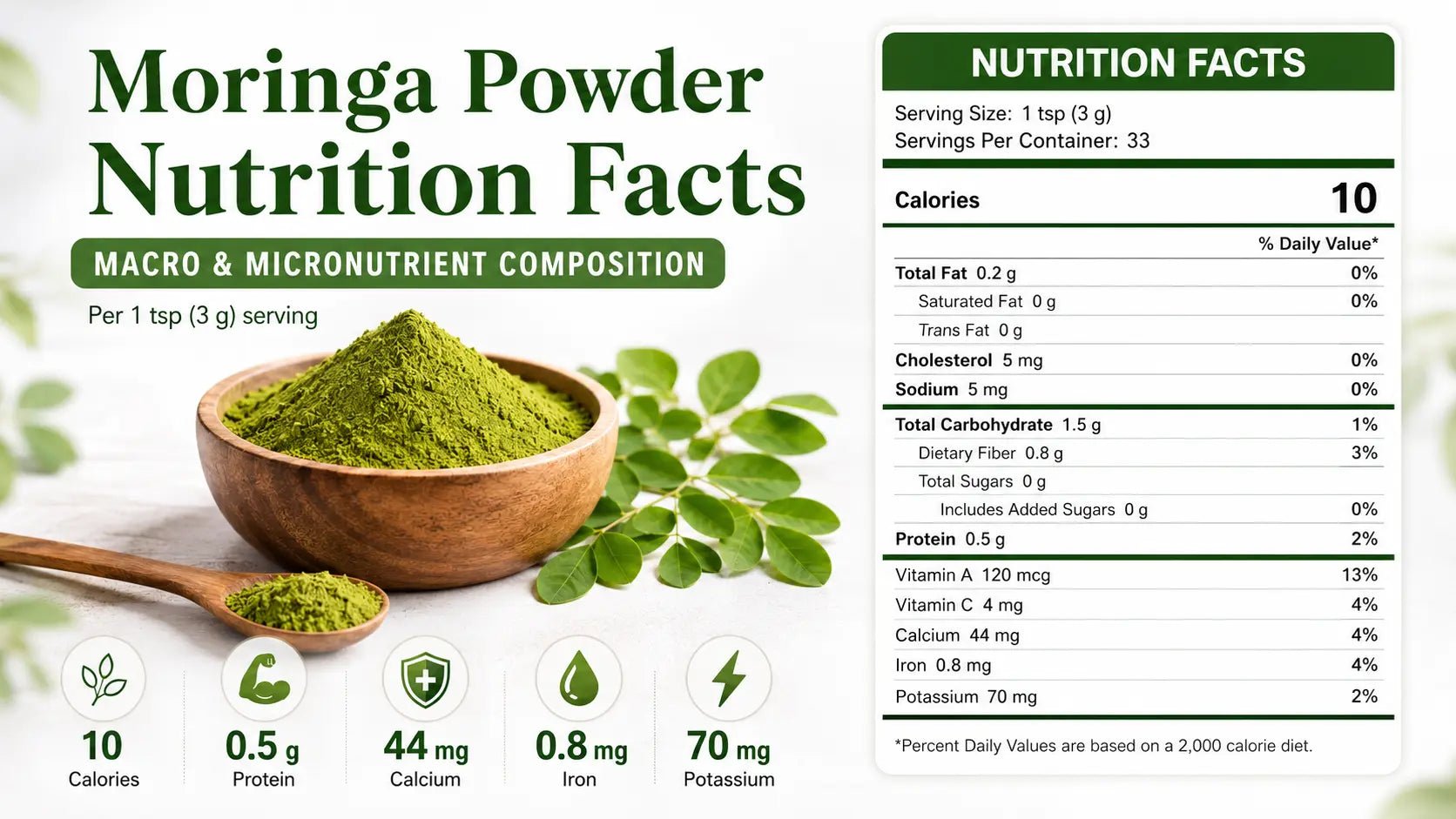
A common mistake is describing moringa powder only by its per 100 g values. That can mislead readers because most people do not eat 100 g of moringa powder in one day.
A realistic serving is usually much smaller:
| Serving size | Approximate amount | Practical meaning |
|---|---|---|
| 1 teaspoon | 2–3 g | Beginner serving |
| 1 tablespoon | 6–8 g | Common smoothie or food serving |
| 5 g | 5 g | Standard small serving |
| 10 g | 10 g | Larger daily food-use serving |
| 100 g | 100 g | Laboratory comparison value |
Per 100 g values are useful for scientific comparison, but per-serving values are more useful for real-life nutrition. The FDA explains that Percent Daily Value is based on the amount of a nutrient in a serving, and that 5% DV or less is considered low while 20% DV or more is considered high.
This means a nutrient table may say moringa powder contains around 25 g protein per 100 g, but a 5 g serving would provide only about 1.25 g protein if the powder contains 25% protein. The same logic applies to iron, calcium, potassium, magnesium, and other nutrients.
Approximate Nutritional Composition of Moringa Powder Per 100 g
The values below are approximate reported values from studies on dried moringa leaves or moringa leaf powder. They should not be treated as universal values for every product. A commercial powder’s true nutrient profile depends on the leaf source, drying method, storage, and laboratory testing.

| Nutrient | Approximate reported amount per 100 g dried moringa leaf powder | Notes |
|---|---|---|
| Protein | About 23–29 g | Relatively high for a dried leaf powder |
| Fat | About 4–10 g | Not the same as moringa seed oil |
| Fiber | About 6–12 g, sometimes higher depending on method | Whole-leaf powder contributes dietary fiber |
| Available carbohydrates | About 37–60 g | Often calculated by difference |
| Ash/mineral content | About 6–10 g | Indicates mineral-rich dry matter |
| Moisture | Often around 6–8 g | Lower moisture supports storage stability |
| Calcium | Reported examples range from about 520 mg to over 1,300 mg | Highly variable by sample and source |
| Iron | Around 7.7 mg in one reported study | Plant-based non-heme iron |
| Magnesium | Around 82.6 mg in one reported study | Varies by sample |
| Potassium | Reported around 1,317–2,025 mg in one study | Relevant for electrolyte intake |
| Phosphorus | Reported around 152–304 mg in one study | Contributes to mineral profile |
| Zinc | Around 0.8 mg in one reported study | Trace mineral contribution |
A Bangladesh study reported dried moringa leaves containing about 22.99–29.36% protein, 4.03–9.51% fat, 6.00–9.60% fiber, and 8.05–10.38% ash. A Botswana study reported mean values including 27.1% protein, 7.78% fat, 9.1% fiber, 46.5% available carbohydrates, 7.34% ash, and 6.93% moisture, along with measured mineral values such as calcium, iron, magnesium, zinc, manganese, and others.
Moringa Powder Nutrition Per 5 g and 10 g Serving
The table below converts common reported values into practical serving amounts. These are estimates, not a substitute for a product’s nutrition label or certificate of analysis.
| Nutrient | Approximate amount in 5 g | Approximate amount in 10 g | Practical meaning |
|---|---|---|---|
| Protein | About 1.2–1.5 g | About 2.3–2.9 g | Useful for a green powder, but not a protein supplement |
| Fat | About 0.2–0.5 g | About 0.4–1.0 g | Small amount |
| Fiber | About 0.3–0.6 g | About 0.6–1.2 g | Modest fiber contribution |
| Calcium | Highly variable | Highly variable | Depends strongly on source and testing |
| Iron | About 0.4 mg if using 7.7 mg/100 g as reference | About 0.8 mg | Non-heme iron |
| Magnesium | About 4 mg if using 82.6 mg/100 g as reference | About 8 mg | Small but useful contribution |
| Potassium | About 66–101 mg using 1,317–2,025 mg/100 g range | About 132–203 mg | More relevant at larger servings |
This is why moringa powder should be described as nutrient-dense, not as a single-serving solution for daily nutrient requirements.
Macronutrients in Moringa Powder
Protein in Moringa Powder
Moringa powder contains a relatively high amount of protein for a dried leafy vegetable powder. Several studies report moringa leaf protein in the low-to-high 20% range on a dry-weight basis. This means 100 g of dried moringa leaf powder may contain roughly 23–29 g of protein, depending on the sample.
However, moringa powder should not be marketed as a primary protein source. A normal serving is small:
| Serving | Approximate protein |
|---|---|
| 1 teaspoon, 2–3 g | About 0.5–0.9 g |
| 1 tablespoon, 6–8 g | About 1.4–2.3 g |
| 5 g | About 1.2–1.5 g |
| 10 g | About 2.3–2.9 g |
Moringa powder can support total protein intake, especially when used regularly in meals, but it does not replace beans, lentils, eggs, dairy, meat, fish, soy foods, or dedicated protein powders.
Amino Acid Profile of Moringa Powder
Moringa leaves contain amino acids, including essential amino acids. This is one reason moringa is often discussed as a useful food-fortification ingredient. However, the presence of essential amino acids does not mean a teaspoon or tablespoon provides a large protein dose.
A responsible way to describe moringa is: moringa leaf powder contains essential amino acids, but normal servings provide modest total protein. It can improve the nutrient density of meals, but it should not be positioned as a full protein replacement.
Carbohydrates in Moringa Powder
Moringa powder contains carbohydrates from dried leaf material. These carbohydrates are part of the plant matrix and include structural components and fiber. Reported available carbohydrate values vary widely between samples because of differences in moisture, leaf maturity, growing region, and testing method.
This does not mean moringa powder is a high-sugar food. In normal servings, the carbohydrate contribution is small.
Fiber in Moringa Powder
Because moringa powder is made from the whole dried leaf, it contains dietary fiber. Fiber contributes bulk, supports digestive regularity, and may support satiety as part of a balanced diet.
People new to moringa powder should start with a small amount. Increasing fiber too quickly from any concentrated green powder may cause gas, bloating, or abdominal discomfort in sensitive individuals.
Fat in Moringa Powder
Moringa leaf powder contains a small to moderate amount of fat on a dry-weight basis, but it is not a high-fat food in typical servings. It should not be confused with moringa seed oil, which is a separate oil-rich product.
This small amount of fat is nutritionally relevant because moringa also contains carotenoids such as beta-carotene. Beta-carotene is fat-soluble, and the NIH notes that carotenoid absorption from foods can vary and is generally lower than absorption of preformed vitamin A from animal-derived foods.
For better carotenoid use, take moringa powder with food that contains some fat, such as yogurt, milk, nuts, seeds, avocado, olive oil, or a balanced meal.
Calories in Moringa Powder
Moringa powder is not calorie-free, but typical servings contribute relatively few calories because the amount used is small. For most people, the value of moringa powder is its nutrient density rather than its calorie content.
Minerals in Moringa Powder
Calcium in Moringa Powder
Moringa powder can contain meaningful calcium on a dry-weight basis. However, calcium values vary widely across studies and products. One study reported average calcium around 520 mg/100 g, while another reported calcium values above 1,300 mg/100 g in dried leaves.
Per serving, the amount is much smaller. For example, if a powder contains 520 mg calcium per 100 g:
| Serving | Approximate calcium |
|---|---|
| 5 g | About 26 mg |
| 10 g | About 52 mg |
If the tested powder contains higher calcium, the serving contribution will be higher. This is why batch-specific testing matters.
Calcium content is also not the same as calcium absorption. Plant foods can contain compounds such as oxalates and phytates that may reduce mineral availability. Some calcium in moringa leaves may be bound as calcium oxalate, which means the body may not absorb all of the calcium listed in a lab report.
Iron in Moringa Powder
Moringa powder contains iron, but it is non-heme iron, the form found in plant foods. Non-heme iron is more affected by meal composition than heme iron from animal foods. Reviews on iron absorption note that phytates, polyphenols, and calcium can reduce iron absorption, while vitamin C can improve non-heme iron absorption.
One reported study found iron around 7.7 mg/100 g of moringa leaves. Using that value:
| Serving | Approximate iron |
|---|---|
| 5 g | About 0.4 mg |
| 10 g | About 0.8 mg |
Moringa can contribute to iron intake, but it should not be described as a cure for anemia or iron deficiency. People with fatigue, weakness, low hemoglobin, heavy menstrual bleeding, pregnancy-related iron needs, or suspected anemia should seek proper testing such as CBC, ferritin, and professional medical guidance.
Best pairing for iron absorption: take moringa powder with vitamin C-rich foods such as lemon, orange, guava, amla, berries, or citrus-based smoothies.
Potassium in Moringa Powder
Moringa powder can contain potassium. One study reported potassium values around 1.317–2.025 g/100 g in dried leaves.
At practical serving sizes, this becomes approximately:
| Serving | Approximate potassium |
|---|---|
| 5 g | About 66–101 mg |
| 10 g | About 132–203 mg |
For healthy adults, this can contribute to dietary potassium. People with kidney disease or potassium restrictions should be cautious with frequent or high intake of concentrated green powders.
Magnesium in Moringa Powder
Moringa powder contributes magnesium, a mineral involved in normal muscle, nerve, and enzyme function. One study reported magnesium around 82.6 mg/100 g. At a 5–10 g serving, that equals about 4–8 mg magnesium.
This is a useful contribution, but moringa powder should not be treated as a high-dose magnesium supplement.
Zinc, Phosphorus, Copper, and Manganese
Moringa powder may also contain trace minerals such as zinc, manganese, copper, and phosphorus. These minerals support normal metabolic and enzyme functions, but amounts vary by growing conditions and product testing.
The best way to know the true mineral content of a moringa powder is to check a product-specific nutrition label or certificate of analysis.
Vitamins in Moringa Powder
Vitamin A and Beta-Carotene
Moringa leaves contain carotenoids, including beta-carotene. Beta-carotene is a provitamin A carotenoid, meaning the body can convert some of it into vitamin A.
This distinction matters. Moringa powder should not simply be described as “high in vitamin A” unless the product has been tested and the result is expressed correctly. The NIH explains that vitamin A values are expressed as retinol activity equivalents because retinol and provitamin A carotenoids have different biological activities.
Beta-carotene absorption depends on meal fat, food matrix, digestive health, vitamin A status, and overall diet. For better absorption, use moringa powder with a meal that contains some fat.
Vitamin C
Fresh moringa leaves may contain vitamin C, but dried moringa powder usually contains less because vitamin C is sensitive to heat, oxygen, light, and storage. Studies report that drying methods can significantly change vitamin C and phytochemical levels in moringa leaves.
This means moringa powder may contribute vitamin C, but strong vitamin C claims should only be made if the specific product has been lab-tested.
To preserve vitamin C, avoid boiling moringa powder for a long time. Add it after cooking or mix it into cool or warm foods.
Vitamin E
Moringa powder may contain vitamin E compounds that contribute to its antioxidant nutrient profile. Vitamin E is fat-soluble, so its nutritional relevance depends on both the amount present and the meal context.
Because exact vitamin E values vary, it is better to discuss vitamin E as part of moringa’s broader micronutrient profile instead of claiming that every moringa powder is a high-dose vitamin E source.
Vitamin K
As a dried green leaf powder, moringa may contribute vitamin K. This can be nutritionally useful, but it matters for people taking warfarin or similar anticoagulant medication.
The NIH advises that people taking warfarin and similar anticoagulants need to maintain consistent vitamin K intake because sudden changes can affect anticoagulant action.
People using blood-thinning medication should not suddenly add large amounts of moringa powder without medical guidance.
B Vitamins and Folate
Moringa leaves may contain B vitamins such as thiamin, riboflavin, niacin, vitamin B6, and folate, depending on the sample and testing method.
However, moringa powder should not be considered a reliable source of vitamin B12 unless a specific product has verified lab testing or fortification. NIH states that vitamin B12 is not naturally present in plant foods, although some plant foods are fortified with B12.
This is especially important for vegans and strict vegetarians, who should use dependable B12 sources.
Antioxidants and Phytonutrients in Moringa Powder
Moringa powder contains plant compounds beyond essential nutrients. These include polyphenols, flavonoids, carotenoids, glucosinolates, and isothiocyanate-related compounds. Reviews describe moringa leaves as a source of bioactive compounds and phytochemicals.
Commonly discussed compounds include:
| Compound group | Examples / notes | Nutritional relevance |
|---|---|---|
| Polyphenols | Phenolic acids and related compounds | Contribute to antioxidant capacity |
| Flavonoids | Quercetin- and kaempferol-type compounds may be present | Studied for biological activity |
| Carotenoids | Beta-carotene and lutein-type compounds | Provitamin A and antioxidant roles |
| Glucosinolates | Sulfur-containing plant compounds | Contribute to moringa’s phytochemical profile |
| Isothiocyanate-related compounds | Breakdown products of glucosinolates | Studied in cell and laboratory models |
These compounds make moringa nutritionally interesting, but they should not be used to make disease-treatment claims. Laboratory antioxidant activity does not automatically mean the same effect will happen in the human body after digestion, absorption, and metabolism.
Nutrient Bioavailability: What the Body Actually Absorbs
Nutrient composition tells you what is present in the powder. Bioavailability tells you how much the body can absorb and use. These are not the same thing.
This distinction is especially important for moringa powder because several nutrients, especially minerals, can be affected by plant compounds such as phytates, oxalates, tannins, and polyphenols.
| Nutrient | Bioavailability issue | Practical tip |
|---|---|---|
| Iron | Non-heme iron; affected by phytates, polyphenols, calcium | Pair with vitamin C-rich foods |
| Calcium | May be affected by oxalates and phytates | Use as part of a varied calcium-rich diet |
| Beta-carotene | Fat-soluble; absorption varies | Take with a meal containing fat |
| Vitamin C | Heat-, oxygen-, and storage-sensitive | Avoid long boiling |
| Minerals | Depend on soil and growing conditions | Choose tested powder |
Moringa leaves can contain anti-nutritional factors such as phytates, oxalates, tannins, saponins, and trypsin inhibitors. These compounds are naturally found in many plant foods and do not mean moringa is unhealthy when used normally. They simply mean that nutrient values should be interpreted realistically.
Why Moringa Powder Nutrition Values Vary
Moringa powder does not have one fixed nutritional profile. It is an agricultural whole-food ingredient, not a standardized isolated supplement.
Nutrient values can vary because of:
- soil mineral content
- growing region
- climate and rainfall
- irrigation and farming methods
- leaf maturity
- harvest season
- tree variety or provenance
- drying temperature
- shade drying, sun drying, oven drying, or freeze drying
- grinding method
- storage time
- exposure to air, heat, light, and moisture
- laboratory testing method
- moisture level of the finished powder
Studies have found meaningful variation in protein, fat, fiber, ash, minerals, and other components across moringa samples.
This is why the most reliable moringa powder is not the one with the biggest claims. It is the one with the best transparency and batch-specific testing.
Fresh Moringa Leaves vs Dried Moringa Powder
Fresh moringa leaves and dried moringa powder are not nutritionally identical.
Drying removes water and concentrates many nutrients by weight, especially protein, fiber, and minerals. However, drying can reduce some sensitive nutrients, especially vitamin C, and can alter phytochemical content.
| Form | Nutritional advantage | Limitation |
|---|---|---|
| Fresh moringa leaves | Fresh whole-food use; may retain more vitamin C | Short shelf life |
| Dried moringa powder | Concentrated, shelf-stable, easy to add to foods | Some nutrients may decline during drying |
| Moringa extract | May concentrate selected compounds | Not nutritionally equivalent to whole-leaf powder |
| Moringa capsules | Convenient | Usually provide a small food quantity |
The main mistake is comparing 100 g of fresh leaves with 100 g of dried powder without explaining water content. Dried powder looks much more concentrated because it contains far less moisture.
Is Moringa Powder “High” in Nutrients?
Whether moringa powder is “high” in a nutrient depends on the serving size and the reference value.
Per 100 g, moringa powder may appear high in several nutrients. Per teaspoon or tablespoon, the contribution is smaller. A fair nutrition comparison should compare realistic serving sizes, not only 100 g laboratory values.
For example, people may drink 250 ml of milk, but they usually consume only a few grams of moringa powder. Therefore, claims such as “moringa has more calcium than milk” can be misleading unless the comparison clearly states the serving size and source of the nutrient data.
The FDA’s general guide is useful here: 5% DV or less per serving is low, and 20% DV or more per serving is high.
How Much Moringa Powder Should You Take Daily?
There is no universal dose that fits everyone. For general food use, most people use small amounts.
| User level | Suggested amount |
|---|---|
| Beginner | ½ to 1 teaspoon daily |
| Regular food use | 1 teaspoon to 1 tablespoon daily |
| Higher intake | Best used with professional guidance |
Start low and increase gradually if tolerated. Higher amounts may cause digestive discomfort in some people because moringa powder contains fiber and concentrated plant compounds.
Moringa powder should be used as food support, not as medical treatment.
Best Ways to Use Moringa Powder for Nutrition
Moringa powder can be added to:
- smoothies
- yogurt
- oatmeal after cooking
- soups after heat is reduced
- lentils or stews near the end of cooking
- lemon water or citrus drinks
- green sauces
- chutneys
- salad dressings
- energy balls
For better nutrient use:
| Nutrient goal | Pair moringa with | Why |
|---|---|---|
| Iron intake | Lemon, orange, guava, berries, amla | Vitamin C supports non-heme iron absorption |
| Carotenoid absorption | Yogurt, milk, nuts, seeds, avocado, olive oil | Fat supports absorption of fat-soluble carotenoids |
| Digestive tolerance | Oats, yogurt, soup, porridge | Gentler food matrix |
| Mineral intake | Balanced meals | Avoid relying on powder alone |
Store moringa powder in an airtight container away from heat, sunlight, and moisture.
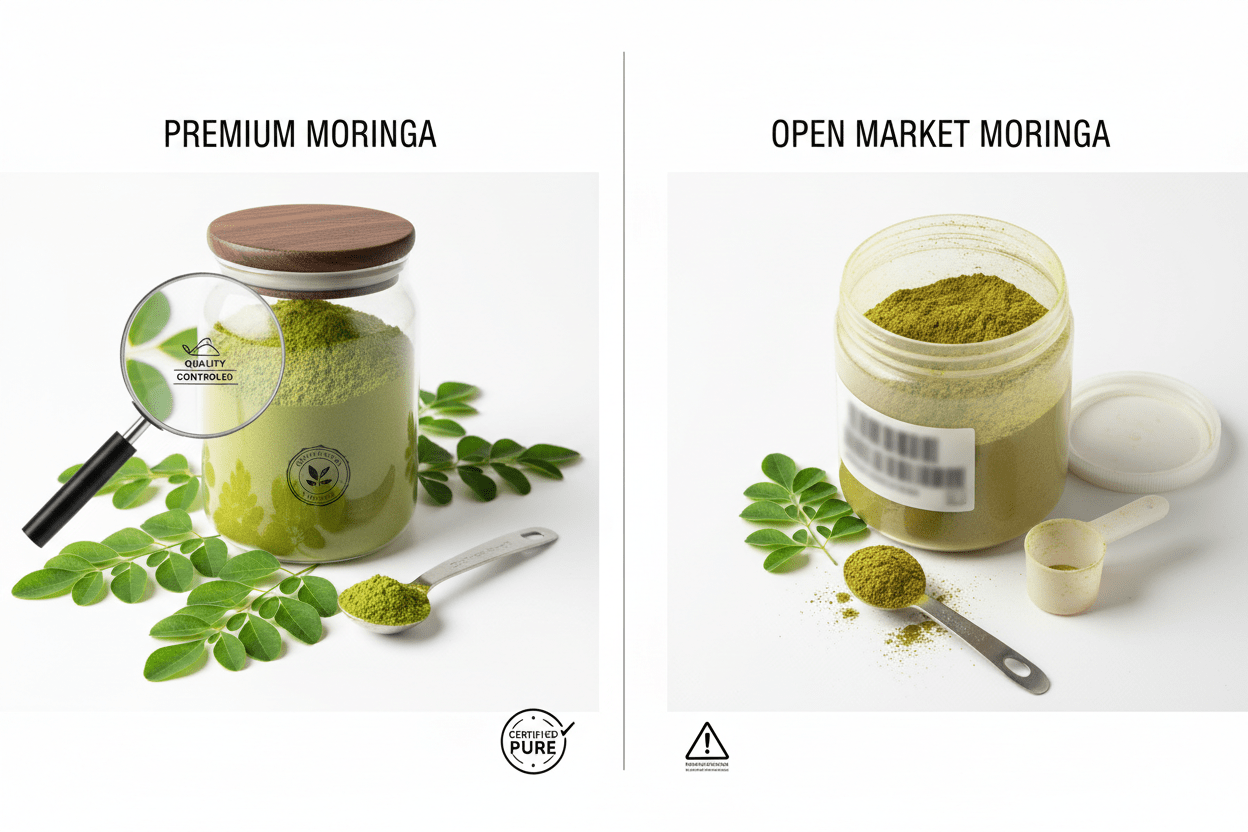
How to Choose a Nutritionally Reliable Moringa Powder
The best moringa powder is the one with transparent quality testing.
Look for:
- 100% moringa leaf powder
- no fillers or artificial colors
- clear country of origin
- organic certification, if important to your audience
- batch-specific nutrition testing
- heavy metal testing
- microbial testing
- pesticide residue testing
- low moisture content
- airtight, light-protective packaging
- clear expiration or best-before date
- certificate of analysis available on request
A moringa brand should ideally show actual lab data instead of relying only on generic “superfood” comparisons.
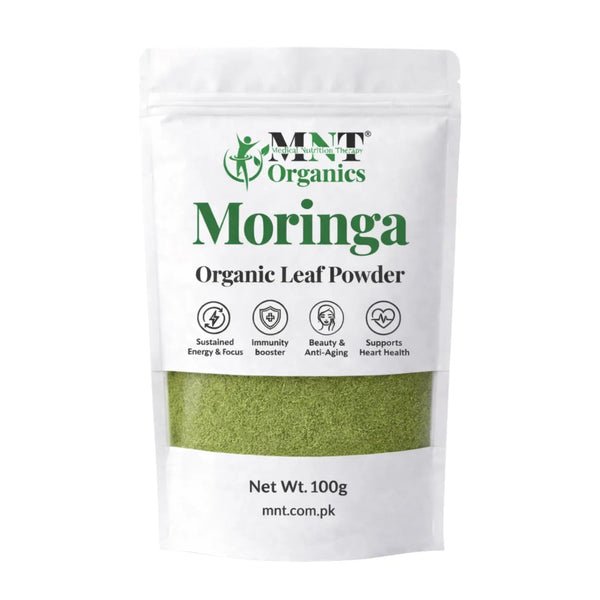
Moringa Powder – 100% Organic Moringa Leaf Powder
For readers who want to use moringa powder as a whole-leaf food powder, MNT Moringa Powder is made from 100% Organic Moringa Oleifera Leaf Powder and can be added to smoothies, yogurt, soups, herbal drinks, or lemon water.
- 100% Organic Moringa Oleifera Leaf Powder
- No additives, preservatives, artificial colors, or fillers
- Suggested daily intake: ½–1 teaspoon, or 2–5 g per day
- Best suited for readers looking for moringa leaf powder, not moringa extract or seed oil
Note: Moringa powder is a food product, not a medicine or treatment for any disease. Use within the suggested serving size and consult a qualified healthcare professional if pregnant, breastfeeding, taking medication, or managing a medical condition.
Nutritional Limitations of Moringa Powder
Moringa powder is nutrient-dense, but it is not nutritionally complete.
It should not be treated as:
- a complete meal replacement
- a multivitamin replacement
- a protein powder replacement
- a treatment for anemia
- a cure for any disease
- a guaranteed source of vitamin B12
- a substitute for a varied diet
- a replacement for prescribed supplements when deficiency is diagnosed
Its biggest nutritional strength is that it can add a concentrated mix of leafy-green nutrients to meals in a small amount.
Safety Notes
Most healthy adults use moringa powder in small food-like amounts. However, some people should be careful with regular or high intake.
Speak with a qualified healthcare professional before using moringa powder regularly if you:
- are pregnant or breastfeeding
- take blood thinners such as warfarin
- take medication for diabetes or blood pressure
- have kidney disease or potassium restrictions
- have iron overload or hemochromatosis
- are giving it to children
- have digestive sensitivity
- use multiple supplements already
Because moringa powder may contain vitamin K, minerals, fiber, and bioactive compounds, high intake may not be appropriate for everyone. People taking warfarin or similar anticoagulants should maintain consistent vitamin K intake and discuss major diet changes with a healthcare professional.
Product quality also matters. Poorly handled powders may carry contamination risks, including microbial contamination, pesticide residues, or heavy metals. Choose products with third-party testing or a batch-specific certificate of analysis.
Common Myths About Moringa Powder Nutrition
Myth 1: Moringa Powder Can Replace a Complete Diet
Moringa is nutrient-dense, but it cannot replace a balanced diet. It does not provide every nutrient in the amounts needed for complete nutrition.
Myth 2: Moringa Iron Works Like Meat Iron
Moringa contains non-heme iron. This form is generally more affected by inhibitors such as phytates and polyphenols than heme iron from animal foods. Vitamin C-rich foods can improve non-heme iron absorption.
Myth 3: More Moringa Always Means More Benefits
More is not always better. High intake may cause digestive discomfort and may not be suitable for everyone.
Myth 4: Every Moringa Powder Has the Same Nutrition
Nutrition values vary by soil, region, harvest stage, drying method, storage, and testing method.
Myth 5: Moringa Powder Cures Anemia
Moringa may contribute iron and other nutrients, but anemia requires proper diagnosis and treatment. It should not be promoted as a cure.
Myth 6: Moringa Powder Is a Reliable B12 Source
Moringa powder should not be considered a reliable vitamin B12 source unless a specific product is fortified or lab-tested. NIH notes that vitamin B12 is not naturally present in plant foods.
Nutrient-by-Nutrient Answers
Is moringa powder high in protein?
Moringa powder is relatively high in protein for a dried leaf powder, with studies commonly reporting around 23–29 g protein per 100 g. However, a tablespoon provides only a small amount of protein. It should not be used as a primary protein supplement.
Is moringa powder high in iron?
Moringa powder contains iron, but it is non-heme iron. Its absorption depends on vitamin C intake, phytates, polyphenols, calcium, and the rest of the meal. It can contribute to iron intake but should not be described as a treatment for anemia.
Is moringa powder high in calcium?
Moringa powder can contain calcium, but reported values vary widely. It may contribute calcium to the diet, especially at larger servings, but the actual amount depends on the tested powder and serving size.
Is moringa powder high in vitamin C?
Fresh moringa leaves can contain vitamin C, but dried powder may lose vitamin C during drying and storage. For vitamin C claims, product-specific testing is more reliable than generic values.
Is moringa powder high in vitamin A?
Moringa powder may contain beta-carotene, a provitamin A carotenoid. The body can convert some beta-carotene into vitamin A, but absorption and conversion vary. Consuming moringa with some dietary fat may improve carotenoid absorption.
Is moringa powder high in potassium?
Moringa powder can contain potassium, especially per 100 g. In realistic servings, it contributes smaller amounts. People with kidney disease or potassium restrictions should be cautious with frequent high intake.
Does moringa powder contain vitamin B12?
Moringa powder should not be considered a reliable source of vitamin B12 unless a specific product has verified testing or fortification. People following vegan or strict vegetarian diets should use dependable B12 sources.
Frequently Asked Questions
What nutrients are in moringa powder?
Moringa powder contains protein, fiber, carbohydrates, small amounts of fat, calcium, iron, potassium, magnesium, phosphorus, zinc, manganese, beta-carotene, vitamin C, vitamin E, vitamin K, B vitamins, and antioxidant plant compounds.
What are the macronutrients in moringa powder?
The main macronutrients are protein, carbohydrates, dietary fiber, and small amounts of fat. On a dry-weight basis, studies often report moringa leaf protein around 23–29%.
What are the micronutrients in moringa powder?
The main micronutrients include calcium, iron, potassium, magnesium, phosphorus, zinc, manganese, beta-carotene, vitamin C, vitamin E, vitamin K, and some B vitamins.
How much protein is in moringa powder?
Studies commonly report around 23–29 g protein per 100 g dried moringa leaf powder. A 5 g serving provides about 1.2–1.5 g protein, while a 10 g serving provides about 2.3–2.9 g.
How much iron is in moringa powder?
One study reported about 7.7 mg iron per 100 g. That equals about 0.4 mg in a 5 g serving or 0.8 mg in a 10 g serving. The exact amount depends on the powder and testing method.
Is moringa powder good for iron deficiency?
Moringa powder can contribute non-heme iron, but it should not be used as a treatment for iron deficiency or anemia. People with suspected iron deficiency should seek medical testing and guidance.
How much calcium is in moringa powder?
Reported calcium values vary widely. One study reported about 520 mg/100 g, while another reported values above 1,300 mg/100 g. Product-specific testing is the best way to know the actual amount.
Does moringa powder contain vitamin C?
Yes, moringa leaves can contain vitamin C, but dried powder may contain less because vitamin C can decline during drying, heating, and storage.
Does drying moringa reduce nutrients?
Drying removes water and concentrates many minerals and macronutrients by weight, but it can reduce sensitive nutrients such as vitamin C and alter phytochemicals.
Is moringa powder a complete protein?
Moringa leaves contain essential amino acids, but normal servings provide only small amounts of protein. It can support dietary diversity but should not replace primary protein foods.
Can moringa powder replace a multivitamin?
No. Moringa powder is a whole-food powder, not a standardized multivitamin. Its nutrient values vary and it may not provide enough of specific nutrients to replace supplements when supplements are medically needed.
Is moringa powder safe to take daily?
Many people use small food-like amounts daily, but high or regular intake may not be appropriate for everyone. People who are pregnant, breastfeeding, taking medication, managing kidney disease, or using blood thinners should seek medical advice.
What is the best way to take moringa powder for nutrition?
Take it with food. Pair it with vitamin C-rich foods for iron absorption and with some dietary fat for carotenoid absorption. Avoid boiling it for long periods if preserving vitamin C is a priority.
Final Takeaway
Moringa powder is a nutrient-dense dried leaf powder that can add plant protein, fiber, minerals, vitamins, carotenoids, and antioxidant plant compounds to the diet. Its strongest nutritional features are its dry-weight protein content, mineral profile, carotenoids, and whole-leaf phytonutrients.
However, moringa powder should be interpreted realistically. Per 100 g, it can look very rich in nutrients. Per teaspoon or tablespoon, it provides smaller but still useful amounts. Nutrient content is also not the same as nutrient absorption. Bioavailability, anti-nutrients, drying method, storage, and serving combinations all affect the final nutritional value.
In simple terms: moringa powder is a valuable nutrient-dense green powder, but it is not a miracle food, medicine, multivitamin, protein powder, anemia cure, or complete meal replacement.
We rely on peer-reviewed studies and reputable medical journals.