

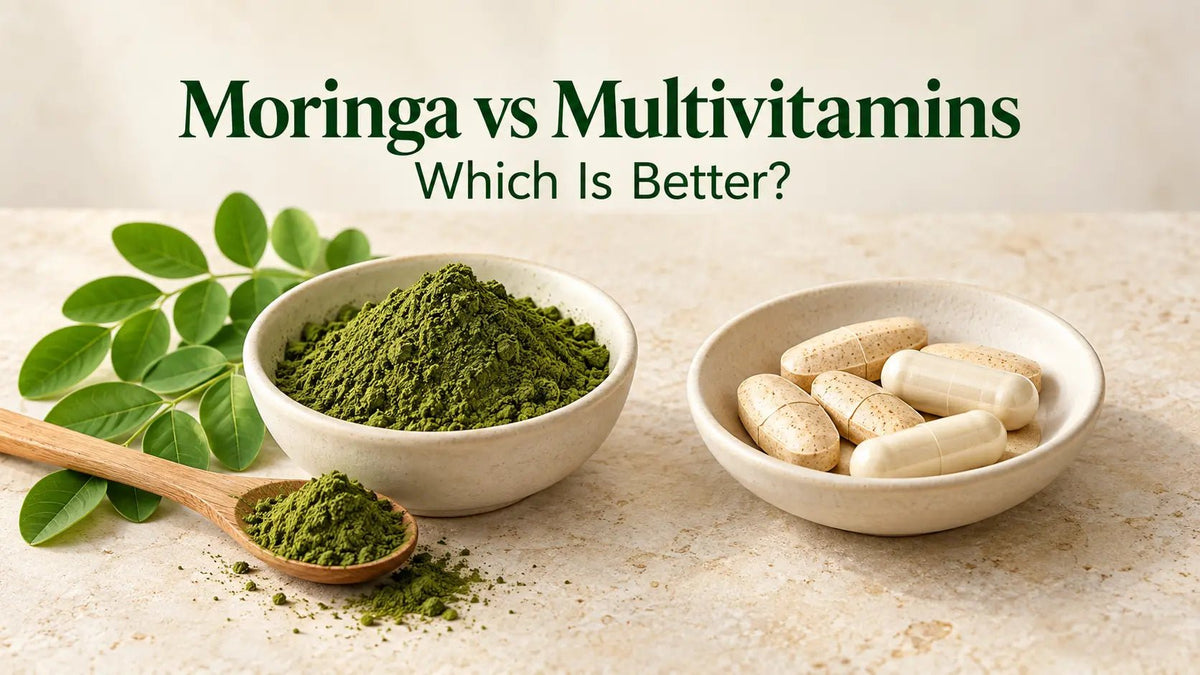
Moringa vs Multivitamins: Which Is Better?
Moringa adds nutrients to meals, while a suitable multivitamin can help fill dietary gaps. Compare realistic servings, absorption, research, and safety before choosing either.
For filling gaps in vitamin and mineral intake, a suitable multivitamin is usually more reliable than moringa leaf powder. Moringa adds some nutrients and plant compounds to meals, but it cannot reliably replace a multivitamin’s full formula. If your diet meets your needs, you may need neither. A diagnosed deficiency may require a specific nutrient at a treatment dose, rather than a basic multivitamin. (1, 2)
The right choice starts with one question: Which nutrient or benefit do you actually need? A green powder, a daily vitamin, and a prescribed supplement can serve very different purposes.
Moringa vs Multivitamins at a Glance
| What matters | Plain moringa leaf powder | Multivitamin with minerals |
|---|---|---|
| Main purpose | Adding a plant food to meals | Adding selected vitamins and minerals |
| Nutrient amounts | Depend on the product, processing, and portion | Listed per serving; formulas vary |
| Vitamin B12 | Not a reliable source | Often included; check the amount |
| Vitamin D | Do not rely on it to meet your needs | May contain D2 or D3; check the label |
| Fiber and plant compounds | Present, but small portions add limited amounts | Basic formulas generally provide no fiber |
| Treating a deficiency | Should not replace treatment | A basic formula may not provide the treatment dose |
| Complete nutrition | Does not replace a varied diet | Does not replace a varied diet |
The comparison is between plain Moringa oleifera leaf powder and multivitamin/mineral supplements. Roots, bark, seeds, extracts, and blends with added vitamins need separate assessment. (1, 3, 19)
What Are Moringa and Multivitamins?
What is moringa leaf powder?
Moringa leaf powder is made by drying and grinding the leaves of Moringa oleifera, also called the drumstick tree. It contains minerals, protein, fiber, carotenoids, and other plant compounds. Growing conditions and processing affect what ends up in the powder. (5, 6)
Food-grade powder can be stirred into dal, soup, yogurt, or a smoothie. This adds a plant ingredient to the meal. It does not turn that meal into complete nutrition.
What is a multivitamin?
A multivitamin combines several vitamins. Many products also contain minerals, such as iron, zinc, or iodine. These are often called multivitamin/mineral supplements.
There is no single standard formula. Adult products, prenatal vitamins, and gummies can contain different nutrients and amounts. The daily serving may be one tablet, several capsules, or more than one gummy. Check the full serving rather than assuming every pill supplies the same dose. (3)
Nutrient Comparison: What Does a Real Serving Provide?
Compare the portion you will use with the multivitamin’s full labeled serving. A nutrient chart for 100 grams of powder does not tell you what a small spoonful provides.
If a chart lists nutrients per 100 grams, a 5-gram portion provides 5% of those amounts. This is a calculation example, not a recommended daily dose.
A measured example of moringa powder nutrition
A 2024 laboratory study tested moringa leaf powder from Senegal. The table below converts that sample’s results to a five-gram portion. (7)
| Mineral | Calculated amount in 5 g of the studied powder | Approximate U.S. Daily Value |
|---|---|---|
| Calcium | 114 mg | 9% |
| Iron | 2.1 mg | 12% |
| Magnesium | 25 mg | 6% |
| Zinc | 0.09 mg | Less than 1% |
These are results for one studied powder, not nutrient claims for every moringa product or for MNT’s powder. Figures are rounded. U.S. Daily Values are label reference amounts; your needs can differ by age, sex, and life stage. (7, 8)
This portion adds some minerals, but it does not meet a full day’s requirement for any mineral listed. Nor does the amount present show how much your body will absorb.
For comparison, a multivitamin that lists 100% Daily Value for zinc supplies 11 mg per labeled serving. Another formula may supply less or omit zinc. Many basic multivitamins also contain relatively little calcium and magnesium. (3, 8)
Why “more nutrients than spinach or milk” can mislead
Before trusting a comparison, check whether it uses fresh leaves, dried powder, or an extract. Then check the portion sizes. Drying removes water and can also change vitamin content. A gram-for-gram comparison may not reflect the amounts people actually eat. (6)
The useful question is: How much of the nutrient does my actual serving provide?
Which Nutrients Need Special Attention?
Does moringa contain vitamin B12?
Unfortified plant foods are not reliable B12 sources. Plain moringa should not replace a B12 supplement or foods fortified with B12. This matters especially for people following a vegan diet. (4)
A moringa blend may contain added B12. If so, check the amount per serving. That does not establish B12 content in plain leaf powder.
Vitamin D: check a stated amount
Do not depend on moringa powder to meet vitamin D needs. Few foods naturally supply vitamin D, and some people need fortified foods or supplements. A multivitamin may contain vitamin D2 or D3, but the amount varies. (3, 9)
Vitamin A and vitamin C: form and processing matter
Moringa leaves contain beta-carotene, which the body can turn into vitamin A. It is not equivalent, gram for gram, to preformed vitamin A. Labels use retinol activity equivalents, or RAE, to account for these differences. (6, 10)
Vitamin C content also depends on processing. Research found different levels of vitamin C retention with different drying methods. Fresh-leaf values should not automatically be used for dried powder. (6)
Folate, iodine, and prenatal needs
Do not assume that a green powder supplies enough folate, iodine, or other nutrients needed in pregnancy. Follow a prenatal plan with known amounts.
The U.S. Preventive Services Task Force recommends 400–800 micrograms of folic acid daily for people planning to or who could become pregnant. People at higher risk may need different advice. Moringa should not replace this recommendation. (11)
Protein, fiber, and plant compounds
Moringa offers components that a basic vitamin tablet generally lacks. But portion size still matters. In one laboratory analysis, five grams of the studied powder would provide about 1.25 grams of protein and 0.6 grams of fiber. That is an addition to a meal, not a replacement for protein-rich or fiber-rich foods. (5)
The leaves also contain plant compounds with antioxidant activity in laboratory tests. Those results do not prove that a daily spoonful prevents disease or provides better health outcomes than a multivitamin. (5, 12)
Can Moringa Replace a Multivitamin?
Moringa cannot reliably replace the full nutrient formula of a multivitamin. Calling it “nature’s multivitamin” does not establish that it supplies the same nutrients in the same amounts.
There are three separate decisions:
- Adding a food: You may choose moringa for its taste and nutrients.
- Filling dietary gaps: A suitable multivitamin or individual supplement may help.
- Treating a deficiency: You need a plan that addresses the missing nutrient, dose, and cause.
For example, low B12 caused by poor absorption may need a different approach from a small dietary shortfall. A standard daily multivitamin may not supply the treatment required. (2, 4)
If a clinician recommended a supplement, find out which nutrient it supplies before changing it. If you take a multivitamin without a clear reason, review your food intake first. Stopping an unnecessary supplement does not create a need to replace it with moringa.
Is Moringa Better Absorbed Than Multivitamins?
Neither option is always better absorbed. Absorption depends on the nutrient, its form, the dose, the meal, and your health. “Natural” and “synthetic” do not settle the comparison.
Moringa provides plant iron, also called nonheme iron. Vitamin C helps the body absorb nonheme iron, while plant compounds such as phytate can reduce absorption. Pairing a plant-iron meal with guava, citrus fruit, or peppers can help. (13)
The Senegal powder study also tested mineral availability in a laboratory digestion model. Only a small share of its iron became accessible in that model. This supports caution about equating iron content with iron absorbed, but it does not tell us exactly what a person would absorb. (7)
Supplement nutrients can be useful too. B12 in supplements is already free from the food proteins to which naturally occurring B12 is bound. This can help people who struggle with that first step of digestion. (4)
When a seller claims “better absorption,” ask: Which nutrient, compared with what, and tested in whom?
What Does Human Research Show?
Human studies do not establish moringa as a complete multivitamin replacement. Nutrient measurements, laboratory antioxidant tests, and clinical trials answer different questions.
Moringa studies: what they can and cannot tell us
| Study | Main finding | What it means for this comparison |
|---|---|---|
| Three-month trial with results from 64 breastfeeding women with anemia | Hemoglobin rose in both groups, but iron stores improved only in the iron-and-folic-acid group | This small, open-label trial did not compare moringa with a full multivitamin or show restored iron stores with moringa. (14) |
| Twelve-week trial in 65 adults with prediabetes, using 2.4 g of leaf powder daily | Favorable changes in fasting glucose and HbA1c compared with placebo | A small trial in one group cannot establish general benefits or nutritional equivalence to a multivitamin. (15) |
| Four-week trial in 32 adults with type 2 diabetes, using 8 g daily | No significant difference in fasting glucose or HbA1c between groups | Results were mixed across trials; this short trial did not establish a glucose-control benefit. (16) |
The amounts in this table are study doses, not instructions for daily use.
A 2025 meta-analysis combined nine randomized trials of moringa and outcomes such as blood sugar, cholesterol, and blood pressure. It found no consistent benefits, and rated the certainty of evidence as very low. This makes broad promises about metabolic health difficult to justify. (12)
Moringa can still be a food ingredient. The evidence simply does not support treating it as a proven substitute for needed supplements or medicines.
Multivitamins: nutrient intake is different from disease prevention
A multivitamin supplies the nutrients in its formula. That does not automatically mean it prevents disease.
The USPSTF found insufficient evidence to recommend for or against multivitamins for preventing cardiovascular disease or cancer in generally healthy, nonpregnant adults. That assessment does not apply to people with known deficiencies or to prenatal needs. (17)
The relevant benefit should match the reason for use: supplying a missing nutrient differs from promising longer life or disease prevention.
Which Option Fits Your Needs?
| Your situation | A practical starting point |
|---|---|
| You eat a varied diet and have no identified nutrient gap | Review your intake before adding either product |
| You want a plant ingredient for meals | Consider food-grade moringa leaf powder as an optional addition |
| Your diet excludes several food groups or your intake is low | Identify likely gaps; a suitable multivitamin or targeted supplement may help |
| You follow a vegan diet | Secure a reliable B12 source; assess other nutrients separately |
| Tests show a deficiency | Follow the nutrient-specific treatment and follow-up plan |
| You are pregnant or planning pregnancy | Follow prenatal guidance; do not replace it with moringa |
| You have poor nutrient absorption or have had weight-loss surgery | Get an individual supplement plan |
You do not need to buy both products to make a good choice. Start with your food intake, health needs, and the nutrient amounts involved. (1, 2, 4, 11)
Can You Take Moringa and a Multivitamin Together?
Some adults may be able to use both, but safety depends on the products, amounts, medicines, and health conditions involved. Taking both does not guarantee an extra benefit.
Before combining them:
- Read the full daily serving on each label.
- Check whether the moringa product has added vitamins or minerals.
- Count any separate iron, vitamin D, or other supplements you use.
- Include fortified foods and drinks when checking total intake.
- Ask a pharmacist about interactions with your medicines. (1, 18, 19)
Plain leaf powder differs from a fortified greens blend. A blend may duplicate nutrients already supplied by your multivitamin.
Taking products at different times does not automatically prevent an interaction. Use the directions for the specific supplement and medicine rather than a universal morning-and-afternoon schedule.
Side Effects, Medicines, and Safety
Stomach and bowel symptoms
Moringa is not guaranteed to be gentler than a vitamin tablet. In the four-week diabetes trial, four of sixteen participants taking moringa reported diarrhea that resolved within days. A small, short trial does not establish long-term safety for everyone. (16)
Iron supplements can also cause stomach symptoms. If a product makes you feel unwell, review its ingredients, dose, and necessity with your clinician instead of assuming another “natural” product will solve the problem. (13)
Medicine interactions
Many possible moringa–medicine interactions come from animal or laboratory research. Their effects in people remain uncertain. Have a pharmacist assess the specific product if you use prescription medicines, including diabetes medicines. (19)
Two established supplement issues deserve attention:
- Warfarin: Vitamin K intake and changes to vitamin-K-containing supplements can affect treatment. Discuss changes before starting them. (1)
- Levothyroxine: Iron supplements, including iron-containing multivitamins, can reduce absorption of this medicine. Follow the prescribed spacing instructions. (13)
These examples do not mean that separating every supplement by a few hours makes all combinations safe.
Pregnancy, breastfeeding, and children
Do not replace prenatal vitamins with moringa. During pregnancy or breastfeeding, avoid starting moringa supplements unless your maternity clinician advises their use. Safety findings for one plant part or preparation cannot be applied to another. (11, 19)
Adult portions and adult multivitamins may not suit children. Poor growth, a very limited diet, or suspected anemia needs assessment rather than a powder chosen from advertising. Many supplements lack good safety data for children. (18)
More is not always better
The Daily Value on a label is not the upper safe limit. Taking several products can push some nutrients above appropriate levels. Too much preformed vitamin A is a particular concern in pregnancy; its risk differs from beta-carotene in foods. (8, 10, 18)
How to Choose a Product and Compare Cost
Choosing moringa powder
Look for a product that identifies:
- The plant as Moringa oleifera and the ingredient as leaf powder.
- The serving size in grams.
- Any added vitamins, minerals, or herbs.
- The manufacturer, batch number, and expiry date.
- Relevant testing for identity, bacteria, and contaminants.
Ask for product-specific nutrient data if the seller claims a serving meets a large share of your needs. A published study on another powder does not verify those claims.
Contamination matters too. The FDA has posted a recall of a specific moringa capsule product because of possible Salmonella contamination. This does not show that all moringa products are affected; it shows why reliable processing and batch checks matter. (20)
Choosing a multivitamin
Match the formula to the nutrients you need and your life stage. Check the full serving and avoid assuming that higher percentages mean better results.
Independent testing can help assess contents and contaminants. A quality seal does not prove that a product provides health benefits or suits your needs. (18)
Which is better value for money?
Cost per serving = pack price ÷ number of servings.
For example, a 100-gram pack provides twenty five-gram portions. This tells you how long the pack lasts; it does not establish an effective dose.
For a nutrient gap, compare the cost of supplying the required nutrient safely. For a food ingredient, compare taste, quality, price, and how often you will use it. A low pack price alone does not settle the choice.
Frequently Asked Questions
Is moringa a natural multivitamin?
“Natural multivitamin” is a description used in marketing, not proof of nutritional equivalence. Moringa contains several nutrients, but its actual portion may not supply the nutrients and amounts you need.
How much moringa equals one multivitamin?
There is no fixed equivalent. Powders and vitamin formulas vary, and more plain moringa will not make it a reliable B12 source. Compare individual nutrients per serving instead of trying to match a spoonful to a tablet. (3, 4)
Is moringa better than synthetic vitamins?
Being natural does not establish better absorption or outcomes. Compare the nutrient, form, amount, product quality, and reason for use. For some needs, a supplement is more useful than a food powder. (4, 13)
Can moringa replace iron tablets or a prenatal vitamin?
It should not replace either when recommended for you. The anemia trial did not find restored iron stores with moringa, and prenatal folic acid needs a known dose. (11, 14)
Which is better for energy, immunity, or hair health?
Neither is a guaranteed solution. Correcting a deficiency may help a symptom caused by that deficiency, but fatigue or hair loss does not identify the missing nutrient. Persistent symptoms need assessment rather than a product selected for an “energy” or “immunity” claim. (2, 4, 13)
Are moringa capsules better than powder?
Capsules may be easier to swallow; powder can be mixed into meals. Compare the ingredient and total grams. Two 500 mg capsules provide one gram. A capsule containing an extract is different from one containing plain leaf powder.
Is moringa tea as nutritious as leaf powder?
Not necessarily. When leaves are steeped and removed, you are not eating the whole powder. Nutrient results for dried leaves cannot establish what is in the brewed tea. The brewing method and the amount extracted matter.
Is moringa better than gummy vitamins?
Compare their contents. Gummies may supply B12 or vitamin D that plain moringa cannot reliably provide, but formulas vary. Check the nutrients, full serving, added sugar, and suitability for your needs. Neither format is automatically better. (3, 4, 9)
How much moringa should I take, and when?
The studies discussed here do not establish one effective daily dose or best time of day for everyone. Follow the specific product’s directions and any medicine-spacing advice. A five-gram nutrition example is not a dose recommendation, and research doses should not be copied as a personal treatment plan.
The Final Verdict
Choose a suitable multivitamin when you need help filling vitamin and mineral gaps. Choose moringa when you want an optional plant ingredient for meals. For a diagnosed deficiency, follow a nutrient-specific treatment plan.
Neither option replaces a varied diet. If your intake already meets your needs, you may not need either. The best choice is the one that meets a real need at a suitable amount—not the one with the longest nutrient list or the strongest advertising claim.
If you are unsure where your diet falls short, a registered dietitian can review your meals, current supplements, and relevant test results before you buy another product.
Disclosure: MNT sells moringa powder. This comparison is based on nutritional needs and the evidence cited below.
Book an MNT nutrition consultation
Discuss your meals and supplement choices with an MNT dietitian.
We rely on peer-reviewed studies and reputable medical journals.