

Moringa vs Spirulina: Which Green Powder Is Better?
Spirulina has more protein per gram. Moringa leaf powder usually has more fiber and calcium. The better choice depends on your goal. Neither powder is best for everything.
Moringa vs Spirulina: Quick Answer
Neither moringa nor spirulina is better for every goal. Choose spirulina if you want more protein per gram or its blue pigment, phycocyanin. Choose moringa leaf powder if you want more fiber and usually more calcium. It is often lower in sodium. Its mild taste also works well in food.
- For protein: spirulina wins, but a normal 5 g serving still provides only about 3 g.
- For fiber and calcium: moringa usually wins.
- For iron: there is no clear winner. The amount and absorption vary.
- For vitamin B12: choose neither. Spirulina is not a dependable source of active B12.
- For weight loss or disease care: neither should be your main plan.
No strong human trial has compared them head to head. No study has proved that one improves health more overall. The batch, serving size, diet, and your true needs matter more than the word “superfood.”
Moringa vs Spirulina Comparison at a Glance
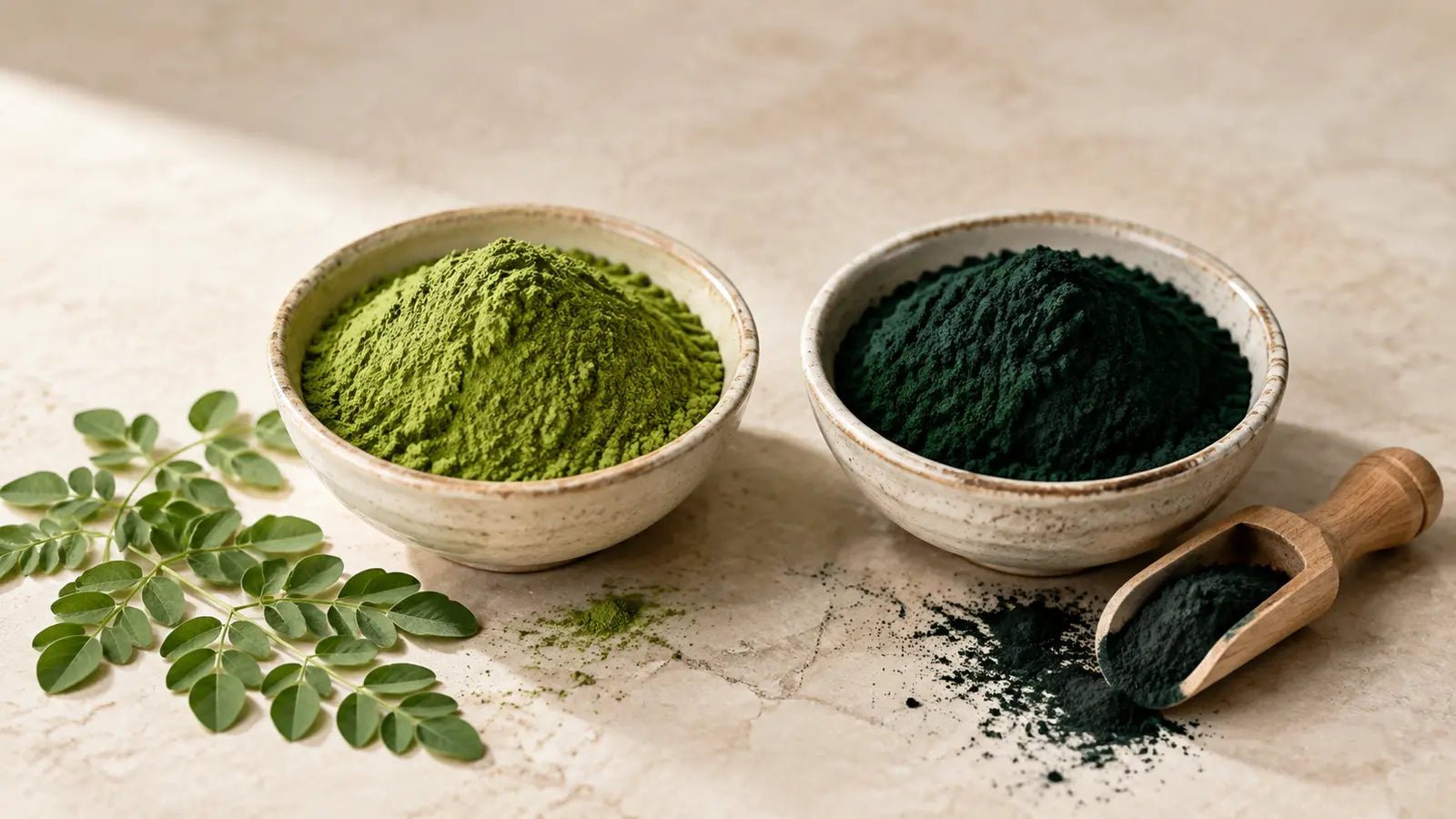
This article compares 100% dried moringa leaf powder with dried spirulina powder. Moringa roots, seeds, extracts, blends, and small capsules are different products. They are not equal to whole-leaf powder.
| Question | Better choice | Why |
|---|---|---|
| Which has more protein? | Spirulina | About 57% protein by dry weight in USDA data, versus roughly 19–29% in studies of moringa leaf powder. |
| Which has more fiber? | Moringa | Whole-leaf moringa usually contains much more fiber per equal weight. |
| Which has more calcium? | Moringa | Moringa leaf powder generally contains much more calcium, although the amount varies by sample. |
| Which has more vitamin A? | Usually moringa | Moringa often has more provitamin A carotenoids. The tested amount and serving size still matter. |
| Which has more vitamin C? | Usually moringa, but check the test | Drying, heat, air, and storage can sharply lower vitamin C in moringa powder. |
| Which has more iron? | Depends on the product | Values can overlap. The iron is not a set treatment dose, and absorption matters. |
| Which is better for weight loss? | Neither as a primary method | Spirulina has somewhat stronger human evidence, but the average effect is small. |
| Which has stronger human research? | Spirulina | More trials and reviews report small changes in some heart and blood-sugar markers. |
| Which is easier to use in food? | Moringa | Its earthy taste is usually easier to add to yogurt, smoothies, soups, dals, and sauces. |
| Which is the better B12 source? | Neither | Spirulina mainly contains inactive B12-like compounds and should not replace a reliable B12 source. |
Moringa vs Spirulina Nutrition: A Fair 5 g Comparison
Many online pages compare 100 g of each powder. That is a lab amount, not a normal daily serving. The table below uses the same 5 g weight for both. It does not use “one tablespoon.” A spoon can hold a different weight of each powder.
The moringa range comes from peer-reviewed food studies. The spirulina values come from USDA FoodData Central.1–3
| Nutrient per 5 g | Moringa leaf powder | Spirulina powder | What it means |
|---|---|---|---|
| Protein | About 1.0–1.5 g | About 2.9 g | Spirulina has more. Still, neither serving replaces protein-rich food. |
| Fiber | About 0.3–1.2 g | About 0.2 g | Moringa usually provides more whole-leaf fiber. |
| Iron | About 0.4–1.3 mg | About 1.4 mg | Values can overlap. A lab result is not the amount your body can use. |
| Calcium | About 26–74 mg | About 6 mg | Moringa usually has more. Yet 5 g is not a full source of calcium. |
| Potassium | About 66–101 mg | About 68 mg | The gap may be small and depends on the product. |
| Key plant compounds | Carotenoids, polyphenols, glucosinolates | Phycocyanin and carotenoids | Their presence does not prove that the powder treats disease. |
Important: These are example ranges, not set values for every brand. Soil, harvest, drying, storage, species, and test methods can change the result. A current report for the actual batch is better than a general online table. For a moringa-only guide, read Moringa Powder Nutrition Facts.
Which Is Better for Your Goal?
Moringa vs Spirulina for Protein
Winner: Spirulina. It has more than twice as much protein per equal weight. It also has all essential amino acids. Still, “high per gram” does not mean “a large serving.” About 5 g of spirulina gives roughly 3 g of protein. If you need 20–30 g, eggs, dairy, fish, chicken, beans, lentils, soy, or a standard protein powder are easier choices.
Moringa vs Spirulina for Iron and Anemia
Winner: No clear winner. Both can have iron, but the amount varies by batch. Your body absorbs only part of the listed iron. Moringa has non-heme iron. Do not assume that dried moringa has a large dose of vitamin C. Drying and storage can lower it.
Neither powder should replace tests or prescribed care for iron-deficiency anemia. Low hemoglobin has many causes. A CBC, ferritin test, and health check are more useful than a claim on the front of a pack.
Moringa vs Spirulina for Weight Loss
Research winner: Spirulina. Real-world winner: Neither. A 2025 review of 17 trials found about 1.07 kg more weight loss with spirulina on average. It found no clear change in waist size.6 This was a small mean effect. It does not prove that spirulina “burns fat.”
A 2025 review of moringa trials found no steady benefit for weight, BMI, blood sugar, or blood fats. The authors rated the proof as very weak.5 For lasting weight loss, food intake, protein, fiber, movement, and sleep matter much more.
Moringa vs Spirulina for Blood Sugar and Cholesterol
Spirulina has more human research, but neither treats disease. Reviews of spirulina trials report small gains in some blood-fat and blood-pressure tests. Yet the studies used different doses, products, and groups of people.7 Moringa trial results are less clear.
Do not stop or cut diabetes, cholesterol, or blood-pressure medicine because you start a green powder. Ask your clinician before regular use.
Moringa vs Spirulina for Daily Nutrition
Moringa is often the easier food-like choice. It usually adds more fiber and calcium. It also has a milder taste. Spirulina suits people who mainly want more protein per gram or phycocyanin. Neither replaces vegetables, full meals, or care for a known lack of a nutrient.
Moringa vs Spirulina for Vegans and Vitamin B12
Choose neither as your B12 source. Most of the B12-like material in spirulina is an inactive form called pseudovitamin B12.4 Vegans need a trusted fortified food or B12 supplement with a clear dose.
Moringa vs Spirulina Benefits: What Human Research Actually Shows
The sound answer is not that one powder wins every point. It is this:
- We know what nutrients they contain: both have value, but normal servings are small and brands differ.
- More human trials have tested spirulina: some reviews find small changes in weight, blood fats, and blood pressure.
- Moringa has weaker trial data: its clearest role is as a leaf food, not a proven treatment.
- We do not know the long-term effect: neither has been shown to stop heart attacks, cure diabetes, or replace usual care.
- There is no proven winner: no strong human study has compared the two powders directly.
This point matters. A powder can have protein, minerals, or plant compounds and still not treat disease.
Can You Take Moringa and Spirulina Together?
Many healthy adults may be able to use both in the labeled amount. Yet no good study shows that the mix works better than either one alone. They have different nutrients. That does not prove they work better as a pair.
If you decide to use both:
- check the serving size in grams on each label;
- start one product first, so you can see how you feel;
- do not double the dose to chase faster results;
- take them with food if they upset your stomach;
- get medical advice if you take medicine or manage a health condition.
There is no proven best time to take either powder. Your comfort and the label matter more than morning versus night.
Moringa vs Spirulina Safety: Who Should Be Careful?
| Issue | Moringa leaf powder | Spirulina |
|---|---|---|
| Common problems | May cause nausea, gas, loose stools, or stomach pain. | May cause nausea, stomach pain, headache, or an allergy. |
| Product-specific risk | Harmful germs, including Salmonella, can get into the powder. | Blue-green algae products can contain microcystins, germs, or heavy metals. |
| Important distinction | Leaf powder is not the same as root, bark, seed, or concentrated extract. | The label should identify spirulina/Arthrospira rather than a vague “blue-green algae” blend. |
| Extra caution | Pregnancy, breastfeeding, children, liver or kidney disease, and medicines for blood sugar, blood pressure, or clotting. | Pregnancy, breastfeeding, children, phenylketonuria, autoimmune disease, liver or kidney disease, immune-suppressing medicines, or blood thinners. |
How to Choose a Safe, High-Quality Green Powder
Look for:
- a complete ingredient name and amount per serving;
- a lot or batch number and clear expiry date;
- a recent certificate of analysis for that batch;
- microbial testing, including Salmonella and E. coli;
- heavy-metal testing;
- microcystin testing for spirulina or other blue-green algae products;
- sealed, moisture-protected packaging;
- no claims to cure, detox, or replace medicine.
“Organic” does not prove that a powder is free from germs, toxins, or heavy metals. A current batch report tells you more than color, taste, or sales claims.
Final Verdict: Is Moringa or Spirulina Better?
Spirulina is better for protein per gram. It also has more human research for a few small effects on heart and blood-sugar markers. Moringa leaf powder is better for fiber, usually calcium, mild taste, and food-like use.
For iron, there is no clear winner for every brand. For B12, anemia care, major weight loss, diabetes care, or “detox,” neither is the right main choice.
Choose one for a clear reason. Buy the powder with the best batch tests, not the longest list of claims.
Frequently Asked Questions
Is moringa the same as spirulina?
No. Moringa powder comes from the dried leaves of the Moringa oleifera tree. Spirulina is dried cyanobacterial biomass, commonly from Arthrospira species.
Does spirulina have more protein than moringa?
Yes. Per equal dry weight, spirulina has more than twice as much protein. A typical small serving, however, still provides only a few grams.
Does spirulina have more iron than moringa?
Not always. Some samples are similar, while others differ widely. Check the tested product value and remember that listed iron is not the same as absorbed iron.
Can moringa and spirulina replace a multivitamin?
No. Their nutrient content is variable, and neither reliably covers all essential vitamins and minerals. Spirulina should not replace vitamin B12.
Which tastes better: moringa or spirulina?
Most people find moringa easier to use because it tastes earthy and mildly bitter. Spirulina often has a stronger algae-like taste.
Can you take moringa or spirulina every day?
There is no one daily dose for every person or product. Many healthy adults use the labeled amount, but the batch must be safe. Ask a clinician first if you take medicine, have a health condition, are pregnant or breastfeeding, or plan to give it to a child.
Which is better for energy, hair, skin, or immunity?
There is no clear winner. Neither powder is proven to fix fatigue, hair loss, skin problems, or weak immunity. If a symptom comes from low iron, B12, protein, or another health problem, proper tests and cause-based care are more useful.
If Moringa Fits Your Goal
If you prefer a whole-leaf green powder for food-based use, review the ingredient, serving, safety information, and current availability before buying.
Disclosure: MNT sells moringa leaf powder. The comparison and verdict above are based on the cited evidence and do not claim that moringa is better for every person or goal.
Need Personal Nutrition Advice?
If you take medicines, manage a health condition, or are unsure whether either powder fits your diet, an MNT clinical dietitian can review your goals, food intake, and supplement use.
We rely on peer-reviewed studies and reputable medical journals.