

Chia Seeds vs Tukhm-e-Sharbati: Are They the Same? Differences, Benefits & Uses
Chia seeds and tukhm-e-sharbati are often confused, but the local name does not always identify the same seed. Learn how chia, basil seeds and tukh malanga differ in botanical identity, nutrition, soaking, uses and health...
Quick answer: Chia seeds are always the seeds of Salvia hispanica. “Tukhm-e-sharbati” (تخم شربتی), however, is not a reliable botanical name on its own. The name is used for different gel-forming seeds in South Asian sources and markets. Kew's medicinal plant names database records “tokhm sharbati” with Ocimum basilicum (sweet basil), while several Pakistani sellers currently use “tukhm-e-sharbati” for Salvia hispanica chia.
The safest way to know what you are buying is to check the scientific name:
- Salvia hispanica = chia seeds
- Ocimum basilicum = sweet basil seeds
- Tukhm-e-sharbati written without a botanical name = identity not certain
This distinction matters because chia and basil seeds come from different plants. Both absorb water and form a gel, so they can look similar after soaking, but their botanical identity, texture, research base and common culinary uses are not the same. Kew recognizes Salvia hispanica and Ocimum basilicum as separate taxa.
Chia Seeds vs Tukhm-e-Sharbati at a Glance
| Feature | Chia Seeds | Tukhm-e-Sharbati / Basil-Type Seeds* |
|---|---|---|
| Scientific identity | Salvia hispanica | Check the label; Ocimum basilicum means basil |
| Same seed? | — | Not if the product is Ocimum basilicum |
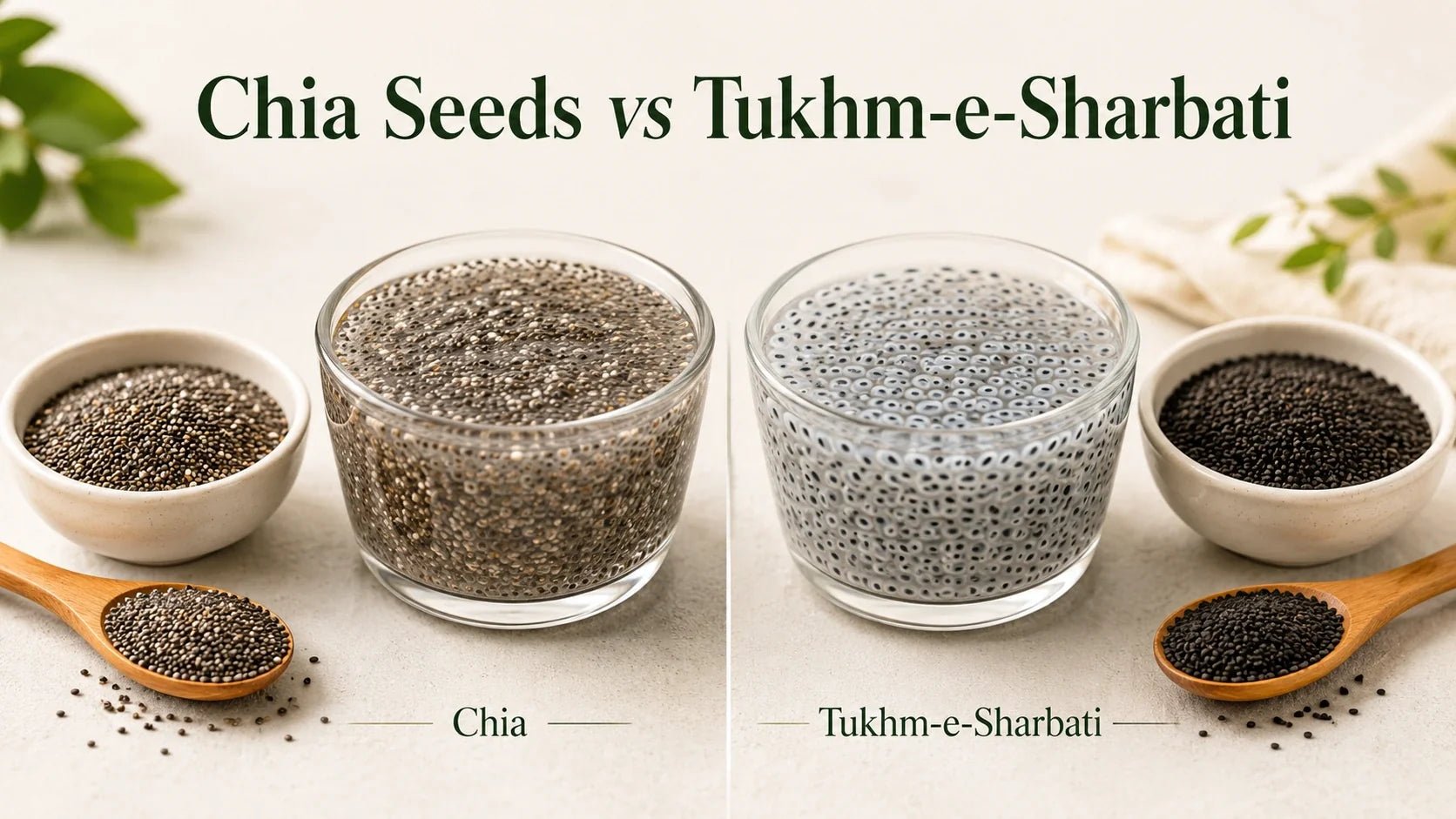
| Dry appearance | Often mottled black, grey, brown or white | Basil seeds are usually more uniformly dark |
| After soaking | Develop a soft gel around the seeds and through the liquid | Basil seeds often show a clearer gel coating around a dark center |
| Gel formation | Strong water-binding ability | Strong water-binding ability; gel behaves differently |
| Dietary fiber | High | Can also be high |
| Plant omega-3 | Well-established source of ALA | Basil seed oil can also contain ALA; reported amounts vary greatly |
| Human health research | Relatively more extensive | Much more limited for the edible seed itself |
| Common uses | Pudding, oats, yogurt, smoothies, baking | Falooda, sharbat and other drinks |
| Best identification method | Look for Salvia hispanica | Look for Ocimum basilicum |
*“Tukhm-e-sharbati” is a common name rather than a dependable scientific identity. When the term appears alone, check the ingredient or botanical name before deciding whether the packet contains chia or basil seed.
Why Is There So Much Confusion About Tukhm-e-Sharbati in Pakistan?
The confusion is not just a consumer mistake. The name itself is being used inconsistently.
For example, current Pakistani listings from Fruity Nuts and Bombay Dry Fruits identify “Tukhm-e-Sharbati” as Salvia hispanica chia. Marham also describes Tukhm-e-Sharbati as an Urdu name for chia. At the same time, Kew's Medicinal Plant Names Services records forms of “tokhm sharbati” among vernacular names linked with Ocimum basilicum.
That means the question:
“Is tukhm-e-sharbati chia?”
cannot always be answered safely from the local name alone.
The better question is:
“What is the botanical name of the seed in this packet?”
The simple identification rule
If the label says:
Salvia hispanica → Chia seed
Ocimum basilicum → Sweet basil / sabja-type seed
If there is no scientific name, the product name “tukhm-e-sharbati” alone is not enough to prove which plant the seeds came from.
This is especially useful when buying loose seeds from herbal shops, grocery markets or online sellers.
Tukhm-e-Sharbati vs Tukh Malanga vs Sabja vs Tukmaria
Several names can appear in discussions about chia and basil seeds:
These should not automatically be treated as perfect synonyms.
In Pakistani retail and health content, tukh malanga is commonly used for basil-type seeds, while true chia is botanically Salvia hispanica. Pakistani comparison pages also commonly distinguish tukh malanga/basil from chia.
But because common names change between regions and sellers, botanical identification remains more reliable than trying to build a rigid translation table.
Practical rule
Instead of asking:
“What is this seed called locally?”
ask:
“What species is this seed?”
That avoids most of the confusion.
What Are Chia Seeds?
Chia seeds are the edible seeds of Salvia hispanica, a species accepted by the Royal Botanic Gardens, Kew. Its native range is Mexico to Guatemala, and it has a long history of use as food.
Chia seeds contain:
- dietary fiber,
- plant protein,
- fat,
- minerals,
- and a high proportion of the plant omega-3 fatty acid alpha-linolenic acid (ALA).
Clinical research commonly describes chia as a food rich in fiber and ALA, although having these nutrients does not mean chia can treat disease by itself.
Another important feature of chia is its mucilage. When the seed comes into contact with water, material around it absorbs liquid and forms a gel. This allows chia to thicken foods such as pudding, overnight oats and yogurt.
What Are Basil or Sabja Seeds?
Sweet basil seeds come from Ocimum basilicum, which is botanically different from chia. Ocimum basilicum is an accepted basil species in Kew's botanical database.
Basil seeds also form mucilage when placed in water. Research comparing seed-based gels shows that basil and chia both build water-binding gel networks, but their physical structures and behavior are not identical.
Basil seeds can contain:
- dietary fiber,
- plant protein,
- fats,
- minerals,
- and polyunsaturated fatty acids.
Importantly, basil seeds should not automatically be described as “omega-3 free.” A scientific review found substantial variation in basil-seed fatty-acid composition, including widely varying levels of linolenic acid depending on genotype, origin and growing conditions.
This is why simple online claims such as “chia has omega-3 but basil has none” are too absolute.
How to Tell Chia Seeds and Basil Seeds Apart
The scientific name is the strongest test. Appearance is helpful but should be secondary.
1. Check the botanical name
Look for the ingredient information on the packet.
Salvia hispanica = chia
Ocimum basilicum = basil
If there is no botanical name, continue with the visual clues below—but treat them as clues, not proof.
2. Look at the dry seeds
Chia seeds
Chia commonly has a mottled appearance. A packet can contain a mixture of:
- black,
- grey,
- brownish,
- and white seeds.
Basil seeds
Basil/sabja seeds are commonly:
- darker,
- more uniformly black,
- and less mottled than chia.
Natural variation means color alone cannot identify every seed correctly.
3. Watch what happens after soaking
Both seeds develop mucilage.
Basil seeds often develop a very noticeable translucent gel layer surrounding a dark center.
Chia also develops a gelatinous coating, but as many seeds hydrate together, the mixture tends to form a more blended gel. Laboratory research confirms that chia and basil mucilage form different nanoscale gel networks.
Best identification order
Use this hierarchy:
- Botanical name
- Ingredient/supplier information
- Dry appearance
- Appearance after soaking
Do not rely only on the words “tukhm-e-sharbati.”
Chia Seeds vs Tukhm-e-Sharbati Nutrition
If “tukhm-e-sharbati” means basil seed in the product you have, both chia and basil can contribute useful nutrients.
However, the comparison is not as simple as many online charts suggest.
Basil-seed composition varies significantly across varieties and growing conditions, while chia has a larger body of standardized food-composition and human research.
Calories
Both are seeds, so both provide calories.
Whether a seed helps or hurts a weight-management goal depends partly on how much you use and what you eat it with.
A small amount added to unsweetened yogurt is very different from several spoonfuls added to a large sweetened falooda.
The full meal matters more than the reputation of the seed.
Protein
Chia contains plant protein, but it should not be treated as a replacement for a complete protein-rich diet.
Foods such as:
- eggs,
- dairy,
- fish,
- meat,
- lentils,
- beans,
- and other pulses
usually make a larger contribution to daily protein intake.
Basil seeds also contain protein, although published values vary between samples. A review of basil-seed nutrition reported notable variation in protein and other nutrient values.
Fiber
Both chia and basil seeds can provide dietary fiber.
Fiber contributes to normal bowel function and can increase the volume and texture of food. Both seeds also contain water-binding material that forms mucilage.
However, it is misleading to say that basil always has more fiber than chia—or vice versa—without comparing products tested under similar conditions. Reported basil-seed fiber values vary substantially in the scientific literature.
Omega-3 Fatty Acids
This is one of the most misunderstood parts of the chia vs basil debate.
Chia
Chia is a well-established plant source of alpha-linolenic acid (ALA). Human chia trials consistently identify ALA as an important part of its fatty-acid profile.
Basil seeds
Basil seed oil can also contain substantial ALA. Published research shows wide differences between basil seed samples, with genotype, location and environmental conditions influencing fatty-acid composition.
Therefore:
“Basil seeds contain no omega-3” is not scientifically accurate.
At the same time, chia currently has the better-established consumer nutrition and human research base as an ALA-rich food.
Important distinction: ALA is not EPA or DHA
ALA is a plant omega-3 fatty acid.
It is not nutritionally identical to the longer-chain omega-3 fats EPA and DHA, which are found mainly in seafood and algae-derived sources.
So eating chia should not be presented as nutritionally equivalent to eating oily fish.
Calcium, Magnesium, Iron and Other Minerals
Chia contains several nutritionally important minerals, and basil seeds can also contain minerals such as calcium, potassium and magnesium.
However, fixed claims such as:
“Chia has exactly three times more calcium than basil”
should be treated cautiously unless both seed samples were analyzed under comparable conditions.
Variety, soil, climate and processing can change food composition.
Which Is More Nutritious: Chia or Tukhm-e-Sharbati?
There is no universal nutritional winner.
If the “tukhm-e-sharbati” you have is actually Salvia hispanica, then you are simply comparing chia with chia.
If it is Ocimum basilicum, the comparison is chia vs basil seed.
Chia has an advantage when you want:
- a well-characterized source of ALA,
- a food with a larger body of human clinical research,
- a seed for pudding, oats and similar recipes.
Basil seeds make sense when you want:
- their particular gel texture,
- a traditional ingredient for drinks,
- or simply more variety in your diet.
Neither needs to be treated as a “superfood cure.”
Chia Seeds vs Tukhm-e-Sharbati for Weight Loss
Neither chia nor basil seed burns body fat by itself.
Chia can increase short-term fullness in some settings. In randomized studies, adding chia to food or a glucose challenge affected appetite ratings, and chia added to yogurt increased short-term satiety and reduced food intake at a later meal.
But feeling fuller after a meal is not the same as proving long-term fat loss.
A 12-week randomized trial in overweight and obese adults found that 50 g of chia per day did not significantly change body weight or body composition compared with placebo.
More recent evidence points in the same direction overall. A 2025 meta-analysis of eight randomized controlled trials found no significant reduction in body weight or BMI with chia, although waist circumference and blood pressure showed some improvement in the pooled analysis. Another 2025 review also found no significant overall effect on body weight or BMI.
One longer trial in people with type 2 diabetes did report greater weight loss with chia than a control intervention, showing that results can differ by population and study design.
So which is better for weight loss?
There is not enough direct human evidence to say basil seed is better than chia for fat loss.
Chia has more human research behind it, but it is still not a stand-alone weight-loss treatment.
The seed is most useful when it helps you build a filling meal while your overall calorie intake and eating pattern support your goal.
Adding chia to a large sugary drink does not turn that drink into a weight-loss food.
Which Is Better for Constipation?
Both seeds can add fiber and water-holding material to the diet.
For some people, gradually increasing fiber can support regular bowel movements. But adding a large amount suddenly can also cause:
- gas,
- bloating,
- abdominal discomfort,
- and changes in bowel habits.
Because basil-seed fiber values vary greatly between samples, there is not enough good direct evidence to claim that basil is always better than chia—or chia always better than basil—for constipation.
Practical approach
If you are new to either seed:
- start with a small amount,
- increase gradually if comfortable,
- and drink enough fluid.
Persistent constipation deserves proper assessment, especially when it occurs with:
- rectal bleeding,
- unexplained weight loss,
- persistent vomiting,
- severe or worsening abdominal pain,
- or a major unexplained change in bowel habits.
Seeds should not be used to delay medical care for concerning symptoms.
Which Is Better for Blood Sugar?
This question needs an important distinction between short-term post-meal glucose and long-term diabetes control.
Some small randomized chia studies found that chia reduced the rise in blood glucose after a meal or glucose challenge.
However, larger evidence syntheses are less dramatic.
A 2024 systematic review and meta-analysis of eight randomized controlled trials involving 362 participants found no significant overall effect of chia on fasting blood glucose, HbA1c or insulin.
A separate 2025 systematic review similarly found no significant overall effect on fasting glucose or HbA1c.
What does that mean?
Chia may alter the immediate glucose response to some meals, partly through its fiber and viscosity.
But the current evidence does not support telling people that chia treats diabetes or reliably lowers long-term blood sugar.
Human evidence for basil seeds is much more limited.
Neither seed should replace diabetes medication, glucose monitoring or individualized medical nutrition therapy.
Chia Seeds and Heart Health
Chia contains fiber and unsaturated fats, including ALA.
Several clinical trials have examined its effects on cardiovascular risk factors, particularly blood pressure.
A 2021 randomized trial in adults with type 2 diabetes found a reduction in systolic blood pressure with 40 g/day of chia over 12 weeks, while most other measured metabolic outcomes did not significantly change.
More recent meta-analyses have reported reductions in systolic and diastolic blood pressure across pooled chia trials, although the evidence base remains relatively small and study results are heterogeneous.
This does not mean chia:
- prevents heart attacks,
- “cleans arteries,”
- cures high blood pressure,
- or replaces prescribed medication.
For cardiovascular health, your overall dietary pattern, activity, smoking status, sleep, blood pressure, lipids, diabetes control and medical care matter far more than one seed.
Which Seed Keeps You Full Longer?
Chia can improve short-term satiety, but we do not have strong direct human evidence proving that chia keeps people fuller longer than basil seeds.
Controlled chia studies have reported:
- reduced hunger,
- improved satiety ratings,
- and lower food intake at a later meal in some conditions.
But fullness depends on far more than the seed itself.
It is affected by:
- protein,
- total fiber,
- calorie density,
- meal volume,
- fat,
- liquid,
- eating speed,
- and the person's usual diet.
Chia mixed into yogurt with fruit, for example, is a very different meal from chia added to sweetened juice.
Are Tukhm-e-Sharbati or Basil Seeds Really “Cooling”?
Basil/sabja-type seeds have a long traditional association with cold drinks such as sharbat and falooda in South Asia. Pakistani retailers and food pages continue to describe these seeds mainly in the context of summer drinks.
But “cooling” is a traditional food description, not a clearly defined clinical outcome in the human trials discussed above.
Drinking a cold beverage containing hydrated seeds may feel refreshing, but neither chia nor basil seed should be presented as a treatment for:
- heatstroke,
- dangerous dehydration,
- fever,
- or abnormally high body temperature.
Those conditions require appropriate medical care.
Do Chia Seeds Need to Be Soaked?
Chia does not have to be soaked before every use.
It can be mixed into foods that already contain enough moisture, such as:
- yogurt,
- oatmeal,
- smoothies,
- batters,
- or other wet foods.
Soaking mainly hydrates the seed in advance and develops its gel texture.
What about basil seeds?
Basil seeds are commonly soaked before being added to drinks and desserts because their mucilage absorbs water and develops the characteristic gel coating. Their strong gel-forming properties have also been demonstrated experimentally.
If you have swallowing difficulties or a condition that affects swallowing, discuss the safest food textures with your healthcare professional rather than experimenting with large amounts of highly water-absorbing foods.
Chia vs Basil Seeds for Different Foods
| Food or Drink | Better Choice | Why |
|---|---|---|
| Chia pudding | Chia | Produces the familiar pudding texture |
| Overnight oats | Chia | Mixes easily through the oats |
| Yogurt | Either | Depends on texture preference |
| Smoothie | Either | Both can be incorporated |
| Falooda | Basil/sabja | Traditional texture and use |
| Sharbat | Basil/sabja or chia | Both can work, but texture differs |
| Baking | Chia | Commonly used as a hydrated binder or seed ingredient |
| Chia water | Chia | Uses chia's characteristic gel |
| Traditional sabja drink | Basil | Gives the expected visible gel coating |
The “better” seed here is mainly a culinary choice, not a medical ranking.
Can You Replace Chia Seeds With Tukhm-e-Sharbati?
First identify what your tukhm-e-sharbati actually is.
If the packet says Salvia hispanica, it is chia already.
If it says Ocimum basilicum, it is basil seed.
Can basil replace chia?
Sometimes, but not perfectly.
Both absorb water and can work in:
- drinks,
- yogurt,
- smoothies,
- and some desserts.
But their mucilage structures and physical behavior differ, so swapping them can change the final texture.
For classic chia pudding, chia usually provides the expected result.
For falooda and many traditional drinks, basil/sabja seeds give the more familiar appearance and texture.
Side Effects and Safety
Both chia and basil seeds can be used as foods by many people, but large amounts are not automatically better.
A sudden increase in fiber may lead to:
- bloating,
- gas,
- abdominal discomfort,
- loose stools,
- or other bowel changes.
Chia can also act as an allergenic food in susceptible people. Published research has identified chia proteins capable of IgE binding and potential cross-reactivity with other seed or nut allergens, including sesame in laboratory testing.
Extra care is sensible if you:
- have a known seed allergy,
- have difficulty swallowing,
- have significant digestive disease,
- follow a medically restricted diet,
- or plan to make major dietary changes while taking medicines for diabetes or blood pressure.
Food should complement prescribed treatment, not replace it.
How Much Chia or Basil Seed Should You Eat?
There is no universal medical dose of chia or basil seeds that every healthy adult needs.
They are foods, not essential supplements.
If you are not used to eating much fiber, starting with a modest food portion and increasing gradually is more sensible than suddenly taking several large spoonfuls each day.
The right amount depends on:
- the rest of your diet,
- your energy needs,
- digestive tolerance,
- medical conditions,
- and what other fiber-rich foods you already eat.
A person regularly eating vegetables, fruit, pulses and whole grains does not need to chase extreme amounts of fiber from seeds.
Chia Seeds or Tukhm-e-Sharbati: Which Should You Choose?
The answer becomes simple once you know the botanical identity.
Choose chia if:
You specifically want Salvia hispanica.
It is particularly useful for:
- chia pudding,
- overnight oats,
- yogurt,
- smoothies,
- baking,
- and adding an established food source of ALA and fiber.
Chia also has the larger human clinical research base.
Choose basil/sabja seeds if:
The product is Ocimum basilicum and you:
- enjoy the texture,
- want the traditional seed used in falooda or sharbat,
- or simply want another fiber-containing seed in your diet.
Either can fit when:
Your aim is simply to add:
- variety,
- texture,
- fiber,
- and plant foods
to an otherwise balanced diet.
Do not choose either expecting it to:
- melt belly fat,
- “detox” the body,
- cure diabetes,
- clean arteries,
- cure chronic constipation,
- or replace medicine.
The evidence does not support those claims.
How to Buy the Right Seeds in Pakistan
This may be the most practical part of the comparison.
Step 1: Ignore the front-of-pack marketing name
“Tukhm-e-sharbati” alone may not tell you enough.
Current Pakistani sellers use this term for Salvia hispanica chia, while botanical naming databases also record forms of the name with Ocimum basilicum.
Step 2: Read the ingredients
For authentic chia, look for:
Chia seeds — Salvia hispanica
For sweet basil seed, look for:
Basil seeds — Ocimum basilicum
Step 3: Be cautious with unlabelled loose seeds
If a seller offers only “tukhm-e-sharbati,” ask:
“Is this Salvia hispanica or Ocimum basilicum?”
If the seller cannot identify the plant, appearance may help—but it still cannot replace a trustworthy botanical label.
Step 4: Choose according to use
Want chia pudding, oats or specifically Salvia hispanica?
Buy chia.
Want the traditional black seed with a clear gel coating for falooda or sharbat?
Look for correctly identified basil/sabja seed.
Chia Seeds vs Tukhm-e-Sharbati: Final Verdict
Chia seeds have one clear botanical identity: Salvia hispanica. “Tukhm-e-sharbati” does not give you the same certainty.
The term is used differently across South Asian naming sources and current Pakistani sellers, so it should not be used as the only way to identify a seed.
Remember the rule:
Salvia hispanica = chia
Ocimum basilicum = basil/sabja-type seed
Both seeds can form a gel. Both can contribute useful nutrients. Chia has a stronger human research base and is well established as an ALA-containing food, while basil seed nutrition can vary substantially between varieties and samples.
For weight loss, blood sugar, digestion or heart health, neither seed should be treated as a cure or a substitute for the rest of your diet or medical care.
The best seed is the one that fits your food, your needs and your preferences.
The most important step is simply knowing what seed you actually bought.
Frequently Asked Questions
Are chia seeds and tukhm-e-sharbati the same?
They can be—but the name alone cannot prove it. True chia is Salvia hispanica. Several Pakistani sellers call Salvia hispanica “tukhm-e-sharbati,” while Kew's medicinal plant names database also records forms of “tokhm sharbati” with Ocimum basilicum. Check the botanical name rather than relying only on the local name.
What is the scientific name of chia seeds?
The scientific name of chia is Salvia hispanica L. Kew recognizes Salvia hispanica as an accepted species.
What is the scientific name of tukhm-e-sharbati?
There is no safe universal botanical answer based only on that common name. The product may be labelled as Salvia hispanica in Pakistani commerce, while “tokhm sharbati” also appears among vernacular names associated with Ocimum basilicum in Kew's medicinal plant names resource. Check the actual botanical name on the product.
What are chia seeds called in Urdu?
“چیا سیڈز” or “چیا کے بیج” are unambiguous ways to refer to chia. Many Pakistani sellers and websites also use تخم شربتی (Tukhm-e-Sharbati) for chia, but because that common name can create botanical confusion, Salvia hispanica is the most reliable identifier.
Is tukh malanga the same as chia?
Generally, no. In Pakistani usage, tukh malanga commonly refers to basil-type seeds, while chia is Salvia hispanica. Check the botanical name for certainty.
Are sabja seeds and chia seeds the same?
No, when sabja refers to sweet basil seeds from Ocimum basilicum. Chia comes from Salvia hispanica. They can look similar after soaking but belong to different botanical species.
How can I tell chia from basil seeds?
Check the scientific name first. Chia is usually mottled in shades of black, grey and white. Basil seeds are often more uniformly dark and develop a noticeable translucent coating after soaking. Appearance is useful, but the botanical label is more reliable.
Which seed swells faster in water?
Basil/sabja seeds commonly develop their obvious outer gel rapidly, while chia tends to produce a more blended gel mixture. The exact speed depends on temperature, seed condition, water ratio and other factors, so soaking time alone should not be used to prove botanical identity.
Which has more fiber: chia or basil seeds?
Both can contain substantial fiber. Chia has a more standardized food-composition evidence base, while published basil-seed fiber values vary widely between samples. A universal winner cannot be declared without comparing tested products.
Which has more omega-3: chia or basil seeds?
Chia is a well-established source of the plant omega-3 ALA. Basil seed oil can also contain significant ALA, and published concentrations vary greatly between basil varieties and origins. Therefore, basil should not be described as automatically omega-3-free.
Which is better for weight loss?
Neither is a fat-burning food. Chia may increase short-term fullness, but systematic reviews do not show a reliable overall reduction in body weight simply from adding chia to the diet. There is much less direct human weight-loss evidence for basil seeds.
Which is better for constipation?
Both can add fiber to the diet, but there is not enough direct comparative evidence to say one is always better. Increase fiber gradually and consume adequate fluid.
Is chia good for diabetes?
Chia may reduce the immediate glucose rise after some meals, but a 2024 meta-analysis found no significant overall improvement in fasting blood glucose, HbA1c or insulin. Chia should not replace diabetes treatment.
Do chia seeds have to be soaked overnight?
No. Overnight soaking is convenient for chia pudding and overnight oats, but chia can also be added to foods that already contain adequate moisture.
Can I replace chia with basil seeds?
In some drinks and foods, yes, but the texture will differ. Their mucilage has different physical properties, so they are not perfect substitutes in every recipe.
Can chia and basil seeds be used together?
They can both be included as foods if you tolerate them. Because both can add substantial fiber, there is little reason to use very large amounts of both at the same time.
Can I eat chia seeds every day?
Chia can be part of a regular balanced diet if it suits your digestive tolerance and overall nutritional needs. There is no need to treat it as a required daily supplement.
We rely on peer-reviewed studies and reputable medical journals.