

Moringa vs Ashwagandha: Which Is Better for Your Goal?
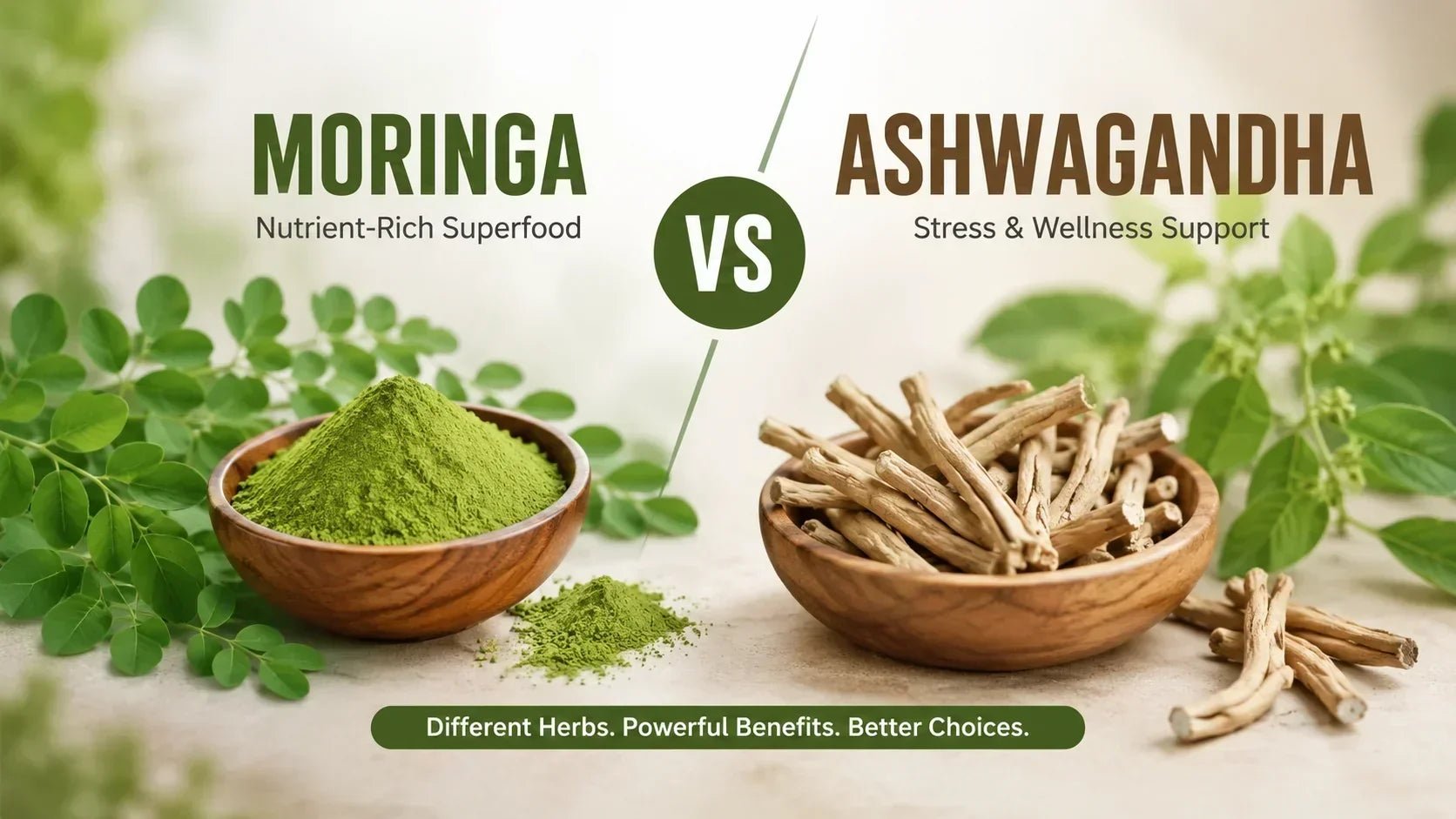
Moringa and ashwagandha serve different purposes. Moringa is mainly a nutrient-rich food plant, while ashwagandha has stronger human evidence for stress and sleep support.
Moringa and ashwagandha are both popular herbal products, but they are not substitutes and are not “better” for the same reasons.
The main difference is simple: moringa (Moringa oleifera) is mainly a nutrient-containing edible plant, while ashwagandha (Withania somnifera) is an herbal supplement studied most directly for stress and sleep.
If your main goal is adding a nutrient-rich leafy plant to your diet, moringa is the more relevant choice. If your goal is stress or sleep support, ashwagandha has stronger direct human evidence.
Neither is a proven treatment for weight loss, diabetes, thyroid disease, chronic fatigue, hormone imbalance or other medical conditions.
Moringa vs Ashwagandha: Quick Answer
| Your goal | More relevant option | What the evidence suggests |
|---|---|---|
| Nutrition | Moringa | Leaves contain nutrients and plant compounds |
| Stress | Ashwagandha | Stronger direct human evidence |
| Sleep | Ashwagandha | Some trials show modest benefit |
| General food use | Moringa | Leaves and pods can be eaten as foods |
| Energy | Depends on the cause | Neither is a stimulant or universal fatigue treatment |
| Blood sugar | Neither as treatment | Moringa has been studied, but results remain inconsistent |
| Weight loss | Neither | Neither is a proven fat-loss supplement |
| Testosterone | Ashwagandha has more research | Evidence remains limited |
| Thyroid problems | Neither as treatment | Ashwagandha requires particular caution |
| General “hormone balance” | Neither | This broad claim is not established |
| Diabetes, hypertension or high cholesterol | Neither as replacement treatment | Standard medical and nutrition care remains more evidence-based |
Bottom line: Choose according to your specific goal, not according to which herb has the longest list of online claims.
Moringa vs Ashwagandha: Key Differences
| Feature | Moringa | Ashwagandha |
|---|---|---|
| Scientific name | Moringa oleifera | Withania somnifera |
| Plant type | Tree | Evergreen shrub |
| Commonly used part | Mainly leaves; also pods and seeds | Mainly root or root-and-leaf extract |
| Best described as | Nutrient-containing food plant | Herbal/adaptogenic supplement |
| Main role in this comparison | Nutrition | Stress and sleep |
| Stress evidence | Limited | More direct human evidence |
| Sleep evidence | Limited | Some supportive human evidence |
| Nutrient contribution | Relevant | Not its main purpose |
| Blood sugar evidence | Preliminary and inconsistent | Not established as treatment |
| Weight-loss evidence | Insufficient | Insufficient |
| Testosterone evidence | Not established | Limited |
| Important safety issue | Product and plant part matter | Thyroid effects, drug interactions and rare liver injury |
| Can they be combined? | Possibly, but added benefit is unproven | Possibly, but added benefit is unproven |
The most useful way to understand the difference is this:
Moringa belongs mainly in a food-and-nutrition discussion. Ashwagandha belongs mainly in a herbal-supplement discussion.
That distinction prevents many of the misleading comparisons found online.
What Is Moringa?
Moringa is a tree known scientifically as Moringa oleifera. Its leaves and immature pods are eaten in several parts of Asia and Africa, while dried leaves are commonly sold as moringa powder.
Moringa leaves contain nutrients such as protein, fiber, vitamins and minerals along with many plant compounds.
However, the nutritional value of moringa varies with:
- the plant part used;
- growing conditions;
- whether the leaves are fresh or dried;
- processing;
- serving size;
- storage;
- the type of supplement.
Common moringa products include:
- fresh leaves;
- cooked leaves;
- dried leaf powder;
- capsules;
- teas;
- concentrated extracts;
- seed-based products.
These products should not automatically be treated as equivalent.
Eating moringa leaves as a vegetable is different from swallowing a small capsule or using a concentrated extract.
That difference becomes especially important when discussing safety, dosage and medical claims.
What Is Ashwagandha?
Ashwagandha is an evergreen shrub known scientifically as Withania somnifera. It has a long history of use in Ayurvedic and Unani medicine.
Commercial supplements commonly use:
- root powder;
- root extracts;
- root-and-leaf extracts;
- capsules;
- tablets.
Ashwagandha contains several biologically active plant compounds, including withanolides.
It is commonly described as an adaptogen, a broad term used for substances proposed to help the body respond to stress.
However, the word “adaptogen” should not be interpreted to mean that ashwagandha treats every problem linked to stress.
Current human evidence is most relevant to:
- perceived stress;
- some anxiety-related measures;
- sleep.
Evidence for many other claims is either limited or insufficient.
Moringa vs Ashwagandha: Evidence at a Glance
A useful comparison needs more than a list of claimed benefits. It should also show how strong the human evidence actually is.
| Health goal | More relevant option | Evidence level in this comparison |
|---|---|---|
| Nutritional contribution | Moringa | Strong for its role as a food; not proof of treating deficiencies |
| Stress | Ashwagandha | Promising human evidence |
| Sleep | Ashwagandha | Promising but generally modest evidence |
| Energy/fatigue | Depends | Cause-specific; neither is a general treatment |
| Blood sugar | Moringa has more direct research | Low/uncertain for treatment |
| Cholesterol | Neither | Insufficient for treatment |
| Blood pressure | Neither | Insufficient for treatment |
| Weight loss | Neither | Insufficient |
| Testosterone | Ashwagandha | Limited |
| Male fertility | Ashwagandha | Limited |
| Female fertility | Neither | Insufficient |
| Thyroid disease | Neither | Ashwagandha may create safety concerns |
| “Hormone balancing” | Neither | Not established |
| Immunity | Neither as a clinical treatment | Broad “immune boosting” claims are not established |
Evidence level refers to the specific health use—not whether the plant itself contains biologically active compounds.
A plant can contain antioxidants, vitamins or interesting phytochemicals without being proven to treat a disease.
Moringa vs Ashwagandha for Different Goals
Moringa vs Ashwagandha for Stress
Better supported: Ashwagandha
Stress is one of the clearest areas where ashwagandha has an advantage over moringa.
A 2024 systematic review and meta-analysis included nine randomized controlled trials involving 558 participants. Ashwagandha preparations were associated with improvements in perceived stress and some anxiety-related measures compared with placebo.
NIH guidance also concludes that some ashwagandha preparations may help with stress, although studies have used different extracts, doses and treatment periods.
That limitation matters.
An effect shown with one standardized extract cannot automatically be assumed for every ashwagandha powder or capsule on the market.
Moringa does not currently have comparable human evidence for psychological stress.
For moringa vs ashwagandha for stress, ashwagandha has the stronger evidence.
However, it should not replace assessment or treatment for severe anxiety, depression, trauma-related symptoms or another mental health condition.
Moringa vs Ashwagandha for Sleep
Better supported: Ashwagandha
Ashwagandha also has more relevant human research for sleep.
A systematic review and meta-analysis of five randomized controlled trials involving 400 adults found a small but significant improvement in overall sleep.
Benefits appeared more noticeable in some participants with insomnia and in studies using longer treatment periods.
NIH similarly notes that small studies suggest ashwagandha may help some people:
- fall asleep faster;
- sleep for longer;
- wake less often.
The overall effect, however, should not be exaggerated.
Moringa does not have comparable clinical evidence as a sleep supplement.
For moringa vs ashwagandha for sleep, ashwagandha is the more evidence-based choice.
Persistent insomnia, loud snoring, pauses in breathing during sleep or major daytime sleepiness need proper assessment rather than supplement use alone.
Moringa vs Ashwagandha for Nutrition
More relevant: Moringa
This is where moringa has the clearest advantage.
Moringa leaves are foods. They provide nutrients and plant compounds, while ashwagandha is not normally taken to supply meaningful amounts of protein, vitamins or minerals.
However, three things should not be treated as nutritionally identical:
Serving size matters.
A capsule containing a small amount of powdered leaf may provide far less actual food material than a normal serving of cooked leaves.
Moringa also should not automatically be described as a replacement for:
- vegetables;
- a balanced diet;
- iron treatment;
- vitamin D treatment;
- vitamin B12 treatment;
- other deficiency-specific therapy.
If your main goal is food-based nutritional support, moringa is the more relevant of the two.

Prefer Moringa for Nutrition?
If moringa is the option that fits your goal, MNT Organic Moringa Leaf Powder is made from 100% Moringa oleifera leaves with no additives, preservatives, artificial colors or fillers.
View Moringa PowderMoringa vs Ashwagandha for Energy and Fatigue
Neither is a universal energy supplement.
The word “energy” is vague.
Someone saying “I need more energy” may actually have:
- inadequate sleep;
- low calorie intake;
- iron deficiency;
- vitamin B12 deficiency;
- thyroid disease;
- stress;
- depression;
- infection;
- medication side effects;
- poor hydration;
- another medical problem.
Neither moringa nor ashwagandha works like caffeine.
Moringa and energy
Moringa can contribute nutrients when eaten as food or used in meaningful amounts.
That does not mean moringa automatically corrects anemia, vitamin deficiency or unexplained fatigue.
If fatigue is caused by a specific deficiency, the amount and form of the missing nutrient matter.
Ashwagandha and fatigue
Some ashwagandha trials have reported improvements in fatigue or wellbeing, particularly in people experiencing stress.
This does not establish ashwagandha as a general treatment for chronic fatigue.
For nutritional contribution, moringa is more relevant.
If fatigue seems related to stress or poor sleep, ashwagandha has more related research, but persistent fatigue deserves investigation of the underlying cause.
Moringa vs Ashwagandha for Blood Sugar
Neither should replace diabetes treatment.
Moringa is frequently promoted for blood sugar control and has received more direct research attention in this area.
However, human results remain inconsistent.
A 2025 meta-analysis of randomized controlled trials examined moringa supplementation and cardiometabolic outcomes including blood glucose, blood pressure, blood lipids and body measurements.
Nine randomized controlled trials were included. Overall, moringa did not produce consistent benefits across most outcomes, and the certainty of evidence was rated very low.
That means claims such as “moringa controls diabetes” go beyond the current evidence.
Ashwagandha is also not an established diabetes treatment.
For moringa vs ashwagandha for blood sugar, moringa has more direct research interest, but neither has evidence strong enough to replace standard diabetes care.
People taking glucose-lowering medicines should also be cautious about adding herbal supplements specifically to lower glucose.
Moringa vs Ashwagandha for Cholesterol
Neither is a proven cholesterol treatment.
Moringa has been studied for:
- total cholesterol;
- LDL cholesterol;
- HDL cholesterol;
- triglycerides.
However, recent randomized-trial evidence has not shown consistent enough benefits to recommend moringa as a cholesterol-lowering treatment.
Ashwagandha is not an established treatment for high cholesterol either.
If you have high cholesterol, neither moringa nor ashwagandha should replace dietary management, physical activity or prescribed treatment when medically indicated.
Moringa vs Ashwagandha for Blood Pressure
Neither is a proven replacement for blood-pressure treatment.
Moringa has been investigated for blood-pressure effects.
The 2025 meta-analysis reported a modest reduction in diastolic blood pressure in the pooled analysis, but this result was not robust in sensitivity testing and overall evidence certainty remained very low.
Ashwagandha is not an established hypertension treatment and may interact with medicines used to lower blood pressure.
Neither supplement should be used as a substitute for evidence-based hypertension care.
Moringa vs Ashwagandha for Weight Loss
Winner: Neither
Both herbs are marketed aggressively for weight loss, but marketing claims are much stronger than the human evidence.
Does moringa burn fat?
There is not enough high-quality clinical evidence to show that moringa causes meaningful, reliable weight loss.
Claims that moringa “boosts metabolism,” “melts belly fat” or automatically reduces cravings should therefore be treated cautiously.
Does ashwagandha cause weight loss?
Ashwagandha is sometimes promoted through a simplified argument:
Human weight regulation is far more complex.
Stress can influence appetite, eating behavior, sleep and activity, but changing one stress marker does not automatically produce meaningful fat loss.
Ashwagandha should not be treated as a proven fat burner.
For moringa vs ashwagandha for weight loss, neither should be your main strategy.
More reliable priorities include:
- appropriate calorie intake;
- adequate protein;
- fiber-rich foods;
- physical activity;
- resistance training;
- sleep;
- long-term adherence;
- treatment of underlying medical conditions when relevant.
Moringa vs Ashwagandha for Testosterone
Ashwagandha has more relevant evidence, but that evidence is limited.
Some clinical research suggests ashwagandha may influence testosterone levels or sperm-related measures in certain men.
NCCIH describes the evidence as limited and notes that some studies lasting approximately two to four months have reported increases in testosterone levels and improvements in sperm quality.
This is very different from saying:
It is not.
There is not comparable strong human evidence showing that moringa reliably raises testosterone.
For moringa vs ashwagandha for testosterone, ashwagandha has more evidence, but neither should replace assessment of suspected testosterone deficiency.
Moringa vs Ashwagandha for Men
Neither herb is automatically a “men's supplement.”
Ashwagandha may be more relevant when a man's main interest is:
- stress;
- sleep;
- limited research around testosterone;
- limited research around male fertility.
Moringa is more relevant as a nutrient-containing plant food.
Neither should be assumed to automatically:
- increase muscle mass;
- increase testosterone;
- improve sexual performance;
- cure infertility;
- cause weight loss.
Men with symptoms such as low libido, infertility, erectile dysfunction or possible low testosterone should identify the underlying cause rather than relying only on supplements.
People with hormone-sensitive prostate cancer should avoid ashwagandha according to NIH guidance.
Moringa vs Ashwagandha for Women
There is no single “best herb for women.”
The answer depends on the goal.
For stress
Ashwagandha has more relevant human evidence.
For sleep
Ashwagandha has more evidence.
For food-based nutrition
Moringa is more relevant.
For PCOS
Neither should be presented as a proven PCOS treatment.
PCOS management may involve nutrition, physical activity, weight management when appropriate and medical treatment based on symptoms and metabolic or reproductive goals.
For female fertility
Evidence is not strong enough to recommend either herb as routine infertility treatment.
During pregnancy and breastfeeding
Ashwagandha should be avoided during pregnancy and is not recommended while breastfeeding according to NCCIH.
Moringa requires more nuance because leaves are traditionally eaten as foods in some cultures, while concentrated supplements may use different plant parts and doses.
Food use and concentrated herbal supplementation should not automatically be treated as equivalent.
Anyone who is pregnant, breastfeeding or trying to conceive should discuss the exact supplement product with an appropriate healthcare professional.
Moringa vs Ashwagandha for Thyroid Health
Neither is an established thyroid treatment.
This comparison is particularly important because of ashwagandha's potential effects on thyroid function.
NIH notes that ashwagandha may affect the thyroid and may interact with thyroid hormone medicines.
People with:
- hypothyroidism;
- hyperthyroidism;
- Hashimoto's disease;
- Graves' disease;
- thyroid medication use
should therefore not start ashwagandha casually.
Claims that ashwagandha simply “boosts the thyroid” are misleading because an increase in thyroid activity is not desirable in every thyroid condition.
Moringa also does not have sufficient human evidence to treat thyroid disease.
For thyroid disease, neither supplement should replace thyroid testing, medication or medical care.
Moringa vs Ashwagandha for Hormone Balance
Neither is proven to broadly “balance hormones.”
“Hormone balance” is an imprecise marketing phrase.
The human endocrine system includes many hormones, including:
- insulin;
- thyroid hormones;
- cortisol;
- estrogen;
- progesterone;
- testosterone;
- prolactin;
- growth hormone.
A supplement affecting one hormone or marker in one population does not mean it “balances hormones” throughout the body.
Ashwagandha has some research involving cortisol and limited research involving testosterone.
That does not establish it as a universal hormone-balancing supplement.
Moringa also lacks high-quality evidence for broad hormonal balancing.
Choose neither herb simply because a product promises to “balance hormones.”
Identify the specific symptoms or hormone problem first.
Moringa vs Ashwagandha for Immunity
Both plants are sometimes marketed as “immune boosters,” but this phrase can be misleading.
Moringa contains nutrients and phytochemicals that can form part of a nutritious diet.
Ashwagandha contains biologically active compounds and has shown effects on biological pathways in laboratory and animal research.
However:
antioxidant activity or changes in immune markers do not automatically prove that a supplement prevents infections or meaningfully improves immune function in humans.
Ashwagandha may also interact with immunosuppressant medicines and is not recommended for some people with autoimmune disorders.
Neither should be presented as a proven way to prevent infections or “supercharge” the immune system.
Which Has More Scientific Evidence: Moringa or Ashwagandha?
The answer depends on what outcome you are asking about.
Ashwagandha
Better supported
Stress: promising human evidence
Sleep: promising human evidence, although benefits are generally modest
Limited evidence
- testosterone;
- male fertility.
Not established for routine treatment
- diabetes;
- major weight loss;
- female infertility;
- thyroid disease;
- broad hormone balancing;
- broad immune enhancement.
Many ashwagandha studies are relatively small and use different extracts and doses. This makes it difficult to assume that every commercial product will have the same effects.
Moringa
Clearly relevant
Food and nutrition: moringa leaves are nutrient-containing edible plant foods.
Preliminary or inconsistent treatment evidence
- blood glucose;
- blood pressure;
- cholesterol;
- other cardiometabolic outcomes.
Insufficient evidence for
- meaningful weight loss;
- stress treatment;
- insomnia;
- testosterone enhancement;
- broad “detox” effects;
- general hormone balancing;
- treatment or prevention of cancer.
The key distinction is important:
Moringa can be a nutritious food without being a proven medicine.
How Moringa and Ashwagandha May Work
Understanding possible biological mechanisms is useful, but mechanisms should not be confused with proven clinical outcomes.
How Moringa May Work
Moringa leaves contain nutrients and many plant compounds, including polyphenols and flavonoids.
Researchers have investigated these substances for possible:
- antioxidant effects;
- metabolic effects;
- anti-inflammatory effects;
- effects on glucose-related pathways.
Much of the interesting mechanistic research comes from:
- laboratory studies;
- animal studies;
- biochemical research.
These findings can help researchers decide what to test in humans, but they do not automatically prove a meaningful clinical benefit in people.
How Ashwagandha May Work
Ashwagandha contains compounds known as withanolides along with other phytochemicals.
Researchers have proposed that ashwagandha may influence pathways involved in the body's stress response, including signaling associated with the hypothalamic-pituitary-adrenal, or HPA, axis.
Some human studies have also reported changes in perceived stress and cortisol.
The mechanisms remain an active area of research, and evidence from one standardized extract cannot automatically be applied to every ashwagandha product.
Moringa Powder vs Ashwagandha Powder vs Extracts
The form of the product matters.
Common Moringa Forms
- fresh leaves;
- dried leaves;
- leaf powder;
- tea;
- capsules;
- concentrated extracts;
- seed products.
Common Ashwagandha Forms
- root powder;
- root extract;
- root-and-leaf extract;
- capsules;
- tablets.
Products can differ in:
- plant part;
- dose;
- extraction method;
- concentration;
- standardization;
- active compounds;
- purity;
- contaminants.
For example, a study using a standardized ashwagandha extract does not prove that an equal milligram amount of plain root powder will have the same effect.
The same principle applies to moringa.
A few grams of leaf powder cannot automatically be compared with an extract containing concentrated plant compounds.
Moringa vs Ashwagandha Dosage
There is no single universal evidence-based dose for moringa or ashwagandha that is appropriate for every product, purpose and person.
Ashwagandha Dosage
Clinical trials have used different preparations and doses.
Some NIH-reviewed studies of stress and sleep have reported effects with ashwagandha extracts around the 500–600 mg-per-day range, and some sleep research has found greater effects with approximately 600 mg per day for at least several weeks.
This does not mean:
Different extracts can contain very different concentrations of withanolides and other compounds.
Moringa Dosage
Moringa is even harder to assign a universal dose because research has used different:
- foods;
- powders;
- capsules;
- extracts;
- quantities.
The amount appropriate for one product cannot automatically be transferred to another.
The safest principle
Dose depends on:
- the exact product;
- plant part;
- concentration;
- purpose;
- medications;
- health conditions;
- individual tolerance.
More is not automatically better.
Moringa vs Ashwagandha: Side Effects
Natural products can still cause unwanted effects.
Possible Moringa Side Effects
Moringa leaves have a history of food use, but that does not mean every moringa supplement has identical safety.
Some people may experience digestive discomfort, especially with larger amounts.
Safety also varies according to the plant part and product.
A food serving of moringa leaves should not automatically be considered equivalent to:
- a concentrated extract;
- root product;
- bark product;
- seed extract.
People using medication for blood glucose or blood pressure should be particularly cautious about using concentrated supplements with the intention of affecting the same outcome.
Possible Ashwagandha Side Effects
Short-term side effects reported with ashwagandha can include:
- stomach upset;
- nausea;
- loose stools;
- diarrhea;
- vomiting;
- drowsiness.
Short-term use appears reasonably tolerated in many studies, but long-term safety is less certain.
Can Ashwagandha Affect the Liver?
Yes, rarely.
Cases of clinically apparent liver injury have been linked to ashwagandha-containing supplements.
The NIH LiverTox database classifies ashwagandha as a likely cause of clinically apparent liver injury.
Most reported cases have improved after the supplement was stopped, but serious cases have occurred, particularly among people with pre-existing chronic liver disease.
Possible warning signs of liver injury include:
- yellow skin or eyes;
- dark urine;
- severe itching;
- persistent nausea;
- unusual fatigue;
- abdominal discomfort.
These symptoms require medical assessment.
People with cirrhosis or advanced chronic liver disease should avoid casual use of ashwagandha.
Moringa and Ashwagandha Drug Interactions
Medication interactions are one of the most important parts of this comparison.
Ashwagandha may interact with medicines including those used for:
- diabetes;
- high blood pressure;
- thyroid disease;
- seizures;
- sedation or sleep;
- immune suppression.
Moringa also deserves caution when someone uses a supplement specifically to affect the same outcome being treated with medication, such as:
- blood glucose;
- blood pressure.
Do not reduce, stop or replace prescribed medicine because you have started an herbal supplement.
Who Should Be Extra Careful With Ashwagandha?
According to NCCIH, ashwagandha should be avoided during pregnancy and should not be used while breastfeeding.
It is also not recommended for people:
- preparing for surgery;
- with certain autoimmune disorders;
- with thyroid disorders.
Extra caution is needed when using:
- thyroid medicines;
- sedatives;
- anticonvulsants;
- diabetes medicines;
- blood-pressure medicines;
- immunosuppressants.
People with significant liver disease should also discuss ashwagandha with an appropriate healthcare professional before use.
Can You Take Moringa and Ashwagandha Together?
Possibly, but there is no strong clinical evidence that combining them provides a special additional benefit.
The logic often used in supplement marketing is:
That sounds reasonable, but a plausible theory is not the same as evidence from clinical trials.
The combination has not been established as a standard treatment for:
- stress;
- insomnia;
- fatigue;
- weight loss;
- diabetes;
- hormone problems.
Using two supplements also means considering the safety profile of both.
If a side effect develops after starting several products at once, it can be harder to identify which product caused it.
Can You Take Moringa and Ashwagandha at the Same Time?
There is no established medical rule saying moringa and ashwagandha must be taken together or must be separated by a specific number of hours.
You may see routines online suggesting:
- moringa in the morning;
- ashwagandha at night.
This is not a scientifically required schedule.
Timing may depend on:
- the exact formulation;
- stomach tolerance;
- whether ashwagandha causes drowsiness;
- medication timing;
- product instructions;
- professional advice.
There is no good evidence that morning moringa plus nighttime ashwagandha creates a special synergistic effect.
How Long Does Ashwagandha Take to Work?
There is no guaranteed timeline.
Many stress and sleep studies have lasted several weeks, often around six to eight weeks or longer.
That means clinical evidence should not be interpreted as proof that someone will feel an effect after a specific number of days.
Response may also depend on:
- the extract used;
- dose;
- reason for taking it;
- baseline symptoms;
- individual response.
If symptoms such as anxiety, insomnia or fatigue are persistent, the more important step may be identifying their underlying cause.
Can You Take Moringa Every Day?
Moringa leaves are eaten regularly as foods in several cultures.
However, daily food use and daily concentrated supplement use are different questions.
There is no single daily dose that applies to every:
- moringa powder;
- capsule;
- extract;
- seed product.
Follow the exact product guidance and consider medications and medical conditions.
Can You Take Ashwagandha Every Day?
Short-term daily use has been studied.
NIH guidance notes that ashwagandha appears reasonably tolerated for up to about three months in available studies, but evidence about longer-term safety remains limited.
This does not mean everyone can safely take it for three months.
Pregnancy, breastfeeding, thyroid conditions, autoimmune disease, liver disease, medication use and individual side effects can change the safety decision.
Moringa vs Ashwagandha: Which Should You Choose?
Instead of asking:
ask:
| Your main goal | More relevant choice | Important limitation |
|---|---|---|
| Add a nutrient-containing plant food | Moringa | Does not replace a balanced diet |
| Stress support | Ashwagandha | Evidence is promising, not universal |
| Sleep support | Ashwagandha | Benefits appear modest |
| Treat a nutrient deficiency | Neither automatically | Deficiency-specific treatment may be needed |
| Increase everyday energy | Depends on the cause | Persistent fatigue needs assessment |
| Lower blood sugar | Neither as treatment | Do not replace diabetes care |
| Lower cholesterol | Neither | Evidence is insufficient |
| Lower blood pressure | Neither | Do not replace treatment |
| Lose body fat | Neither | Neither is a proven fat burner |
| Raise testosterone | Ashwagandha has more research | Evidence remains limited |
| Treat thyroid disease | Neither | Ashwagandha may be unsuitable |
| “Balance hormones” | Neither | Claim is too broad |
| Improve immunity | Neither as a proven treatment | “Immune boosting” claims are often overstated |
Moringa vs Ashwagandha: Which Is Better Overall?
There is no overall winner because moringa and ashwagandha have different roles.
Moringa makes more sense for:
- using a nutrient-containing leafy plant as food;
- adding moringa leaves or powder to the diet;
- people whose interest is mainly nutritional rather than stress-related.
Ashwagandha has more relevant evidence for:
- perceived stress;
- sleep.
There is also limited research around testosterone and male fertility.
Neither has strong enough evidence to be recommended specifically for:
- major weight loss;
- curing diabetes;
- treating hypertension;
- treating thyroid disease;
- broad hormone balancing;
- curing chronic fatigue;
- “detoxing” the body;
- preventing or treating cancer;
- replacing prescribed medicine.
The most useful supplement is not the one with the longest list of claimed benefits.
It is the one with reasonable evidence for your specific goal, used in a form and situation where the potential benefit is worth the risk.
Frequently Asked Questions
Is moringa the same as ashwagandha?
No. They come from different plants and have different uses. Moringa (Moringa oleifera) is mainly a nutrient-containing edible plant, while ashwagandha (Withania somnifera) is mainly used as an herbal supplement.
Is moringa better than ashwagandha?
Not overall. Moringa is more relevant for nutrition, while ashwagandha has stronger human evidence for stress and sleep. Which is more useful depends on your goal.
Which is better for stress: moringa or ashwagandha?
Ashwagandha. It has substantially more direct human research for perceived stress than moringa.
Which is better for sleep?
Ashwagandha has better evidence. Human trials suggest modest improvements in some adults, although persistent insomnia should be medically assessed.
Which is better for nutrition?
Moringa. Its leaves are edible and contain nutrients. Ashwagandha is not mainly used as a source of vitamins, minerals or protein.
Which is better for energy?
It depends on why you feel tired. Moringa can contribute nutrients, while ashwagandha has some research relevant to stress and sleep. Neither is a stimulant or a proven treatment for unexplained fatigue.
Which is better for weight loss?
Neither. Neither moringa nor ashwagandha has strong enough evidence to be considered a reliable primary weight-loss treatment.
Does moringa burn belly fat?
There is not enough high-quality human evidence to show that moringa specifically burns belly fat or produces clinically meaningful fat loss.
Does ashwagandha reduce belly fat by lowering cortisol?
That claim is oversimplified. Stress and cortisol can influence appetite, sleep and weight regulation, but lowering a stress marker does not automatically cause abdominal fat loss.
Which is better for blood sugar?
Moringa has been studied more directly for glucose control, but randomized-trial findings are inconsistent and evidence certainty remains very low. Neither supplement should replace diabetes treatment.
Which is better for testosterone?
Ashwagandha has more research, but the evidence is limited. It should not be considered a replacement for assessment or treatment of confirmed testosterone deficiency.
Is ashwagandha good for hormone balance?
It should not be described as a general hormone-balancing supplement. It has been studied for specific outcomes such as stress-related cortisol and, to a more limited degree, testosterone.
Is moringa good for hormone balance?
There is insufficient high-quality human evidence to say that moringa broadly “balances hormones.”
Can I take moringa and ashwagandha together?
Possibly, but there is not good clinical evidence showing that taking them together creates extra or synergistic benefits. Medication interactions and individual health conditions still need to be considered.
Can I take moringa and ashwagandha at the same time?
There is no established rule requiring them to be taken together or separated. Timing should depend on the exact products, tolerance, medications and purpose.
Should I take moringa in the morning and ashwagandha at night?
You may see this routine online, but it is not scientifically required. Some people may prefer that timing because ashwagandha can cause drowsiness, but there is no proven special benefit from the morning/night combination.
Can women take moringa and ashwagandha?
It depends on individual circumstances. Ashwagandha should be avoided during pregnancy and is not recommended during breastfeeding. People with thyroid or autoimmune disorders also require particular caution.
Can men take moringa and ashwagandha together?
Some may use both, but there is no proven advantage to the combination. Men considering supplements for fertility, testosterone or sexual symptoms should first identify whether an underlying medical issue is present.
Is ashwagandha an adaptogen?
Ashwagandha is commonly described as an adaptogenic herb because of its traditional use and research related to stress responses. The term does not mean it is proven to treat every stress-related health problem.
Is moringa an adaptogen?
Moringa is better described as a nutrient-containing edible plant. Broad claims that it acts as a clinically proven adaptogen go beyond current human evidence.
Does moringa contain iron?
Yes, moringa leaves contain iron along with other nutrients. The amount varies by product and serving size. Moringa should not automatically replace prescribed iron treatment for diagnosed iron-deficiency anemia.
Can ashwagandha affect the thyroid?
Yes. Ashwagandha may affect thyroid function and may interact with thyroid medicines. People with thyroid disorders should seek professional advice before using it.
Can ashwagandha affect the liver?
Rare cases of clinically apparent liver injury have been associated with ashwagandha. People with advanced chronic liver disease should be particularly cautious.
How long does ashwagandha take to work?
There is no guaranteed timeline. Many clinical studies evaluating stress or sleep lasted around six to eight weeks or longer.
Can you take moringa every day?
Moringa leaves are regularly eaten as foods in some cultures, but concentrated supplements are different. There is no single daily dose appropriate for every product or person.
Can you take ashwagandha every day?
Daily use has been studied mainly over the short term. NIH notes that it may be tolerated for up to around three months in many people, but long-term safety remains uncertain.
Which has better scientific evidence: moringa or ashwagandha?
For a specific therapeutic purpose, ashwagandha currently has clearer human evidence for stress and sleep. Moringa's clearest role is as a nutrient-containing edible plant, while evidence for many proposed medical benefits remains uncertain.
Final Takeaway
When comparing moringa vs ashwagandha, start with one question:
If the goal is adding a nutrient-containing leafy plant to your diet, moringa is the more relevant choice.
If the goal is stress or sleep support, ashwagandha has stronger direct human evidence.
For weight loss, diabetes, high cholesterol, hypertension, thyroid disease, hormone imbalance or chronic fatigue, neither should be viewed as a replacement for evidence-based nutrition and medical care.
And if you are considering taking both together, remember that different uses do not automatically mean proven synergy.
Finally, “natural” does not mean risk-free. The exact plant part, extract, dose, product quality, medications and your health conditions all matter.
We rely on peer-reviewed studies and reputable medical journals.