
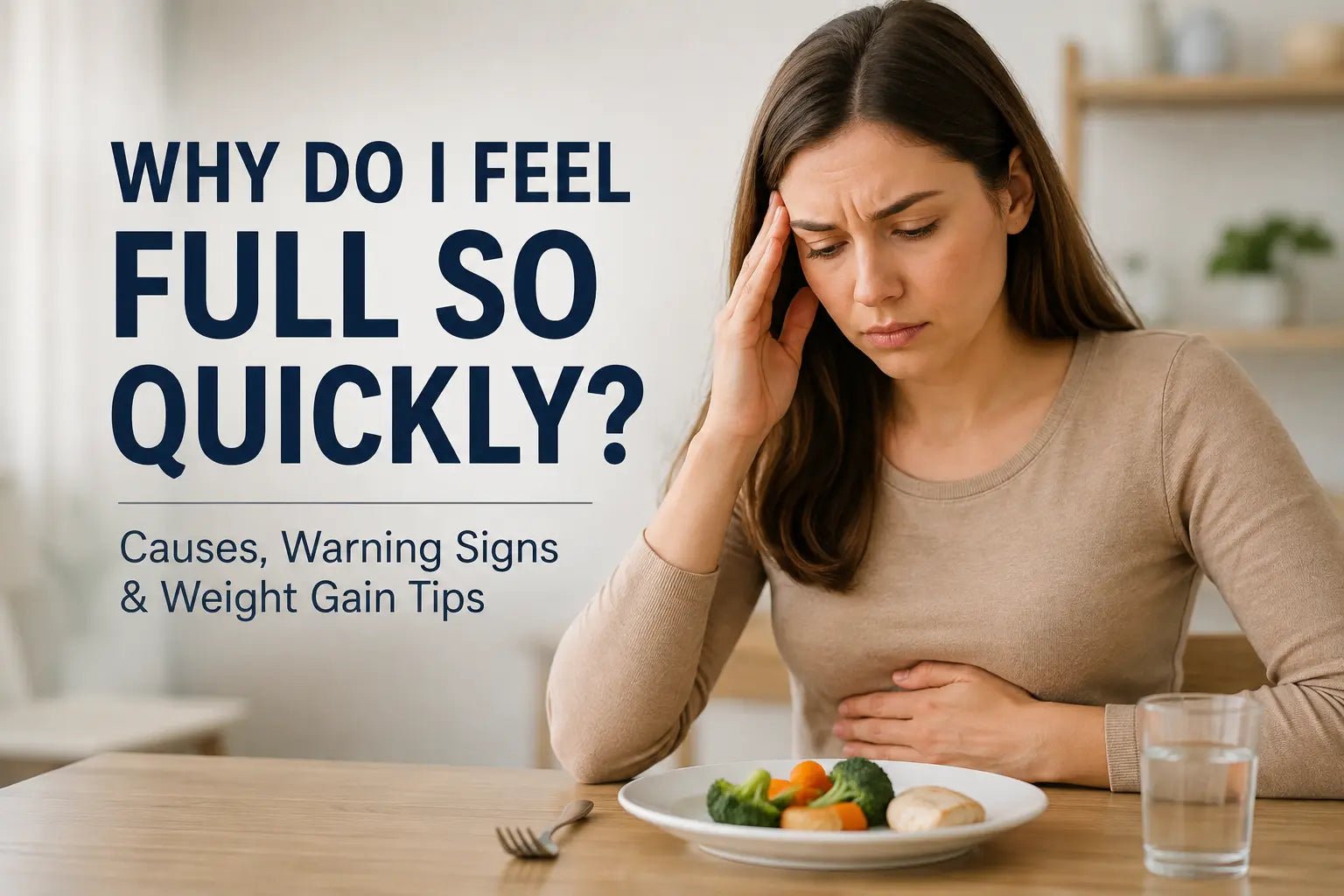
Why Do I Feel Full So Quickly? Causes, Warning Signs & Weight Gain Tips
Feeling full after only a few bites is called early satiety. Learn the common causes, warning signs, and practical ways to gain weight safely when you get full quickly.
Feeling full after eating only a small amount of food is called early satiety. You may start a meal hungry but feel unable to continue after only a few bites.
Early satiety can happen with indigestion or functional dyspepsia, delayed stomach emptying, gastritis, stomach ulcers, certain medicines, previous digestive surgery, and other medical problems. It is a symptom rather than a diagnosis. (niddk.nih.gov)
If you are trying to gain weight, the answer is usually not to force yourself through very large meals. A more practical approach is to eat smaller meals more often and get more calories and protein from the amount of food you can comfortably tolerate. (medlineplus.gov)
Persistent early fullness should be medically assessed if you are losing weight without trying, regularly cannot eat enough, have repeated vomiting, significant abdominal pain, bleeding, or other concerning symptoms.
At a Glance
| Question | Short answer |
|---|---|
| What is feeling full too quickly called? | Early satiety |
| What does it feel like? | Becoming full after a few bites or before finishing your usual meal |
| Is it the same as poor appetite? | No. You can be hungry and still become physically full very quickly |
| What can cause it? | Dyspepsia, delayed stomach emptying, gastritis, ulcers, medicines and other medical problems |
| Can it cause weight loss? | Yes, if it repeatedly prevents you from eating enough |
| How can I gain weight? | Smaller frequent meals, more nutrition per bite, protein-rich foods and nourishing drinks |
| When should I see a doctor? | If it persists, causes weight loss, or comes with vomiting, pain, bleeding or major difficulty eating |
What Does Feeling Full Quickly Mean?
Early satiety means becoming full sooner than expected during a meal.
For example, you may feel hungry before lunch, take several bites, and suddenly feel as if you have eaten a full meal.
This is different from normal fullness after eating enough food.
It is also different from post-meal fullness, where you may finish eating but stay uncomfortably full for a long time. Both symptoms can occur together in digestive disorders such as dyspepsia and gastroparesis. (niddk.nih.gov)
One unusually small meal does not necessarily mean something is wrong. The pattern matters more when it keeps happening or starts affecting your weight and nutrition.
Is It a Small Appetite or Early Satiety?
| Poor or small appetite | Early satiety |
|---|---|
| You may not want to start eating | You may be hungry before the meal |
| Food may not seem appealing | Food may initially seem appealing |
| You may skip meals | You start eating but stop early |
| The main problem is low desire to eat | The main problem is becoming physically full |
| You may eat normally when appetite improves | You may still struggle to finish food despite wanting to eat |
Some people experience both.
This difference matters when trying to gain weight. A person with a naturally small appetite may mainly benefit from regular meals and calorie-dense foods. Someone who repeatedly feels physically full after a few bites may also need the reason for that fullness investigated.
Why Do I Get Full After Only a Few Bites?
To eat a normal meal comfortably, several things need to happen inside your digestive system.
Your stomach must:
- relax and make space for incoming food,
- mix food with digestive juices,
- gradually move the meal into the small intestine, and
- communicate fullness signals with your brain.
Problems with one or more of these processes may make you feel full earlier than expected.
Your stomach needs to relax as you eat
Your stomach is not a rigid container.
When a meal enters, the upper part normally relaxes so the stomach can hold more food without a large increase in pressure. This process is called gastric accommodation.
Research in people with functional dyspepsia has linked impaired stomach accommodation with early satiety. (pubmed.ncbi.nlm.nih.gov)
In simple terms, your stomach may produce a strong “I am full” signal before you have eaten enough.
Food needs to leave the stomach normally
After eating, food gradually passes from your stomach into your small intestine.
When stomach emptying becomes abnormally slow, food stays in the stomach longer. This may lead to:
- feeling full soon after starting a meal,
- staying full for a long time,
- nausea,
- vomiting,
- bloating,
- belching,
- upper abdominal discomfort, and
- poor appetite. (niddk.nih.gov)
One condition that causes delayed stomach emptying is gastroparesis.
However, feeling full quickly does not automatically mean you have gastroparesis. Doctors use your symptoms together with tests that objectively measure gastric emptying before confirming the diagnosis. (niddk.nih.gov)
The stomach and brain also affect each other
The digestive tract and nervous system constantly communicate.
Functional dyspepsia is considered a disorder of gut-brain interaction. Changes in stomach movement, accommodation and sensitivity can all contribute to symptoms. (pubmed.ncbi.nlm.nih.gov)
This helps explain why normal amounts of food or normal stomach stretching may feel much more uncomfortable to one person than another.
What Causes Early Satiety?
There is no single cause of feeling full quickly.
The symptoms that occur with it, your medicines, medical history and weight changes can help a healthcare professional decide what should be investigated.
1. Functional Dyspepsia
Functional dyspepsia is an important cause of persistent upper-digestive symptoms when another structural problem does not explain them.
Symptoms may include:
- feeling full too quickly,
- uncomfortable fullness after eating,
- upper abdominal pain,
- burning,
- bloating,
- nausea, and
- belching. (niddk.nih.gov)
Problems with stomach accommodation, sensitivity and movement may contribute.
So if you often think, “I am hungry but get full after a few bites,” functional dyspepsia is one condition a healthcare professional may consider.
It cannot be diagnosed from that symptom alone.
2. Gastroparesis
Gastroparesis causes delayed movement of food from the stomach when there is no mechanical blockage stopping food from leaving.
Symptoms may include:
- early satiety,
- prolonged fullness,
- nausea,
- vomiting,
- bloating,
- belching,
- upper abdominal pain,
- heartburn, and
- poor appetite. (niddk.nih.gov)
Diabetes is one recognized cause of gastroparesis. Previous surgery that damages nerves controlling the stomach can also contribute. (niddk.nih.gov)
Gastroparesis cannot be confirmed just because you feel full quickly. Testing of gastric emptying is normally required when the condition is suspected. (niddk.nih.gov)
3. Gastritis or Gastropathy
Gastritis involves inflammation of the stomach lining. Gastropathy refers to damage to the stomach lining with little or no inflammation.
Many people with these conditions have no symptoms. When symptoms do occur, they can include:
- upper abdominal pain or discomfort,
- nausea,
- vomiting,
- feeling full too soon,
- excessive fullness after meals,
- reduced appetite, and
- weight loss. (niddk.nih.gov)
Helicobacter pylori infection is one cause of gastritis. Some medicines, including NSAIDs, can also damage the stomach lining. (niddk.nih.gov)
4. Peptic Ulcers
A peptic ulcer is a sore in the lining of the stomach or duodenum.
Symptoms can include:
- upper abdominal pain or discomfort,
- early fullness,
- uncomfortable fullness after meals,
- nausea,
- vomiting,
- bloating, and
- belching. (niddk.nih.gov)
The two most common causes are H. pylori infection and nonsteroidal anti-inflammatory drugs (NSAIDs) such as ibuprofen, naproxen and aspirin. (niddk.nih.gov)
Persistent symptoms should therefore not automatically be dismissed as “gas” or simply a small appetite.
5. Medicines That Affect Stomach Emptying
Medicines can sometimes contribute to early fullness by slowing stomach emptying or causing digestive side effects.
Examples that may affect stomach movement include some:
- opioid pain medicines,
- antidepressants,
- anticholinergic medicines,
- medicines for overactive bladder, and
- other medications that affect gastrointestinal motility.
If your symptoms began after starting a medicine or changing the dose, tell the healthcare professional who prescribed it.
Do not stop prescription treatment on your own.
6. GLP-1 and GIP/GLP-1 Medicines
This is especially relevant for people taking modern medicines for diabetes or weight management.
Current FDA prescribing information states that semaglutide can delay gastric emptying. Tirzepatide also delays gastric emptying, with the effect described as greatest after the first dose and decreasing over time. (accessdata.fda.gov)
This does not mean everyone taking these medicines will develop severe early satiety.
But if you have trouble eating enough, persistent nausea, vomiting or marked fullness after starting or increasing one of these medicines, discuss your symptoms with your prescriber.
Do not stop treatment without medical advice.
7. Previous Stomach or Digestive Surgery
Operations involving the stomach, esophagus or nearby digestive organs can change anatomy or affect nerves involved in stomach movement.
If your early fullness began after gastrointestinal surgery, tell your healthcare team.
8. Other Medical Problems
Early satiety can also occur in other illnesses affecting the stomach or abdomen.
The symptom by itself does not tell you which condition you have.
What matters most is whether the fullness is:
- new,
- persistent,
- getting worse,
- limiting your food intake, or
- accompanied by other warning signs.
What Do Other Symptoms Along With Early Fullness Mean?
Associated symptoms can give your healthcare professional useful clues, although they cannot diagnose the cause by themselves.
| You feel full quickly plus… | What may need consideration | Why it matters |
|---|---|---|
| Nausea | Dyspepsia, gastritis or delayed gastric emptying | Note whether it occurs during or after meals |
| Vomiting | Delayed emptying or another digestive problem | Repeated vomiting needs assessment |
| Bloating | Dyspepsia or altered digestive movement | Timing and meal triggers can help |
| Upper abdominal pain | Dyspepsia, gastritis, ulcer or another cause | Persistent pain should be assessed |
| Poor appetite | Digestive or other medical conditions | May lower intake even further |
| Weight loss | Inadequate intake or underlying illness | Unexplained weight loss should not be ignored |
| Diabetes | Gastroparesis may need consideration | Diabetes can affect stomach movement |
| New medication | Medication effect | Review the timing with your prescriber |
| Black or tarry stool | Possible gastrointestinal bleeding | Seek prompt medical attention |
| Blood in vomit | Possible gastrointestinal bleeding | Seek prompt medical attention |
Peptic ulcer complications, for example, can include black or tarry stool, blood in vomit, severe abdominal pain, dizziness or fainting. (niddk.nih.gov)
When Should I Worry About Feeling Full Quickly?
Feeling unusually full during one or two meals is different from a lasting change in how much food you can eat.
Arrange a medical assessment if:
- you regularly become full after only a few bites,
- the problem keeps returning,
- you are eating much less than normal,
- you are losing weight without trying,
- you cannot maintain or gain weight,
- nausea or vomiting keeps happening,
- you have ongoing abdominal discomfort,
- you are becoming weak because you cannot eat enough,
- symptoms started after surgery, or
- symptoms began after a new medicine or dose increase.
Seek prompt or urgent medical care if you develop:
- blood in your vomit,
- vomit that looks like coffee grounds,
- black or tarry stools,
- severe or sudden abdominal pain,
- persistent or severe vomiting,
- dizziness or fainting,
- marked weakness,
- difficulty breathing, or
- signs of significant dehydration.
These symptoms may need urgent assessment. (niddk.nih.gov)
Can Feeling Full Quickly Cause Weight Loss?
Yes.
If early satiety repeatedly stops you from eating enough food, your calorie and nutrient intake can fall below what your body needs.
You get full quickly → portions become smaller → calorie and protein intake falls → weight begins to drop.
Gastroparesis, for example, can make it difficult to obtain enough calories, nutrients and fluids and may contribute to malnutrition or dehydration. (niddk.nih.gov)
The solution is not always to force yourself through a giant meal.
A better principle is:
Find out why you are getting full and make the food you can tolerate work harder nutritionally.
How to Gain Weight When You Get Full Quickly
If large meals are difficult, focus on increasing your total nutrition across the day without greatly increasing the amount you eat at one time.
If your early satiety is unexplained or causing weight loss, arrange medical assessment as well. Nutrition strategies should support treatment, not replace diagnosis.
1. Eat Smaller Meals More Often
Instead of forcing three large meals, divide your food across the day.
For example:
- breakfast,
- mid-morning snack,
- lunch,
- afternoon snack,
- dinner,
- evening snack.
Nutrition guidance commonly recommends five or six smaller meals when eating enough is difficult. Small, frequent meals may also be recommended in gastroparesis. (medlineplus.gov)
The goal is not to make every meal large.
It is to make the whole day's intake adequate.
2. Focus on Calories per Bite
If a large plate already feels impossible, simply putting more food on it may not help.
Instead ask:
“How can I add more nutrition to the amount I can already tolerate?”
Depending on your health and digestive tolerance, you might:
- make porridge with milk instead of water,
- add milk powder to milk or porridge,
- add cheese to eggs, toast, potatoes or pasta,
- add yogurt to snacks,
- use nut or seed butter if tolerated,
- add calorie-containing spreads or sauces,
- use suitable oils in small amounts,
- add eggs, chicken, fish, dairy, beans, lentils or tofu to small meals,
- choose nourishing drinks instead of low-calorie drinks when appropriate.
MedlinePlus recommends strategies such as smaller meals, calorie-rich additions, milk, cheese, peanut butter, smoothies and nutrition drinks for people struggling to meet energy needs. (medlineplus.gov)
Think:
similar food volume + more useful nutrition.
3. Include Protein Several Times a Day
When your food volume is limited, every meal has to count.
Protein-rich foods may include:
- eggs,
- milk,
- yogurt,
- cheese,
- chicken,
- fish,
- meat,
- lentils,
- beans,
- tofu,
- soy foods,
- nut or seed butter, and
- suitable nutrition drinks.
You do not need a huge protein serving at once.
Try to include some protein at several eating times during the day.
4. Use a Simple Small-Meal Formula
A useful framework is:
Protein + carbohydrate + calorie booster
Examples:
- egg + toast + cheese,
- yogurt + banana + nut butter,
- chicken + rice + a tolerated sauce,
- lentils + soft rice + yogurt,
- milk + oats + banana,
- cheese + crackers + fruit,
- fish + potato + tolerated oil or sauce.
This gives a small meal more nutritional value without requiring a huge plate.
High-Calorie Foods for People Who Get Full Easily
The best food is not simply the one with the most calories.
It also needs to be something you can tolerate.
| Food | Why it may help | Easy way to use it |
|---|---|---|
| Milk | Calories, protein and fluid | Drink between meals or add to porridge |
| Yogurt | Protein in a modest portion | Snack or smoothie base |
| Eggs | Compact protein source | Breakfast or mini-meal |
| Cheese | Adds calories and protein | Add to toast, eggs or potatoes |
| Nut butter | Energy-dense | Add a small amount to toast or smoothies |
| Rice | Useful carbohydrate source | Pair with protein |
| Potatoes | Easy carbohydrate for many people | Mash with tolerated additions |
| Smoothies | Can provide nutrition without a large solid meal | Use between meals |
| Milk powder | Adds calories and protein with little volume | Mix into milk, porridge or suitable foods |
| Oils | Highly energy-dense | Add small amounts if tolerated |
There is, however, an important exception.
What If High-Fat Foods Make Me Feel Even Fuller?
General weight-gain advice often recommends nuts, nut butter, cheese, avocado and oils because they provide a lot of energy in a small amount.
That may be useful for someone who simply has a small appetite.
But someone with gastroparesis or significant delayed stomach emptying may need a different approach.
NIDDK guidance for gastroparesis says clinicians may recommend:
- foods lower in fat,
- foods lower in fiber,
- five or six small meals,
- soft and well-cooked foods, and
- liquid or puréed foods when needed. (niddk.nih.gov)
So there is no single “best weight-gain food” for everyone with early satiety.
If you mainly have a small appetite
Energy-dense foods may allow you to eat more calories without increasing portion size very much.
If you have delayed stomach emptying
Large amounts of fat or fiber may be harder to tolerate.
The cause changes the nutrition plan.
Are Smoothies Good for Weight Gain If I Get Full Quickly?
They can be.
Smoothies and other nourishing drinks may provide calories and protein without requiring another large solid meal.
A simple smoothie could include:
- milk or a suitable alternative,
- yogurt,
- banana,
- oats if tolerated,
- nut butter if tolerated, or
- another suitable source of protein.
You do not need to use every ingredient.
If a large smoothie makes you uncomfortable, use a smaller and more concentrated portion.
For some people with significant gastroparesis who struggle with solid food, clinicians may recommend liquid or puréed nutrition. (niddk.nih.gov)
That does not mean everyone who gets full quickly needs a liquid diet.
Should I Drink Water With Meals If I Get Full Quickly?
You still need adequate fluids.
However, if a large drink before or during a meal fills your stomach so much that you cannot eat, try spreading fluids across the day instead.
You may find it easier to drink more between meals.
MedlinePlus advises people who need extra calories and struggle to eat enough not to fill themselves with large amounts of liquid before or during meals. (medlineplus.gov)
Your fluid needs may be different if you have kidney disease, heart disease, persistent vomiting or another medical condition. Follow individual medical advice in those situations.
Should I Use Protein Shakes or Weight-Gain Shakes?
You can use a protein or nutrition drink if it helps you meet your needs, but you do not automatically need one.
They may be useful when:
- meals are not providing enough nutrition,
- you need a convenient snack,
- solid foods are difficult to tolerate, or
- your healthcare professional or dietitian recommends one.
Do not assume the largest “mass gainer” is automatically better.
A very large drink can make early satiety worse because of its volume.
A smaller, more concentrated serving may sometimes be easier.
Should I Increase Fiber If I Feel Full Quickly?
Not automatically.
Fiber is an important part of a healthy diet for many people, but advice should match the reason for your symptoms.
People with diagnosed gastroparesis may be advised to reduce high-fiber foods as part of their individualized treatment plan. (niddk.nih.gov)
Do not start a very low-fiber diet simply because you had one episode of fullness.
If symptoms persist, find out what is causing them first.
What Can I Eat to Gain Weight Without Large Meals?
Try changing how much nutrition is in the meal, not simply making the plate bigger.
| If this is difficult… | Try this instead |
|---|---|
| A large breakfast | Smaller breakfast plus a snack later |
| A large lunch | Half-size lunch, then another small meal later |
| Plain low-calorie foods | Add protein or calories you tolerate |
| Large amounts of fluid before eating | Drink more between meals |
| Large solid snacks | Try yogurt or a smaller nourishing drink |
| Low-calorie “diet” foods when you need to gain | Use regular versions when medically appropriate |
| One huge protein serving | Spread protein across the day |
Healthy weight gain should provide more than calories alone.
Your body also needs protein, vitamins, minerals and fluids.
Example Day for Someone Who Gets Full Easily
This is an example, not an individual medical diet.
Breakfast
Small bowl of porridge made with milk + banana
Mid-Morning Snack
Yogurt or a small nourishing drink
Lunch
Small serving of rice + chicken, fish, lentils or another protein
Afternoon Snack
Toast with cheese or nut butter, if tolerated
Dinner
Small serving of rice, potato, pasta or bread + protein + tolerated vegetables
Evening Snack
Milk, yogurt, a small smoothie or another nourishing snack
The key idea is:
You do not need to eat all your nutrition in three large meals.
Spread it across the day.
If you have confirmed gastroparesis or another digestive disease, the amount of fat, fiber, solid food and fluid you tolerate may need to be adjusted.
What Not to Do When You Get Full Quickly
If you are trying to gain weight while dealing with early satiety:
- Do not force huge meals that leave you nauseated or uncomfortable.
- Do not ignore unexplained weight loss.
- Do not stop prescription medicines yourself.
- Do not assume your stomach is simply “too small.”
- Do not diagnose yourself with gastroparesis from symptoms alone.
- Do not start a highly restrictive diet without knowing why symptoms are happening.
- Do not automatically increase fiber if it makes your symptoms worse.
- Do not rely only on sweets and low-nutrient foods to raise calories.
- Do not use supplements as a substitute for medical evaluation when you are steadily losing weight.
The goal is not simply to increase the number on the scale.
The goal is to meet your energy, protein, vitamin, mineral and fluid needs while addressing the reason you cannot eat normally.
How Do Doctors Find the Cause of Early Satiety?
There is no single test for everyone who gets full quickly.
A healthcare professional may first ask:
- When did the problem begin?
- How much can you eat before becoming full?
- Does it happen at every meal?
- How long does the fullness last?
- Do you have nausea or vomiting?
- Do you have bloating?
- Is there abdominal pain or burning?
- Have you lost weight?
- Do you have diabetes?
- Have you had stomach or abdominal surgery?
- Which medicines and supplements do you take?
- Did symptoms begin after a medication change?
Testing depends on your symptoms and medical history.
For digestive symptoms, evaluation may sometimes involve blood tests, testing for H. pylori, upper gastrointestinal endoscopy, imaging or other investigations.
When gastroparesis is suspected, doctors use tests that measure how quickly the stomach empties. NIDDK notes that gastric-emptying scintigraphy commonly follows the movement of a test meal for about four hours. (niddk.nih.gov)
The important point is:
Feeling full after three bites is a symptom—not a diagnosis.
How Is Persistent Early Satiety Treated?
Treatment depends on the cause.
There is no single diet or medicine that is right for every person.
Management may involve:
- identifying and treating the underlying digestive condition,
- reviewing medicines that may affect stomach movement,
- treating H. pylori when appropriate,
- treating gastritis or peptic ulcer disease,
- managing functional dyspepsia,
- treating confirmed gastroparesis,
- improving diabetes management when relevant,
- controlling nausea or vomiting,
- preventing dehydration,
- preventing further weight loss, and
- improving calorie and nutrient intake.
For gastroparesis specifically, treatment can include dietary changes, medicines and, in more severe cases, nutrition support. (niddk.nih.gov)
If you are losing weight because you cannot eat enough, support from a qualified dietitian can help you build a plan that fits both your nutritional needs and digestive tolerance.
Why Do I Feel Full Quickly Even Though I Am Hungry?
Hunger and stomach fullness are not exactly the same signal.
You may genuinely want to eat, but your stomach may still produce a strong sense of fullness after food arrives.
This pattern can occur in conditions involving stomach accommodation, sensitivity or emptying, including functional dyspepsia. (pubmed.ncbi.nlm.nih.gov)
If it happens often, especially with nausea or weight loss, discuss it with a healthcare professional.
Why Do I Feel Full Quickly and Bloated?
Early satiety and bloating often occur together in upper digestive disorders.
Both can occur with dyspepsia and gastroparesis. (niddk.nih.gov)
If this keeps happening, it can help to record:
- what you ate,
- how much you ate,
- when the bloating started,
- when you became full,
- how long symptoms lasted,
- whether nausea occurred, and
- whether certain meals repeatedly made symptoms worse.
This can give your healthcare professional a clearer picture of what is happening.
Why Do I Feel Full Quickly and Nauseous?
Early satiety with nausea can occur when the upper digestive system is not handling meals normally.
Nausea and early fullness are both reported with dyspepsia, gastroparesis and gastritis/gastropathy. (niddk.nih.gov)
Seek medical advice if nausea keeps returning, leads to vomiting or makes it difficult to eat and drink enough.
Why Do I Get Full Quickly and Then Feel Hungry Again?
Early fullness does not necessarily mean you consumed enough energy.
You may stop eating because your stomach feels full, yet the meal may be too small to meet your body's needs.
Hunger can then return later.
If this happens often, smaller planned meals and snacks may make it easier to meet your needs across the day.
Can Stress or Anxiety Make Me Feel Full Quickly?
The brain and digestive tract are closely connected.
Functional dyspepsia is recognized as a disorder of gut-brain interaction, and psychological and biological factors can interact in digestive symptoms. (pubmed.ncbi.nlm.nih.gov)
However, persistent early satiety should not automatically be dismissed as stress or anxiety, particularly when you also have weight loss, vomiting, bleeding, severe pain or a major change in your ability to eat.
Is Early Satiety a Sign of Gastroparesis?
It can be a symptom of gastroparesis, but it does not prove you have it.
Gastroparesis may cause early satiety along with prolonged fullness, nausea, vomiting, bloating, belching and upper abdominal symptoms. (niddk.nih.gov)
Doctors generally need objective evidence that stomach emptying is delayed before confirming the diagnosis. (niddk.nih.gov)
Does Early Satiety Mean I Have Stomach Cancer?
Early satiety by itself does not identify the cause of your symptoms.
Many non-cancerous digestive conditions can cause early fullness.
What matters is whether the problem persists and whether other concerning symptoms are present.
Unexplained weight loss, gastrointestinal bleeding, repeated vomiting, worsening pain or a major ongoing change in how much you can eat should be medically evaluated rather than self-diagnosed.
How Can I Gain Weight If I Have a Very Small Appetite?
If your main problem is low appetite rather than unexplained digestive fullness, focus on:
- eating five or six smaller meals or snacks,
- eating regularly instead of waiting for a large appetite,
- choosing calorie-dense foods in modest portions,
- including protein several times a day,
- using nourishing drinks between meals, and
- adding calories to food you already eat instead of simply making portions larger.
MedlinePlus recommends smaller frequent meals and calorie-rich additions for people struggling to eat enough. (medlineplus.gov)
If you remain underweight or continue losing weight despite trying these strategies, seek medical and dietetic advice.
Frequently Asked Questions
Why do I feel full after only a few bites?
Feeling full after only a few bites is called early satiety. It may occur with functional dyspepsia, delayed stomach emptying, gastritis, peptic ulcer disease, medicines or other medical problems. If it keeps happening or causes weight loss, medical assessment is advisable. (niddk.nih.gov)
Why am I full when I have barely eaten?
Your stomach may produce fullness signals earlier than expected. Changes in stomach relaxation, sensitivity or emptying may contribute in some people.
Can feeling full quickly cause weight loss?
Yes. If early satiety repeatedly prevents you from eating enough calories and nutrients, it can lead to unintended weight loss and poor nutrition.
How do I eat more calories without feeling too full?
Use smaller meals more often and increase the calorie and protein content of the food you already tolerate. Nourishing drinks between meals can also help. (medlineplus.gov)
Should I force myself to eat when I feel full?
Do not routinely force yourself through very large meals that make you sick or uncomfortable. Smaller eating opportunities may be easier. If you repeatedly cannot eat enough, the reason for the fullness should be assessed.
Can I gain weight eating six small meals instead of three large meals?
Yes. Your total intake across the day matters. Several smaller meals and snacks can be easier than three large meals when portion size is limited. (medlineplus.gov)
Can semaglutide make me feel full quickly?
Semaglutide delays gastric emptying according to current FDA prescribing information, so changes in fullness can be relevant during treatment. If your symptoms are severe or prevent you from eating enough, contact your prescriber rather than changing the medication yourself. (accessdata.fda.gov)
Can tirzepatide make me feel full quickly?
Tirzepatide delays gastric emptying. FDA prescribing information notes that this effect is greatest after the first dose and decreases over time. Speak with your prescriber if fullness, nausea or vomiting is making it difficult to eat or drink adequately. (accessdata.fda.gov)
When should I see a doctor for early satiety?
Arrange medical assessment if early satiety persists, causes unintended weight loss, prevents you from eating enough or occurs with repeated nausea, vomiting or abdominal pain. Seek prompt care for gastrointestinal bleeding, severe abdominal pain, fainting or other serious symptoms. (niddk.nih.gov)
Bottom Line
Feeling full after eating only a small amount is called early satiety.
It can happen with functional dyspepsia, delayed stomach emptying, gastritis, peptic ulcers, medication effects and other medical problems.
If you want to gain weight but get full quickly, do not assume you need much larger meals.
A better strategy is to:
eat smaller amounts more often + increase nutrition per bite + include protein regularly + use nourishing drinks when helpful.
But the nutrition plan should fit the cause.
Energy-dense foods may help someone with a naturally small appetite, while a person with gastroparesis may need adjustments in fat, fiber, texture and meal size.
Most importantly, do not ignore persistent early satiety if you are losing weight, cannot eat enough, have repeated vomiting, gastrointestinal bleeding, severe pain or other concerning symptoms.
We rely on peer-reviewed studies and reputable medical journals.