


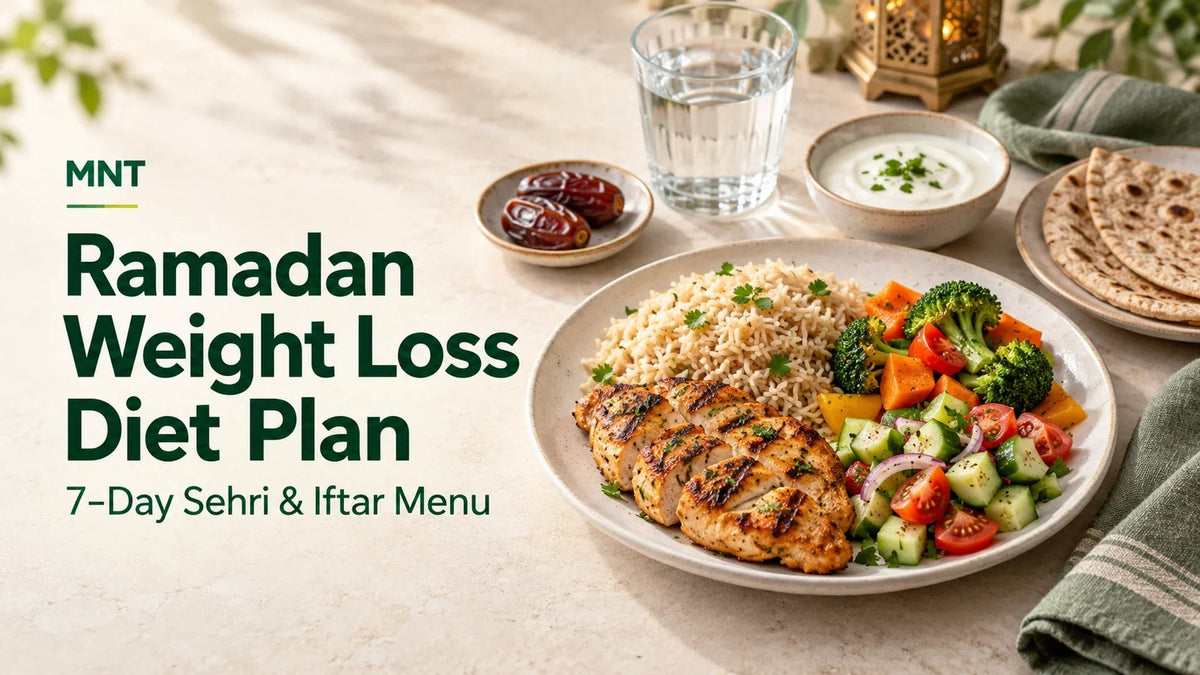
Ramadan Weight Loss Diet Plan: 7-Day Sehri and Iftar Menu
A flexible 7-day Ramadan weight loss diet plan with everyday Pakistani foods for sehri and iftar. Includes portion guidance, hydration tips and realistic weight-loss expectations.
A Ramadan weight loss diet plan works by helping you eat fewer calories than your body uses while still getting enough nutrients. Eat a filling sehri, have a balanced iftar, and spread drinks between sunset and dawn. Include protein, vegetables, fruit, and sensible portions of roti, rice, or oats. Limit frequent fried snacks, sugary drinks, and extra helpings. [1,2]
Fasting changes when you eat. It does not guarantee fat loss. You can lose, maintain, or gain weight depending on your overall intake and routine.
This guide uses everyday Pakistani foods. Sehri, also called suhoor, is the meal before dawn. Iftar breaks the fast at sunset. The weekly menu can be adapted for a 29- or 30-day Ramadan.
Who this plan is for: Generally healthy adults who can fast safely and would benefit from weight loss. The portions are examples, not a personal food allowance. This weight-loss menu is not for children, teenagers, pregnancy, breastfeeding, underweight adults, or people with an eating disorder. If you have a medical condition, read the safety guidance before using it.
7-Day Ramadan Weight Loss Diet Plan
Use this Ramadan diet chart to plan your meals. Start with water and one or two small dates at sunset if you wish. Then eat the main iftar meal shown below, either soon afterward or later in the evening.
Plan one main evening meal. If you prefer dinner after prayers, divide that meal between the two sittings. A full iftar followed by another full dinner can make it easy to exceed your needs.
Portions used in this menu
A small roti uses about 30 g of dry whole-wheat flour, with no added oil or ghee. A measuring cup holds about 240 ml. Chicken and fish weights refer to the cooked, edible portion, without bones. Use plain, unsweetened yogurt and measure cooking oil.
| Day | Sehri / suhoor | Main iftar meal | Evening snack, if needed |
|---|---|---|---|
| 1 | 2 boiled eggs, 2 small rotis, 200 g plain yogurt, and 1 orange | 150 g grilled chicken, 1 cup cooked rice, 1 cup cooked vegetables, and 1 cup salad | 250 ml milk, 20 g unsalted nuts, and 1 small banana |
| 2 | 50 g dry oats cooked in 250 ml milk, 1 boiled egg, 150 g plain yogurt, and 1 fruit | 1 cup thick daal, 100 g chicken, 2 small rotis, and 1 cup salad | 1 fruit and 20 g unsalted peanuts |
| 3 | 1 cup cooked chana, 2 small rotis, 150 g plain yogurt, and 1 guava | 150 g baked fish, 1 cup cooked rice, and 2 cups vegetables and salad | 200 g plain yogurt and 15 g nuts |
| 4 | A 2-egg vegetable omelette, 2 small rotis, 200 g plain yogurt, and 1 fruit | 1 cup cooked lobia, 1 cup cooked rice, 200 g plain strained yogurt, and 2 cups vegetables and salad | 250 ml milk and 1 fruit |
| 5 | 50 g dry oats with 250 ml milk, 150 g plain yogurt, 1 fruit, and 15 g nuts | 150 g chicken tikka, 2 small rotis, 1 cup cooked vegetables, 1 cup salad, and 100 g raita | 30 g roasted chana and 1 fruit |
| 6 | 2 eggs, 2 slices wholemeal toast, 200 g plain yogurt, and 1 fruit | A measured serving of chicken pulao containing about 1 cup cooked rice and 150 g chicken, plus vegetables, salad, and 150 g raita | 250 ml milk and 15 g nuts |
| 7 | 2 eggs, 2 small rotis, 1 cup vegetables, 250 ml milk, and 1 fruit | 1–1.5 cups thick daal, 2 small rotis, 200 g plain yogurt, and 2 cups vegetables and salad | 20 g nuts and 1 fruit |
The days do not contain identical calories or protein. Oil, meat cuts, yogurt type, and recipe sizes change the totals.
An evening snack is optional when your main meals already meet your needs. If two meals leave you short of food or nutrients, include it or increase a main meal. Larger or more active adults may need more food than this chart provides.
A worked example: calories and protein in Day 1
With lower-fat yogurt, 2% milk, skinless chicken breast, and about 10 g of cooking oil in the main meal, Day 1 provides approximately:
| Eating occasion | Approximate calories | Approximate protein |
|---|---|---|
| Sehri | 550 kcal | 32 g |
| Two small dates | 45 kcal | Less than 1 g |
| Main iftar meal | 625 kcal | 54 g |
| Evening snack | 330 kcal | 14 g |
| Whole day, including snack | 1,550 kcal | 100 g |
These are rounded estimates using generic USDA food-composition values. They are not laboratory measurements of your meal. Homemade dahi, larger rotis, chicken skin, marinades, and extra oil can change the result. [4]
About 1,550 calories is an example, not a target for everyone. It may be too little for some adults. Whether it creates a suitable calorie deficit depends on your individual needs.
Using the menu for a 30-day Ramadan diet plan
Repeat the weekly pattern, then use one or two favourite days to complete the month. Rotate vegetables, fruit, grains, and protein foods to keep meals varied.
For a lower budget, use eggs, homemade yogurt, seasonal produce, daal, chana, and lobia more often. Prepare ingredients ahead so a rushed sehri does not turn into tea and biscuits.
For vegetarian meals, combine lentils, beans, tofu, and, if you eat them, eggs or dairy. A cup of daal is not a protein-equivalent replacement for a large chicken portion. Pair it with another protein source where needed.
How to Adjust Calories, Protein, and Portions
There is no single calorie target for Ramadan. Your needs depend on body size, age, sex, activity, and health. A Ramadan diet plan for women or men should account for these factors rather than prescribe the same meals to everyone. [3]
Choose a suitable calorie deficit
A calorie deficit means taking in less energy than your body uses over time. It should still leave enough food for daily life and good nutrition.
For example, if an adult's estimated maintenance intake is 2,000 calories, a 1,700-calorie plan creates an estimated 300-calorie deficit. This illustrates the calculation; it does not predict a fixed weekly weight loss.
A dietitian can help estimate your needs. The NIDDK Body Weight Planner is another option for eligible adults, but it is not designed for children or pregnant or breastfeeding women. [7]
Avoid choosing a very low intake simply because you are fasting. NICE recommends 800–1,200-calorie diets only within supported clinical programmes for suitable patients. Diets below 800 calories require specialist care and a clinically assessed reason. [8]
Make your portions clear
| Food | Example measure | What changes the meal |
|---|---|---|
| Roti | About 30 g dry flour per small roti | Larger rotis and added ghee or oil |
| Rice | A level measuring cup, after cooking | Oil, meat, potatoes, and other ingredients in pulao or biryani |
| Daal or beans | A cup of cooked food | A thick serving differs from mostly watery broth |
| Chicken or fish | Cooked weight without bones | Skin, frying, sauces, and the cut used |
| Yogurt | 150–200 g plain yogurt | Fat content, added sugar, and straining |
| Nuts | 15–20 g | Repeated handfuls from a packet |
| Cooking oil | A measured spoon | The total in the recipe and how many portions it makes |
You do not need to weigh food forever. Use consistent measures while learning what your usual portions contain.
Get enough protein
Include a protein food at sehri and in your main iftar meal. Spread the rest across an evening snack if needed.
Higher-protein weight-loss diets can help with fullness and preserving lean tissue. A review discussed intakes of about 1.2–1.6 g/kg/day. This is research context, not a universal prescription. The right target and the weight used in the calculation may need adjustment for your health and body size. [6]
Useful choices include eggs, chicken, fish, milk, yogurt, tofu, lentils, and beans. Plant-based meals may need more than one protein food.
People with kidney disease should agree on their protein intake with their healthcare team. [19]
What to Eat for Sehri to Stay Full
A filling sehri includes protein, higher-fibre carbohydrates, fruit or vegetables, and fluids. WHO recommends eating suhoor and including wholegrain foods and protein sources. [1]
For example, try eggs with whole-wheat roti, plain yogurt, and fruit. Or have oats made with milk, yogurt, and a small portion of nuts.
These combinations help you fit several food groups into a short eating window. Choose foods you digest comfortably; no meal can guarantee a hunger-free or thirst-free day.
If you have little time or appetite
Keep boiled eggs, plain yogurt, and measured oats ready. A smaller meal such as yogurt with oats and fruit may be easier than a large plate.
If a very late dinner leaves you too full for sehri, move some of that food earlier. Skipping sehri reduces your chances to meet food and fluid needs, but it does not automatically stop your metabolism.
Keep very salty foods modest. Achaar, salty processed foods, and heavily salted leftovers can increase thirst.
What to Eat at Iftar Without Overeating
An iftar diet plan for weight loss should make room for a balanced main meal. Start with water and a small portion of dates if you wish. Soup is optional.
You may find a short pause for Maghrib prayer helps you eat more calmly. There is no required pause that guarantees weight loss. Eat at a comfortable pace and check your appetite before taking more.
Build a balanced iftar plate
As a starting point, give vegetables a generous share of your plate. Add a clear protein source and an amount of rice or roti that suits your needs. Include yogurt or raita if it fits the meal.
For mixed dishes, look at the ingredients. Chicken salan can be balanced with roti and vegetables. Daal can be paired with yogurt, eggs, or tofu when more protein is needed. [5]
Fit traditional foods into the meal
| Food or drink | A practical adjustment |
|---|---|
| Pakoras or samosas | Choose a small portion and include it within the meal |
| Biryani or pulao | Measure the serving and check how much meat and oil it contains |
| Fruit chaat | Use whole fruit and keep added sugar, syrup, and cream modest |
| Sharbat or Rooh Afza | Check the sugar and serving size; make water your main drink |
| Jalebi, kheer, or other sweets | Plan a portion rather than taking repeated servings all evening |
Grilling, baking, or air-frying can reduce cooking oil. The ingredients and portion still matter. Familiar foods can fit into a balanced Ramadan routine. [10]
How to Stay Hydrated Between Iftar and Sehri
Spread fluids through the non-fasting hours instead of trying to drink everything at sehri. NHS guidance uses six to eight cups or glasses of fluid a day as a general guide. Needs may be higher with heat, activity, or illness. This is not a fixed prescription for every person fasting. [9]
Water is a good main drink. Milk and moderate amounts of tea or coffee also count. Food provides some fluid too.
An example drinking schedule
If a healthy adult is aiming for about two litres of drinks, eight 250 ml servings could be spread as follows:
| Time | Example amount |
|---|---|
| Breaking the fast | 250 ml |
| With the main meal | 250 ml |
| At intervals through the evening | 1,000 ml in four separate servings |
| Around sehri | 500 ml, taken gradually |
| Total | 2,000 ml |
Adjust the timing and amount to your needs. This example may be too little in hot weather or with substantial activity. Follow any fluid limit prescribed by your clinician.
Pale-yellow urine is one useful hydration clue. Persistent dark urine, much less urine than usual, or dizziness needs attention. Severe symptoms require medical help.
Caffeine can disturb sleep, even when the drink contributes fluid. Choose a modest amount and consider decaffeinated options if needed.
Exercise and Sleep During Ramadan
Choose exercise that fits your health, energy, and access to fluids. For a beginner, a short walk after iftar may be easier to manage. Start with 10–20 minutes at a comfortable pace and let a large meal settle first.
People who already train can adjust workout timing, length, and intensity. Avoid demanding sessions in heat or while dehydrated. Stop if you feel dizzy or unwell. [11]
Include strength work where appropriate
General adult guidance recommends at least 150 minutes of moderate activity weekly and muscle-strengthening activity on two days. Build toward this at a level you can manage safely. [12]
Strength work can include resistance bands, weights, wall push-ups, or chair squats. Combine it with enough food and protein. A gym is optional.
Protect your sleep
Most healthy adults need around seven to nine hours of sleep. Plan bedtime and sehri together, and reduce late-night caffeine if it keeps you awake. [13]
Make room for meals, worship, movement, and rest. A routine built around all-night snacking is harder to maintain.
Does Ramadan Fasting Help You Lose Weight?
Some people lose weight during Ramadan, but lasting fat loss is not guaranteed. Food intake, activity, health, and the habits you keep afterward all matter.
What the research shows
A 2025 systematic review combined 54 observational studies involving 2,857 healthy adults. It found short-term reductions in weight and small reductions in body fat. Weight tended to return toward pre-Ramadan levels in the weeks afterward. [14]
The researchers observed groups before and after fasting. They did not test this seven-day menu, and the findings cannot predict how many kilograms you will lose.
Ramadan fasting also differs from many time-restricted eating studies because it includes daytime fluid restriction. Findings from one fasting method should not be treated as a guarantee for another.
How much weight can you lose in Ramadan?
There is no reliable figure for everyone. CDC guidance describes gradual weight loss of about one to two pounds, or roughly 0.5–0.9 kg, per week. That is general guidance for adults who need weight loss, not a promised Ramadan result. [15]
Use the month to build a routine you can continue. Avoid forcing a large scale change through severe food restriction or dehydration.
Fat loss versus water weight
Your weight includes body water, stored carbohydrate, food in your digestive tract, and body tissue. Changes in carbohydrate and salt intake can alter water balance. [16]
Weigh under similar conditions each week: for example, after waking and using the bathroom, before eating or drinking. Avoid comparing a thirsty pre-iftar reading with a reading taken after a large meal.
A drop caused by dehydration is not successful fat loss.
Why Am I Not Losing Weight During Ramadan?
Fasting does not create a calorie deficit if evening food and drinks replace all the energy missed during the day. Review the whole evening before making your main meals smaller.
| Common issue | What to review | Useful adjustment |
|---|---|---|
| A large iftar plus a full dinner | Two main evening meals | Divide one planned meal between the two sittings |
| Sweet drinks and milk tea | Sugar, milk, serving sizes, and refills | Include drinks when reviewing intake |
| Generous oil in salan or daal | Oil used in the whole recipe | Measure it and divide the dish into portions |
| Repeated nuts, dates, or sweets | Unplanned servings | Put a portion on a plate or in a bowl |
| Much less activity | Walking and everyday movement | Add manageable activity at a suitable time |
| Sharp scale changes | Hydration and weighing time | Compare readings taken under similar conditions |
If your trend is not changing after a couple of weeks, review several days of meals, drinks, and activity. Choose one or two changes you can repeat. This is a practical check, not proof that your metabolism has stopped.
If you already eat modestly or feel persistently weak, get advice before reducing food further.
Constipation and bloating
Increase fibre gradually through oats, whole grains, beans, fruit, and vegetables. Drink enough during the non-fasting hours to help fibre work. [17]
Eat at a comfortable pace and notice whether large meals trigger discomfort. Persistent symptoms need medical advice.
Who Needs Medical Advice Before Fasting?
A sample diet chart cannot tell you whether fasting is safe for you. Seek advice before fasting if you have diabetes, kidney or heart disease, a condition affected by fasting, or medicines that need food or careful timing.
Diabetes and medicines
People with diabetes need a plan for fasting risk, glucose checks, medicine timing, and when to break the fast. ADA guidance recommends assessing risk and reviewing treatment in advance. Do not change prescribed medicine yourself. [18]
Follow your healthcare team's instructions for low or high glucose. Treat suspected low blood sugar promptly rather than waiting for sunset.
Pregnancy, breastfeeding, and kidney disease
Pregnancy is not a time to follow a general weight-loss diet. Discuss fasting with your maternity team. Breastfeeding also needs advice that considers your food needs and your baby's wellbeing. [20]
Kidney disease may change the right amounts of protein, fluids, potassium, and other nutrients. General advice to drink more or eat more protein may not suit you. [19]
Symptoms that need prompt help
Break the fast and seek urgent medical advice for persistent dizziness or very little urine. Confusion, collapse, or trouble breathing needs emergency care. Do not continue fasting or exercise to meet a weight goal when you are seriously unwell. [21]
How to Keep the Weight Off After Ramadan
Keep the habits that helped you, even when meal times change. Continue balanced meals, sensible portions, regular activity, and attention to drinks and cooking oil.
At Eid, enjoy favourite foods in portions you can eat comfortably. You do not need to punish yourself by skipping meals afterward. Small amounts of favourite foods can fit within a weight-management plan. [22]
As daytime meals return, adjust your total intake to your new routine. Keeping weight stable may require a different intake from active weight loss.
You do not need to follow a fixed “reverse dieting” schedule. A small 2025 trial did not establish that gradual calorie increases prevented weight regain better than the comparison approaches. It was not a Ramadan study. If you are unsure how much to eat for maintenance, ask a dietitian to help you adjust. [25]
Frequently Asked Questions
Can I eat rice and roti while losing weight in Ramadan?
Yes. Rice and roti can fit into a Ramadan weight loss diet plan. Choose portions that suit your needs, include protein and vegetables, and account for added oil or ghee. Choose whole grains often. [22]
Can I eat paratha at sehri?
Yes. Paratha can fit, but its flour portion and cooking fat affect the meal. Measure the oil and pair it with protein. A plain roti may make added fat easier to control.
Should I skip sehri for faster weight loss?
Sehri helps you fit food and fluids into the non-fasting hours. Skipping it may leave you tired or make it harder to meet your needs. The better first step is to review portions, drinks, and frequent extras.
Can I lose 5 kg or 10 kg in Ramadan?
These are not appropriate promises for a general diet plan. A rapid scale drop can include water loss. Set a realistic goal based on your starting weight and health instead of sharply cutting food to reach a number.
Can this plan reduce belly fat?
It can support overall fat loss when it creates a suitable energy deficit. It cannot guarantee fat loss from your abdomen alone. A smaller waist may also reflect changes in bloating. [24]
Do lemon water, green tea, or chia seeds burn fat?
None is required for weight loss. Any weight-loss effect of green tea appears small. Unsweetened drinks can replace sugary drinks, and seeds can add nutrients to meals. They do not cancel extra calories or make a meal plan unnecessary. [23]
Do I need a protein shake during Ramadan?
No, if food meets your protein needs. A shake can be convenient when the eating window is short, but include its calories and choose one suited to your health, preferences, and any allergies.
Can I lose weight in Ramadan without a gym?
Yes. Your food intake matters, and walking or home strength exercises can support your routine. Choose activity that fits your fitness and health.
Is there a different Ramadan diet plan for women and men?
There is no single menu for either group. Portions depend on body size, age, activity, and health as well as sex. Pregnancy and breastfeeding require a separate approach.
Explore MNT nutrition consultations
If you need portions matched to your health, family meals, or work routine, explore MNT's online weight-loss nutrition consultations. Medical conditions may also require input from your treating clinician.
View consultation optionsWe rely on peer-reviewed studies and reputable medical journals.