
Basil Seeds vs Chia Seeds: Differences, Nutrition and Uses
Compare basil (sabja) seeds and chia seeds for nutrition, weight-loss evidence, digestion and everyday uses. Learn how to identify, soak and choose the right seed for your meals.
Basil seeds and chia seeds are different foods. Basil seeds, also called sabja or tukmaria, suit quick-soaking drinks such as falooda and sharbat. Chia seeds work well in pudding, oats and yogurt and are a well-documented source of plant omega-3 fat. Both provide fibre, but neither has a proven weight-loss advantage over the other.
The best choice depends on what you want to make, the nutrients in your portion and how your digestion responds.
Basil seeds vs chia seeds at a glance
| Feature | Basil seeds | Chia seeds |
|---|---|---|
| Plant | Sweet basil, Ocimum basilicum | Salvia hispanica |
| Common names | Sabja, tukmaria, edible sweet-basil seeds | Chia; sold in black and white varieties |
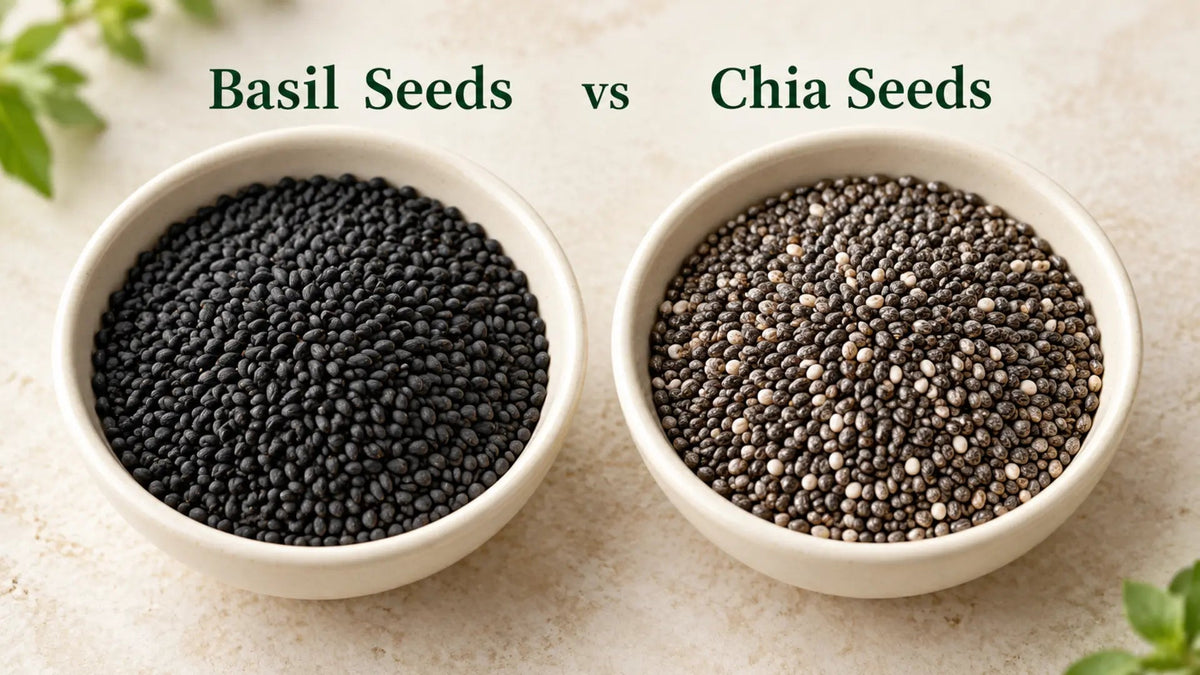
| Dry appearance | Usually fairly uniform and black | Often mottled grey, black, brown or white |
| After soaking | Distinct gel-coated seeds with a dark centre | Gel-coated seeds that can thicken the mixture |
| Taste | Mild, sometimes slightly herbal | Mild, with little distinct flavour |
| Familiar uses | Falooda, sharbat, lemonade and desserts | Pudding, overnight oats, yogurt and baking |
| Soaking | Often develops its coating sooner | A soft gel can form in about 15–20 minutes; thicker recipes may take longer |
| Weight-loss verdict | No established advantage over chia | Human trials do not show consistent weight loss |
Both belong to the mint family. Their shared ability to form a gel explains some of their food uses, but it does not prove that they have the same health effects.
Are basil seeds and chia seeds the same?
No. Sabja seeds and chia seeds come from different plants. Edible sweet-basil seeds come from Ocimum basilicum. Chia seeds come from Salvia hispanica. Looking similar and swelling in water does not make them the same seed.
Sabja, tukmaria and tukh malanga: understanding the names
Sabja and tukmaria are common names for edible basil seeds. In Pakistan, spellings such as tukh malanga, tukhm malanga and tukhm-e-malanga can make the comparison confusing.
Related local names are not always used consistently. Scientific literature identifies tukhm-e-balango as Lallemantia royleana, a separate plant whose seeds can be confused with sweet-basil seeds in herbal markets.
When comparing tukh malanga vs chia seeds, check the botanical name on the pack or ask the seller. A local name alone may not identify the species.
How can you tell the seeds apart?
Look at the dry seeds, their soaked form and the label together.
Basil seeds usually look more uniformly black. Chia often has a mottled surface, although white chia is also sold. After soaking, basil seeds develop a pale gel around a dark centre. Chia also forms a gel and can make a mixture thick enough to eat with a spoon.
The water-holding coating is called mucilage. Seed quantity, liquid quantity and preparation conditions affect the final texture. Appearance is a useful clue; the labelled plant name is more reliable.
Basil seeds vs chia seeds nutrition
Both seeds supply fibre, fats and some protein. A fair comparison uses the same weight of dry seeds. Comparing a spoonful of one with a different-sized spoonful of the other can give a misleading result.
Soaked weights are also misleading: much of the extra weight is absorbed water.
Nutrition comparison per 15 g of dry seeds
This table uses one published basil-seed sample and the USDA reference for dried chia. It illustrates a measured comparison, rather than fixed values for every brand.
| Nutrient | Basil seeds: 15 g of the studied sample | Chia seeds: 15 g, USDA reference |
|---|---|---|
| Protein | 1.4 g | 2.5 g |
| Total fat | 5.0 g | 4.6 g |
| Total carbohydrate | 6.5 g | 6.3 g |
| Reported fibre* | 5.4 g | 5.2 g |
Values are scaled from amounts per 100 g and rounded. The basil study tested Ocimum basilicum var. thyrsiflora. Its reported total fibre and the USDA dietary-fibre value may use different methods, so small differences should not be treated as a nutritional winner. Fibre is included within total carbohydrate.
Why do basil-seed nutrition figures differ between sources?
Basil varieties, growing conditions and laboratory methods can produce different results. Whole seeds, seed oil and extracted seed gum also have different compositions.
This is why claims such as “basil always has 50% more fibre” or “chia always has three times more omega-3” need a clearly identified source and product.
For the pack you are buying, compare reliable labels per 100 g or another equal dry weight.
Which has more omega-3?
Chia is a well-documented source of alpha-linolenic acid, or ALA, a plant omega-3 fat. The USDA reference contains about 2.7 g of ALA per 15 g of dry chia.
Basil seeds can also contain ALA-rich oil. However, the percentage of ALA in extracted oil is not the same as grams of ALA in a serving of whole seeds. Available composition data do not justify a single omega-3 ratio for every basil and chia product.
ALA also differs from EPA and DHA, the omega-3 fats found in fish and algae-based products. Your body converts some ALA into these forms, but conversion is limited.
What about calories, calcium and iron?
The same 15 g USDA portion of chia provides approximately:
- 73 calories
- 95 mg calcium
- 50 mg magnesium
- 1.2 mg iron
Use a reliable basil-seed label or a clearly identified analysis to compare these nutrients. Soaking in plain water increases volume without removing the seeds’ calories. Milk, syrup and other additions change the nutrition of the finished dish.
Which is better for weight loss?
Neither basil seeds nor chia seeds has an established weight-loss advantage over the other. Both can fit into filling meals, but swelling in water does not mean a seed burns fat.
Fullness and weight loss are different outcomes
In a small trial involving 24 adults, yogurt containing 7 g or 14 g of chia increased fullness and reduced food intake at the next meal compared with the control snack. The study measured a short-term appetite response, not long-term fat loss.
A 2025 meta-analysis combined eight trials involving 372 participants. It found no significant overall change in body weight or body mass index with chia supplementation. It studied chia, so it cannot establish whether basil is better or worse.
The whole meal matters more than the seed
Consider what the seeds add or replace:
- Chia in plain yogurt adds fibre to a snack.
- Soaked basil seeds add texture to an unsweetened drink.
- Falooda with syrup and ice cream can still be high in calories.
- Adding seeds to your usual meals adds energy unless something else changes.
For weight management, choose a portion you enjoy within meals that suit your needs. Neither seed targets belly fat, and drinking seed water before meals is not a proven shortcut to weight loss.
Which is better for constipation, bloating and IBS?
Either seed can add fibre, but evidence has not established that one treats constipation better than the other. Your total fibre intake, fluid intake and tolerance matter.
Constipation
Fibre can help bowel regularity, and adequate liquids help it work. The National Institute of Diabetes and Digestive and Kidney Diseases advises adding fibre gradually.
If you are new to seeds, begin with a small portion rather than adding several spoonfuls at once. Increase slowly if you tolerate it.
Persistent constipation needs attention to its cause. A larger seed portion is not always the answer.
Bloating and IBS
Chia has useful FODMAP information. Monash University lists a two-tablespoon serving as low FODMAP, while noting that some people with IBS still do not tolerate it well. FODMAPs are certain carbohydrates that can trigger symptoms in sensitive people.
That makes chia an option to consider, rather than a guaranteed “IBS-safe” food.
You cannot infer basil seeds’ FODMAP content from their gel or fibre content. If you follow a low-FODMAP diet, use current tested-food guidance and advice from your dietitian.
Neither seed is a proven treatment for acid reflux.
Blood sugar and heart health: what does the research show?
Chia has more human trial evidence than basil seeds, but that does not establish clinical superiority. Nutrient content, short-term effects after a meal and long-term disease outcomes answer different questions.
Blood sugar
A gel-forming food may affect how a meal is digested. That does not automatically mean it lowers fasting blood sugar or HbA1c, a measure of average blood sugar over roughly three months.
A 2025 review of eight chia trials found no significant overall effect on fasting blood glucose or HbA1c.
For basil seeds, promising laboratory findings cannot establish that an ordinary seed drink treats diabetes. There is no sound basis for declaring basil or chia the universal blood-sugar winner.
Blood pressure and cholesterol
The eight-trial review involving 372 people found reductions in average blood pressure. The authors called for larger studies to confirm the results.
This does not show that chia prevents heart attacks or lowers cholesterol more effectively than basil seeds.
Both can be food ingredients within a balanced eating plan. If you have diabetes, high cholesterol or high blood pressure, choose meals around your overall needs and continue prescribed treatment.
How to soak and use basil seeds and chia seeds
Hydrate the seeds evenly, stir out clumps and use enough liquid for the texture you want. Follow the pack’s instructions when available.
A simple starting method for a seed drink
For a small first portion, try:
| Seed | Dry amount | Water | Starting time |
|---|---|---|---|
| Basil seeds | 1 level teaspoon | About 80 mL | Allow about 15 minutes, then check the gel coating |
| Chia seeds | 1 level teaspoon | About 80 mL | Allow about 20–30 minutes, stirring again as the gel forms |
These are kitchen starting points, not fixed hydration rules or treatment doses. Basil may develop its coating sooner. Temperature, seed batch, liquid and recipe can change the timing.
- Add the seeds to the liquid.
- Stir well, including around the bottom of the glass.
- Stir again after a few minutes to break up clumps.
- Allow the seeds to hydrate evenly.
- Add more liquid if the mixture is too thick.
For a larger drink using the same ratio, use about 1 tablespoon of seeds in 240 mL of water.
For pudding and thicker foods
Chia needs less liquid for a thick gel than for a drink. Harvard’s preparation guidance uses one part chia to four parts liquid, with roughly 15–20 minutes to form a soft gel. Pudding recipes may call for longer refrigeration.
Stir hydrated seeds into yogurt, oats or smoothies. Keep milk-based mixtures refrigerated.
Can you substitute basil seeds for chia seeds?
Often, yes, especially in drinks and some desserts. Expect the texture to change.
- Drinks: Basil seeds give distinct gel-coated beads. Chia can also work, with more thickening depending on the amount.
- Pudding: Both can be used, but start with a recipe designed for your chosen seed.
- Baking: Use a tested recipe when the seed must bind ingredients or replace an egg.
For a basic chia egg, Harvard suggests 1 tablespoon of whole chia seeds mixed with 3 tablespoons of water, left until thickened. This can replace an egg in suitable recipes; results depend on the bake.
How much should you eat?
Start with a teaspoon if your usual diet is low in fibre. Increase gradually according to your meals, comfort and product instructions.
There is no established treatment dose of either seed for weight loss or constipation. The 15 g used in the nutrition table is a comparison amount, not a daily target everyone needs to reach.
Side effects and who needs extra care
The main practical concerns are digestive discomfort, allergy and swallowing safety.
- Gas or bloating: A sudden rise in fibre may be uncomfortable. Reduce the portion and build up gradually.
- Swallowing problems: Do not swallow a spoonful of dry chia and then wash it down with water. A reported case involved seeds expanding and blocking the food pipe. Prepare basil seeds in liquid too. People with swallowing disorders need individual advice about safe textures.
- Allergy: Allergic reactions to chia have been reported. Stop eating a seed that causes a reaction. Breathing difficulty or swelling of the tongue or throat needs emergency help.
During pregnancy or breastfeeding, ask your clinician before using high-dose seed supplements or seed products as a remedy. For children, use age-appropriate portions and textures. If you take medicines with specific food-timing instructions, follow your pharmacist’s advice.
Which seed should you buy?
Buy the seed that suits your food preferences, budget and needs. You do not need both for a healthy diet.
| Your priority | A practical choice |
|---|---|
| Falooda, sharbat or a drink with distinct gel-coated seeds | Basil seeds |
| A familiar ingredient for oats and thick pudding | Chia seeds |
| A plant ALA source with a clear reference value | Chia seeds |
| More fibre or a particular mineral | Compare reliable labels per equal dry weight |
| Weight management | Choose a suitable portion and consider the whole meal |
| Sensitive digestion | Choose the seed and portion you tolerate |
In Pakistan, compare price per 100 g, the labelled seed identity, pack condition and best-before date. A higher price does not prove better nutritional value.
You can explore MNT’s seeds and superfoods collection to compare available products and pack sizes.
Frequently asked questions
Can you mix basil seeds and chia seeds together?
Yes. Use a modest combined portion and allow enough time for both seeds to hydrate. Mixing them does not create a proven extra weight-loss benefit, and you do not need a full serving of each.
Do basil seeds and chia seeds need grinding?
Grinding is not required for their usual soaked food uses. Both can be served whole in suitable moist foods. Grinding changes the texture and may suit some recipes.
Is it better to eat them in the morning or at night?
Neither seed has an established morning-versus-night advantage for weight loss. Choose a time that fits your meals and feels comfortable. An empty stomach is not required.
Do basil seeds cool the body better than chia seeds?
Basil seeds are a traditional ingredient in refreshing summer drinks. This does not establish that they lower core body temperature better than chia or plain water. Water retention in a gel is not proof of a cooling effect in people.
Can you eat chia seeds without soaking them first?
Chia can be incorporated into moist foods such as yogurt or oatmeal. Avoid swallowing a dry spoonful on its own. Anyone with swallowing difficulty should get advice about the safest preparation.
Personal nutrition guidance with MNT
Discuss your meals, preferences and nutrition goals with an MNT dietitian.
We rely on peer-reviewed studies and reputable medical journals.