

Seed Cycling Method: How to Do It, Chart and Evidence
Learn the common seed cycling schedule, daily portions and preparation tips. Get a clear look at the evidence for PCOS, PMS and irregular periods.
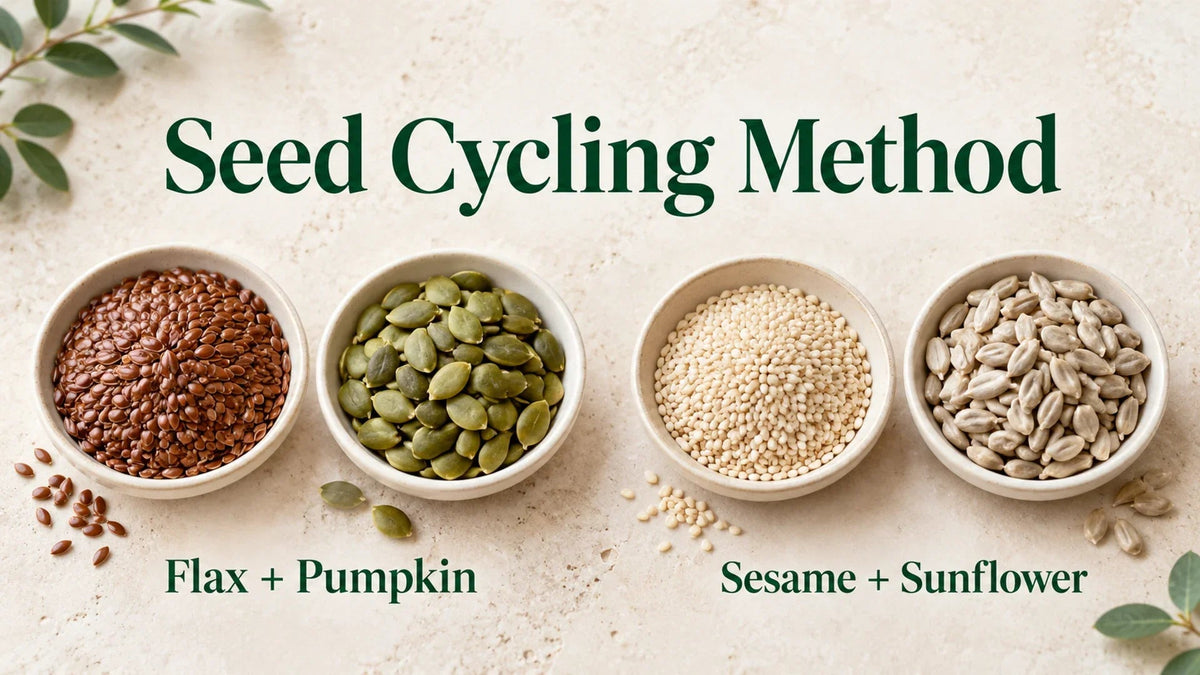
The common seed cycling method uses one tablespoon each of flaxseed and pumpkin seeds daily on cycle days 1–14, then one tablespoon each of sesame and sunflower seeds from day 15 until the next period. That is two tablespoons total per day. Count the first day of your period as day 1. [1]
The seeds provide useful nutrients. However, research has not established that rotating them by cycle phase works better than eating seeds regularly. Seed cycling is a food routine with limited clinical evidence, and there is no established treatment dose for hormone balance, PCOS or PMS. [2–5]
Seed Cycling Chart: Which Seeds to Eat and When
| Common calendar schedule | Seeds to eat each day | Common daily serving |
|---|---|---|
| Days 1–14 | Flaxseed + pumpkin seeds | 1 level tablespoon of each |
| Day 15 until the next period | Sesame seeds + sunflower seeds | 1 level tablespoon of each |
This chart describes a simplified 28-day example. The first part of a natural menstrual cycle ends at ovulation, when an ovary releases an egg. The second part follows ovulation. These phases do not always split into two equal halves, so a fixed day-15 switch may not match your body. [6]
Before starting, check for seed allergies and follow the packet's preparation instructions, especially for flaxseed. Keep taking prescribed treatment unless your clinician changes it.
What Is Seed Cycling?
Seed cycling, also called seed rotation, is an eating routine that changes the seed pair during the menstrual cycle. People often try it for irregular periods, premenstrual syndrome (PMS) or polycystic ovary syndrome (PCOS).
The popular routine links two pairs to two phases:
- Follicular phase: From the start of your period to ovulation. The usual pair is flaxseed and pumpkin seeds.
- Luteal phase: From after ovulation until your next period. The usual pair is sesame and sunflower seeds.
Estrogen usually rises before ovulation. Progesterone rises afterward. The theory behind seed cycling is that different seeds support these changing hormone needs. That theory needs stronger testing in people. [2,6]
The four seed cycling seeds and their Urdu names
| Seed | Common name in Pakistan |
|---|---|
| Flaxseed, also called linseed | Alsi |
| Pumpkin seeds | Kaddu ke beej |
| Sesame seeds | Til |
| Sunflower seeds | Surajmukhi ke beej |
Choose seeds sold for eating. Pumpkin and sunflower kernels are the edible parts normally added to meals. You do not need a special kit, capsule or branded powder to include these foods in your diet.
How to Do Seed Cycling Step by Step
These steps describe the common calendar method. The serving and timing are conventions, rather than a proven medical prescription.
1. Mark the first day of your period
Count the first day of menstrual bleeding as day 1. Record it on a calendar or period tracker. Use the start of your period, rather than the first day of the calendar month. [6]
If you have new spotting or bleeding that is unusual for you, record it and seek advice if needed. A seed schedule cannot explain the cause of bleeding.
2. Eat flaxseed and pumpkin seeds on days 1–14
Measure one level tablespoon of each seed daily. Prepare them according to the packet, then add them to a meal or snack.
You can eat both at one meal or divide them between meals. If seeds are new to your diet, start with a smaller food portion and build up as tolerated.
3. Switch to sesame and sunflower seeds on day 15
In the fixed calendar version, use one level tablespoon of sesame seeds and one level tablespoon of sunflower seeds each day from day 15.
Switching seeds does not confirm that you have ovulated. The calendar is simply how this version of the routine is organized.
4. Restart when your next period begins
When the next period starts, count it as a new day 1 and return to the first pair if you wish to continue. You do not need to finish an old chart before starting the new cycle.
If your next period is late, follow the guidance below. Continuing a seed pair is not a treatment for a missed period.
5. Make the routine easy to follow
Choose meals you already enjoy and keep your portions manageable. Missing a serving does not require an extra dose the next day.
How Much Seed Should You Eat, and When?
The common serving is one tablespoon of each of two seeds: two tablespoons total per day. It does not mean one tablespoon of all four seeds daily. No ideal seed cycling dose has been established for PCOS, PMS or period changes. [1–5]
Use a level measuring spoon for consistency. If you buy a blend, check its ingredients and serving directions. One tablespoon of a mixed powder does not contain one tablespoon of each seed.
How many grams are in a tablespoon?
A tablespoon measures volume; grams measure weight. The weight depends on the seed and whether it is whole, crushed or ground.
For example, Mayo Clinic lists about 7 grams in one tablespoon of ground flaxseed. Do not assume that a tablespoon of every seed weighs 10–15 grams. Use a kitchen scale if you have been given a specific gram amount. [7]
What is the best time to eat seed cycling seeds?
No well-established evidence shows that morning, bedtime or an empty stomach improves seed cycling results. Choose a time that suits your meals and digestion.
Breakfast can be convenient, but the routine does not require it. You can also divide the serving between lunch and dinner.
Seed Cycling With Irregular, Shorter or Longer Cycles
There is no clinically validated seed cycling schedule for irregular periods. A fixed two-week switch may not match ovulation, especially when cycles vary or ovulation does not occur.
If your cycle is shorter or longer than 28 days
Some people follow the calendar version. Others switch pairs around ovulation if they already track it. Research has not established a treatment advantage for either approach.
You do not need to buy ovulation tests to include seeds in meals. If you choose the calendar method and your period starts earlier than expected, count that as the next day 1.
If you have PCOS or unpredictable periods
Some plans alternate the pairs every 14 days. This provides a food schedule, but it should not be presented as a way to restore ovulation or treat PCOS.
You can also eat a variety of seeds without matching them to dates. Assessment and care for ongoing cycle changes matter more than finding a perfect seed calendar.
If your period is missing
If pregnancy is possible, take a pregnancy test according to its instructions. Do not wait for seed cycling to bring on bleeding. Arrange medical assessment if you go three months without a period and are not pregnant or breastfeeding. Seek advice sooner for a new or worrying change. [8,9]
Should you follow the moon phases?
A moon-based schedule is sometimes suggested for people without regular periods. It is not a proven treatment or a reliable way to identify ovulation.
If used as a reminder, it should remain a calendar choice. It does not show what your hormones are doing.
How to Prepare, Eat and Store Seed Cycling Seeds
Do all four seeds need grinding?
Ground flaxseed is easier to digest than whole flaxseed. Whole flax may pass through the gut partly undigested. You can buy milled flax or use a clean food grinder, then follow the product's preparation directions. [7]
Pumpkin and sunflower kernels can be chewed well, chopped or ground. Sesame can be used in foods or as a paste such as tahini. Research has not established that grinding every seed into fine powder improves the hormonal effects of the routine.
Should seeds be raw, roasted or cooked?
There is no proven seed cycling advantage to eating all four seeds raw. Choose food-grade products and prepare them as directed.
Pay particular attention to flaxseed labels. Some products are marked for cooking or baking and should not be added uncooked to yogurt or smoothies. Flax naturally contains compounds that can release hydrogen cyanide; cooking and baking reduce this risk. A brief soak does not replace a required cooking step. [10]
For cold meals, choose flaxseed intended to be eaten without further cooking. The routine does not require avoiding properly prepared or cooked seeds.
Do you need to soak the seeds?
Soaking is optional for texture unless a recipe or product label says otherwise. No clinical evidence sets a soaking time that makes seed cycling more effective.
Follow normal food hygiene and the packet's directions. Do not assume that soaking makes every seed product ready to eat.
Easy ways to add seeds to Pakistani meals
Use your current pair in a food you already enjoy:
- Yogurt or dahi: Stir in seeds suitable for eating without further cooking.
- Porridge or oats: Add the seeds using the preparation method on the packet.
- Raita or salad: Use chopped pumpkin or sunflower kernels, or sesame seeds.
- Smoothies: Blend in a suitable ready-to-eat product.
- Cooked dishes: Include flaxseed in a recipe that meets its cooking instructions.
These are serving ideas. Choose combinations you enjoy and portions that fit your meal.
How to make and store a seed cycling mix
You can keep the two pairs in separate, clearly labelled containers. Measure the seeds before combining them if you want to follow the tablespoon version closely.
Prepare small batches. Store ground flaxseed in an airtight container in the refrigerator, and follow each product's storage and use-by directions. [11]
When buying a premix, check the seed proportions, allergens, added ingredients and preparation instructions. A blend containing herbs or extracts needs a separate safety check from a plain food mix.
Does Seed Cycling Work? What the Science Says
Early studies report some benefits, but the evidence does not establish that rotating seeds by menstrual phase is better than eating seeds without that schedule. Three different questions are often mixed together:
- Do seeds provide useful nutrients?
- Can a particular seed affect a symptom or blood-test result?
- Does switching seed pairs by cycle phase add a benefit?
Evidence for the first or second question cannot, by itself, answer the third.
Why are these four seeds used?
| Seed | Nutrients or compounds that explain interest in it |
|---|---|
| Flaxseed | Fiber, plant omega-3 fat called ALA, and lignans |
| Pumpkin seeds | Magnesium and zinc |
| Sesame seeds | Lignans, which have been studied in hormone-related research |
| Sunflower seeds | Vitamin E |
Flaxseed's nutritional value, the minerals in pumpkin seeds and the vitamin E in sunflower seeds are well documented. [7,12–14] Sesame has also been studied as a food intervention. [15]
Lignans are plant compounds that can interact with hormone-related pathways. This biological interest does not establish that a spoonful of one seed pair raises progesterone or lowers estrogen at the right stage of a cycle.
What have human studies found?
| Research | What it tested or reported | Important limitation |
|---|---|---|
| 2023 combined-seed PCOS study | Seed cycling alongside a portion-controlled diet; changes in hormone measures were reported. | Diet changes and internal reporting inconsistencies limit confidence in the seed-specific effect. [3] |
| 2020 flaxseed trial | In 41 women with PCOS, 30 g of flaxseed daily plus lifestyle changes improved some metabolic measures compared with lifestyle changes alone. | It tested daily flaxseed, not four-seed rotation. [16] |
| 2025 flaxseed trial | In 70 women with PCOS, 30 g of milled flaxseed daily plus lifestyle changes altered some hormone markers. | Several markers, including luteinizing hormone (LH), did not change significantly. It did not test rotation. [4] |
| 2026 capsule study | Forty women began a two-cycle study that reported fewer PMS-related symptoms. | There was no control group; the product contained chasteberry and other ingredients, and the manufacturer sponsored the study. [5] |
The 2023 paper deserves particular caution: it reports 90 participants but also describes three groups of 20. Its findings should not be used to promise a predictable hormone change or establish a treatment dose. [3]
What about the 2025 systematic review?
A 2025 review assessed 10 studies involving 635 participants. It included full seed cycling routines as well as studies of individual seeds. Some reported improvements in period regularity, symptoms or metabolic markers. However, the interventions and study methods varied, and the authors called for larger trials. [2]
It would be misleading to describe this as 10 trials proving that the four-seed rotation works.
Does seed cycling increase progesterone or improve ovulation?
These effects have not been established for the full routine. A small 1993 crossover study of 18 women found a longer luteal phase during daily flaxseed use. It observed no cycles without ovulation during flax use versus three during control cycles, but luteal progesterone levels did not increase significantly. [17]
This is an interesting finding about daily flaxseed. It cannot establish that seed cycling restores ovulation, treats infertility or reliably raises progesterone.
Seed Cycling for PCOS and PMS
Can seed cycling help PCOS or make periods regular?
Seeds can fit into an eating plan for PCOS, but there is not enough reliable evidence to prescribe the rotation as a treatment for irregular periods.
The international PCOS guideline supports sustainable healthy eating tailored to a person's preferences and goals. It does not identify one diet composition as best for hormonal, reproductive or metabolic outcomes. [18]
Focus on an eating pattern you can maintain, suitable physical activity and treatment chosen for your symptoms and goals. A dietitian can help you include seeds while meeting your wider nutrition needs.
Can it reduce PMS or period cramps?
Some seed-based studies report symptom improvements. However, findings from individual seeds or capsules with extra ingredients do not establish a reliable benefit from the timing of plain seeds. [2,5]
If symptoms disrupt sleep, work, study or relationships, seek care. You do not have to complete several seed cycles before discussing treatment.
How Long Does Seed Cycling Take to Work?
There is no proven time frame for seed cycling results. Claims that hormones will balance in 30 days or periods will become regular after three months go beyond the evidence.
Studies lasting a few months show how long people were observed. Their duration does not establish when the routine will work for an individual.
If you choose to try it, keep a simple record:
| What to record | Useful details |
|---|---|
| Periods | Start and end dates |
| Symptoms | Pain, bloating, mood and effects on daily life |
| Food intake | Seed type, amount and digestive tolerance |
| Other changes | Medicines, illness, stress, sleep or wider diet changes |
A symptom diary can help a clinician assess a pattern. Feeling better after starting seeds does not, on its own, prove that hormones have changed or that the seed schedule caused the improvement.
Seed Cycling Side Effects and Safety
Digestive discomfort
Increasing seed intake can cause bloating, fullness or loose stools. Start with a smaller portion if needed, increase as tolerated and drink fluids through the day. Reduce the amount if it causes discomfort. Persistent or severe symptoms need assessment. [19]
Seed allergies
Avoid any seed you are allergic to. Sesame is a major food allergen, and other seeds can also cause reactions. Check blends and seed butters carefully. [20]
Breathing trouble, throat swelling or faintness after eating can signal a severe reaction. Follow your allergy action plan, use prescribed emergency medicine as directed and get emergency help. [20]
Medicines, pregnancy and breastfeeding
Ask your pharmacist about taking flaxseed separately from oral medicines. The right timing depends on the medicine; one spacing rule does not fit every prescription. [7]
Discuss a new daily flaxseed regimen or seed supplement with your clinician if you take medicines, especially blood-thinning medicines. Safety evidence during pregnancy and breastfeeding is limited. Products containing chasteberry or other herbs need separate advice. [19]
When a period problem needs medical care
Arrange an assessment for ongoing irregular periods, repeated bleeding between periods, severe period pain or periods that stop for three months when you are not pregnant or breastfeeding. [8]
Seek urgent care for very heavy bleeding with faintness, marked weakness, chest pain or trouble breathing. [8]
Seed Cycling FAQs
Can I start seed cycling in the middle of my cycle?
You can include seeds in meals at any time. If following the calendar version, use your current cycle day if you know it. There is no proven benefit to waiting for a particular date.
Do I keep eating seeds during my period?
Yes, the common method starts the flaxseed and pumpkin pair on day 1 of your period. Bleeding days are part of the follicular phase.
Can I eat all four seeds together every day?
Yes, if you tolerate them and the total portion suits your needs. A mixed serving can still total two tablespoons; it does not have to mean one tablespoon of each seed. A clear health advantage from keeping the pairs separate has not been established.
What if I miss a day or eat the wrong seed pair?
Resume your usual food portion if you wish to continue. There is no validated reason to double the next serving, restart a month or avoid a seed you normally enjoy in another meal.
Can chia seeds or hemp seeds replace one of the four seeds?
They can be different food choices, but substitutions have not been validated as equivalent seed cycling treatments. If you cannot eat a particular seed, choose suitable foods rather than forcing the routine.
Can I use white sesame instead of black sesame?
White sesame can fit the commonly described sesame portion. Research has not established that one color makes seed cycling more effective. Both are unsuitable for someone with a sesame allergy.
Can I use tahini, seed butter or flaxseed oil?
Tahini and seed butters can be ways to eat seeds, but a tablespoon of paste is not automatically the same weight or composition as a tablespoon of ground seed. Check the ingredients and serving size. Flaxseed oil is a different product and should not be assumed to provide the same benefits as ground flaxseed. [19]
Can I do seed cycling while taking hormonal birth control?
Seeds can be included as foods if suitable for you, but the usual phase chart may not apply. For example, the combined pill suppresses ovulation. Do not stop or change contraception to follow a seed schedule. [21]
Does seed cycling improve fertility?
It has not been established as a fertility treatment. A published pregnancy case also involved medicines, supplements and assisted reproduction, so it cannot show that seeds caused the pregnancy. Seek fertility advice based on your circumstances. [1]
Can I follow seed cycling after menopause?
After menopause, there is no menstrual cycle for the usual schedule to follow. Seeds can still be eaten as foods. A study of sesame in postmenopausal women does not establish that rotating four seeds treats menopause symptoms. [15]
Nutrition guidance with MNT
Discuss your food routine and nutrition goals with an MNT dietitian.
We rely on peer-reviewed studies and reputable medical journals.