



How to Track Fat Loss Without a Weighing Scale: 7 Accurate Method
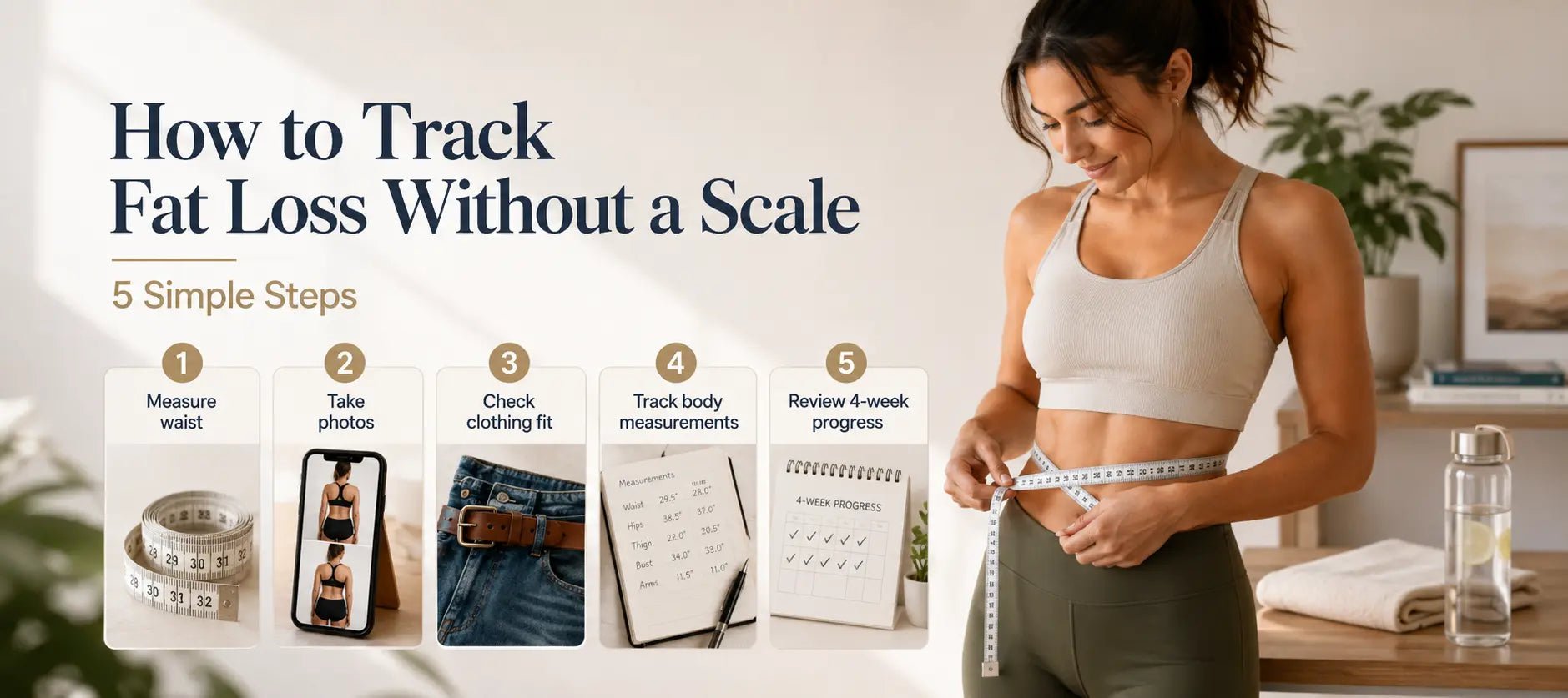
Track fat loss without a scale by measuring your waist, taking progress photos, checking clothing fit, and reviewing your 4-week progress trend.
Quick Answer: How Do You Track Fat Loss Without a Scale?
You can track fat loss without a weighing scale by measuring your waist, taking full-body measurements, using progress photos, checking how your clothes fit, tracking strength and stamina, calculating your waist-to-height ratio, and using body composition testing when needed.
The most reliable at-home method is to combine waist measurement + progress photos + clothing fit + fitness performance and compare the trend over 4 weeks, not one day.
A scale only shows total body weight. It does not tell you how much of that weight is fat, muscle, water, food, glycogen, or temporary fluid retention. BMI also does not directly measure body fat, according to the CDC.
If your waist is smaller, clothes fit better, progress photos look leaner, and your strength or energy is stable, you may be losing fat even without checking your weight.
Best Ways to Track Fat Loss Without a Scale
| Method | How Often | What It Tells You |
|---|---|---|
| Waist measurement | Every 1–2 weeks | Best simple marker for belly fat trend |
| Full-body measurements | Every 2–4 weeks | Shows changes in body size and shape |
| Progress photos | Every 2–4 weeks | Shows visible body-composition changes |
| Clothing fit | Weekly | Shows real-life changes in waist, hips, thighs, and chest |
| Strength and stamina | Weekly | Shows whether muscle and fitness are being preserved |
| Waist-to-height ratio | Monthly | Helps assess abdominal fat distribution |
| Body composition testing | Monthly or quarterly | Gives a more technical estimate of fat and lean mass |
The best approach is not to rely on one method. Use at least three tracking tools together because each method shows a different part of fat-loss progress.
Fat Loss vs Weight Loss: Why the Scale Is Not Always Necessary
Fat loss and weight loss are not the same thing.
Fat loss means your body fat mass is decreasing. This is usually the real goal when someone says they want to “lose weight,” “tone up,” “slim down,” or “lose belly fat.”
Weight loss means your total body weight has gone down. That number can include fat, water, muscle, glycogen, food in your digestive system, and normal fluid changes.
This is why a weighing scale can sometimes hide progress. You may lose fat while your scale weight stays the same because your body is also holding water, storing glycogen, gaining muscle, or recovering from exercise.
Common reasons the scale may not show fat loss clearly include:
- Water retention after salty meals
- Glycogen storage after eating more carbohydrates
- Muscle inflammation after strength training
- Menstrual-cycle-related fluid changes
- Constipation or bloating
- Food volume in the digestive system
- Body recomposition, where fat decreases while muscle is gained or preserved
So, if your goal is fat loss, the scale can be one tool, but it should not be your only tool.
Why You Can Lose Fat Without Losing Weight
You can lose fat without losing much body weight, especially if you are strength training, eating enough protein, improving sleep, or returning to exercise after a break.
This is called body recomposition.
During body recomposition, your body may lose fat while gaining or preserving lean muscle. Since muscle is denser than fat, your body may become smaller, firmer, or more defined even if your total body weight does not change much.
Signs of body recomposition include:
- Waist getting smaller
- Clothes fitting better
- Progress photos looking leaner
- Strength staying the same or improving
- Arms, shoulders, legs, or back looking more defined
- Body measurements changing even if weight does not
This is one of the biggest reasons non-scale tracking is important.
Method 1: Measure Your Waist Circumference
Waist measurement is one of the best at-home ways to track fat loss, especially if your main goal is to reduce belly fat.
Your waist is useful because abdominal fat is closely linked with metabolic health risk. NIDDK notes that a large waist size can increase the risk for weight-related health problems, and it lists waist sizes of 35 inches or more for women and 40 inches or more for men as risk-increasing thresholds. (niddk.nih.gov) Mayo Clinic also notes that waist measurements above 35 inches for women and 40 inches for men are associated with higher health risk. (mcpress.mayoclinic.org)
How to Measure Your Waist Correctly
Use the same method every time:
- Measure in the morning before eating or drinking.
- Use a soft, flexible measuring tape.
- Stand relaxed with your feet about hip-width apart.
- Keep the tape level around your body.
- Do not suck in your stomach.
- Do not pull the tape so tight that it compresses your skin.
- Breathe out normally.
- Record the number in inches or centimeters.
- Repeat once and use the average if needed.
Where Should You Measure Your Waist?
Choose one location and use it every time. You can measure:
- Just above the hip bones
- Around the narrowest part of your waist
- Around the belly button
- Midway between your lower ribs and hip bone
The exact location matters less than consistency. If you keep changing the measurement point, your data becomes unreliable.
How Often Should You Measure Your Waist?
Measure your waist once every 1–2 weeks.
Daily waist measurements are usually misleading because bloating, digestion, posture, water retention, sodium intake, and hormonal changes can temporarily change the number.
What Counts as Progress?
A waist decrease of even 0.5 to 1 inch over several weeks can be meaningful, especially if your progress photos and clothing fit also improve.
Do not judge your fat loss from one measurement. Look at the trend over 4 weeks.
Method 2: Track Full-Body Measurements
Waist measurement is important, but fat loss does not happen only from the belly. Some people notice changes first in the face, chest, back, hips, thighs, arms, or neck.
That is why full-body measurements give a better picture.
Body Parts to Measure
| Body Area | Why It Matters |
|---|---|
| Waist | Best home marker for belly-fat trend |
| Belly button area | Useful for tracking abdominal size |
| Hips | Useful for lower-body shape changes |
| Chest | Shows upper-body size changes |
| Upper arm | Helps track fat or muscle changes |
| Thigh | Useful for lower-body fat and muscle changes |
| Neck | Sometimes used in body-fat estimation formulas |
Full-Body Measurement Routine
Measure these areas every 2–4 weeks:
- Waist
- Belly button area
- Hips
- Chest
- Right upper arm
- Right thigh
- Neck
Use the same side of the body each time. For example, always measure the right arm and right thigh.
How to Avoid Measurement Mistakes
Many people think they are not losing fat because they measure incorrectly. Avoid these mistakes:
- Measuring after a heavy meal
- Measuring after intense exercise
- Measuring at night if you usually bloat
- Changing the tape position
- Pulling the tape too tight
- Flexing muscles during relaxed measurements
- Using different measuring tapes
- Comparing one week instead of a 4-week trend
Your goal is not to get the smallest possible number. Your goal is to track a consistent trend.
Method 3: Take Standardized Progress Photos
Progress photos are one of the most useful non-scale fat-loss tools because they show changes that numbers may not fully capture.
Photos can reveal:
- Smaller waistline
- Less belly projection from the side
- Better posture
- More visible shoulder, arm, back, or leg shape
- Slimmer face or jawline
- Improved muscle definition
- Better clothing fit
- Better shoulder-to-waist ratio
Progress Photo Protocol
Take photos:
- Every 2–4 weeks
- In the same room
- With the same lighting
- At the same time of day
- From the same camera distance
- Wearing the same or similar clothing
- With the same posture
- Against the same background
Take three main angles:
- Front view
- Side view
- Back view
How to Compare Progress Photos
Do not compare today’s body with yesterday’s body. Compare today’s photo with your photo from 4 weeks ago.
Look for:
- Smaller waist
- Less belly protrusion
- Better fit around hips or thighs
- More visible shape in shoulders, arms, back, or legs
- Similar or better muscle definition
- Improved posture
Photos are not perfect. Lighting, posture, clothing, camera angle, bloating, and muscle pump can affect how your body looks. Use photos as one piece of evidence, not the only proof.
Method 4: Use Clothing Fit as a Practical Progress Test
Clothing fit is one of the most practical ways to track fat loss without a weighing scale because it reflects real-life body changes.
You may be losing fat if:
- Your jeans button more easily
- Your waistband feels looser
- Your belt moves to a smaller hole
- Shirts fit better around the stomach or chest
- Trousers fit better around hips or thighs
- Workout clothes feel less tight
- Rings, watches, or bracelets feel looser
The Control Garment Method
Choose 2–3 “tracking clothes” that currently fit snugly but are not painfully tight.
Good options include:
- One fitted shirt
- One pair of jeans or trousers
- One belt
- One formal outfit
- One workout outfit
- One non-stretch garment, such as classic denim
Try them on every 1–2 weeks, preferably in the morning.
Record the fit as:
- Tight
- Snug
- Comfortable
- Loose
- Too loose
Clothing fit is not a scientific measurement, but it is highly useful when combined with waist measurements and progress photos.
Method 5: Track Waist-to-Height Ratio
Waist-to-height ratio compares your waist size with your height. It can help you understand whether you are carrying excess abdominal fat.
The NHS says waist-to-height ratio can be used alongside BMI and advises keeping waist size to less than half of height. (nhs.uk)
Waist-to-Height Ratio Formula
Waist-to-height ratio = waist circumference ÷ height
Use the same unit for both.
Example:
- Waist: 34 inches
- Height: 68 inches
- 34 ÷ 68 = 0.50
A waist size less than half your height is generally a useful target for abdominal fat risk screening.
This method is useful because it focuses on fat distribution, not just total body size.
Method 6: Track Strength, Stamina, and Energy
Fat loss should not only make you smaller. Ideally, it should also help you feel and function better.
Fitness performance does not directly measure fat loss, but it helps show whether your plan is working in a healthy and sustainable way.
Track simple markers such as:
- Push-ups
- Squats
- Plank time
- Walking distance
- Stair climbing
- Gym strength
- Running or cycling pace
- Daily step count
- Workout recovery
- Resting energy level
What Good Progress Looks Like
You are likely moving in the right direction if:
- Waist is decreasing
- Clothes fit better
- Strength is stable or improving
- Stamina is improving
- Energy is better
- Sleep is improving
- Hunger is manageable
- You can follow your plan consistently
This matters because aggressive dieting can reduce energy, performance, and recovery. A good fat-loss plan should help you become leaner without making you feel constantly exhausted.
Method 7: Use Body Composition Testing Carefully
Most people do not need advanced testing to track fat loss. Waist measurements, progress photos, clothing fit, and performance are enough for everyday progress tracking.
However, body composition testing may help if:
- You are an athlete
- You want a more precise baseline
- You have a medical condition
- Your progress is confusing despite consistency
- You are working with a coach, doctor, or dietitian
- You want periodic confirmation beyond home methods
DEXA Scan
DEXA can estimate fat mass, lean mass, and bone density. It is more advanced than home tracking, but it can be expensive and is not necessary for weekly progress tracking.
Skinfold Calipers
Skinfold calipers estimate body fat by measuring fat thickness under the skin at specific body sites.
They can be useful when:
- The same trained person measures you
- The same sites are measured each time
- You use the result for trends, not perfection
The downside is that calipers can be inaccurate if the person measuring is not trained.
Bioelectrical Impedance Analysis
Bioelectrical impedance analysis, or BIA, estimates body composition by sending a small electrical current through the body. Many smart scales and body-composition machines use this method.
BIA can be useful for trends, but hydration status, testing conditions, device quality, equations, age, sex, and body type can affect results. A review in the European Journal of Clinical Nutrition discusses BIA’s clinical utility, limitations, and need for standardization. (nature.com)
Use BIA as a trend tool, not as an exact body-fat percentage.
Which Non-Scale Method Is Most Accurate?
| Method | Reliability | Best For | Main Limitation |
|---|---|---|---|
| Waist measurement | High | Belly-fat trend | Can change with bloating |
| Full-body measurements | High | Body-size changes | Requires consistency |
| Progress photos | Medium-high | Visual changes | Lighting and posture can mislead |
| Clothing fit | Medium | Real-life progress | Subjective |
| Fitness performance | Medium | Strength and stamina | Does not directly measure fat |
| BIA/body-fat devices | Variable | Long-term trend | Hydration affects results |
| DEXA scan | High | Clinical body composition estimate | Cost and access |
For most people, the best combination is:
Waist measurement + progress photos + clothing fit + performance tracking
That combination gives a clearer picture than any single method.
Signs You Are Losing Fat Without Weighing Yourself
You may be losing fat if several of these signs are happening together:
1. Your Waist Is Getting Smaller
A smaller waist over several weeks is one of the strongest at-home signs of abdominal fat reduction.
2. Your Clothes Fit Better
If fitted clothes are looser around your waist, hips, chest, or thighs, your body size is likely changing.
3. Your Progress Photos Look Leaner
Photos can reveal changes that are difficult to notice in the mirror day to day.
4. Your Belly Looks Smaller From the Side
Side photos are especially useful for tracking belly-fat changes.
5. Your Face Looks Leaner
Some people notice fat loss first in the face, jawline, or neck.
6. Your Workouts Feel Easier
Improved endurance, strength, or recovery can suggest your fitness is improving while your body changes.
7. Your Belt, Watch, or Rings Feel Looser
Small fit changes can reflect real body-size changes.
8. Your Body Measurements Are Trending Down
A single measurement is not enough, but a downward trend across several weeks is meaningful.
9. You Feel Lighter During Movement
Walking, climbing stairs, exercising, or playing sports may feel easier as body composition improves.
The strongest evidence comes when several signs improve together.
Why It May Look Like You Are Not Losing Fat
Sometimes fat loss is happening, but the signs are hidden.
Bloating
Digestive changes can make your stomach look larger even when fat loss is occurring.
Water Retention
Exercise, sodium, stress, poor sleep, and hormonal changes can all increase water retention.
Menstrual Cycle Changes
Many women experience predictable changes in water retention, bloating, appetite, and body measurements during different phases of the menstrual cycle. For better comparison, measure at the same point in your cycle each month.
New Strength Training
When you start lifting weights or increase workout intensity, your muscles may hold more water as part of the recovery process.
Constipation
Food volume and digestion can affect waist size temporarily.
Inconsistent Measuring
Changing the tape position, measuring after meals, or sucking in your stomach can make your results unreliable.
Expecting Weekly Visual Changes
Fat loss is often slow visually. Many people need 4–8 weeks before changes are obvious in photos, measurements, or clothing fit.
The 4-Week Non-Scale Fat Loss Tracking System
The best way to track fat loss without a scale is to follow a simple 4-week system.
Week 1: Set Your Baseline
Record:
- Waist measurement
- Hip, chest, arm, and thigh measurements
- Front, side, and back photos
- How key clothing fits
- Current workout performance
- Energy, hunger, sleep, and recovery
Do not judge anything yet. Week 1 is only your starting point.
Week 2: Check Waist and Habits
Record:
- Waist measurement
- Clothing fit
- Workout performance
- Energy and hunger
Do not expect dramatic changes. You are looking for early signals.
Week 3: Repeat Measurements
Record:
- Waist measurement
- Key body measurements
- Clothing fit
- Workout performance
At this point, you may start seeing small changes.
Week 4: Compare the Full Trend
Record:
- Waist measurement
- Body measurements
- Progress photos
- Clothing fit
- Performance
- Energy and recovery
Now compare Week 1 and Week 4. If your waist is smaller, clothes fit better, photos show change, and performance is stable, your fat-loss plan is likely working.
Simple Fat Loss Tracking Template
Copy this into your notes app.
| Date | Waist | Hips | Chest | Arm | Thigh | Photos Taken? | Clothes Fit | Energy | Strength | Sleep | Hunger | Notes |
|---|---|---|---|---|---|---|---|---|---|---|---|---|
| Week 1 | Yes/No | Tight/Same/Loose | Low/Normal/Good | Lower/Same/Better | Poor/Average/Good | Low/Moderate/High | ||||||
| Week 2 | Optional | Tight/Same/Loose | Low/Normal/Good | Lower/Same/Better | Poor/Average/Good | Low/Moderate/High | ||||||
| Week 3 | Optional | Tight/Same/Loose | Low/Normal/Good | Lower/Same/Better | Poor/Average/Good | Low/Moderate/High | ||||||
| Week 4 | Yes/No | Tight/Same/Loose | Low/Normal/Good | Lower/Same/Better | Poor/Average/Good | Low/Moderate/High |
Non-Scale Progress Scorecard
Use this every 4 weeks.
| Progress Marker | Score |
|---|---|
| Waist measurement decreased | +2 |
| Progress photos look leaner | +2 |
| Clothes fit better | +2 |
| Strength or stamina is stable/improved | +1 |
| Energy is stable | +1 |
| Hunger is manageable | +1 |
| Sleep is stable or improved | +1 |
| Measurements are inconsistent | 0 |
| Waist is up for 3–4 weeks | Review plan |
How to Interpret Your Score
| Score | Meaning |
|---|---|
| 0–2 | Progress is unclear; review consistency |
| 3–5 | Some signs of progress |
| 6–8 | Strong signs of fat-loss progress |
| 9–10 | Excellent non-scale progress |
This scorecard is not a medical tool. It is a practical way to avoid obsessing over one number.
Best Tracking Plan by Goal
If You Are a Beginner
Track only:
- Waist measurement
- Progress photos
- Clothing fit
Do not overcomplicate the process.
If You Hate Weighing Yourself
Avoid the scale completely and use:
- Waist measurement every 1–2 weeks
- Photos every 4 weeks
- Clothing fit weekly
This is enough for most people.
If You Go to the Gym
Track:
- Waist
- Photos
- Strength in key lifts
- Workout recovery
- Arm, chest, hip, and thigh measurements
This helps identify body recomposition.
If You Are Trying to Lose Belly Fat
Prioritize:
- Waist measurement
- Side photos
- Clothing fit around the waistband
- Consistency with nutrition, movement, sleep, and stress
You cannot spot-reduce belly fat, but you can track whether abdominal fat is trending down.
If You Are Building Muscle While Losing Fat
The scale may be especially misleading. Track:
- Waist
- Photos
- Strength
- Body measurements
- Clothing fit
If your waist is smaller and strength is increasing, that is a strong recomposition sign.
If You Have Health Concerns
Use waist measurement as one practical marker, but speak with a healthcare professional if you have unexplained body-size changes, rapid fat loss, dizziness, fatigue, disordered eating symptoms, diabetes, PCOS, thyroid issues, pregnancy, postpartum concerns, or another medical condition.
NIDDK recommends looking for weight-loss programs that include qualified experts such as registered dietitians, mental health counselors, or exercise physiologists when support is needed. (niddk.nih.gov)
What If Your Measurements Are Not Changing?
If your measurements are not changing after 3–4 weeks, do not panic. First, check your tracking method.
1. Check Measurement Accuracy
Ask yourself:
- Am I measuring at the same time of day?
- Am I using the same tape?
- Am I measuring the same body point?
- Am I pulling the tape too tight or too loose?
- Am I measuring after meals or workouts?
2. Check Nutrition Consistency
Fat loss usually requires a calorie deficit. The CDC explains that using calories through physical activity, combined with reducing calories from food, creates a calorie deficit that results in weight loss. (cdc.gov)
Review:
- Portion sizes
- Liquid calories
- Weekend overeating
- Protein intake
- Fiber intake
- Snacks and desserts
- Restaurant meals
- Sugary drinks
- Mindless eating
3. Check Exercise Quality
If you only do cardio and eat too little protein, you may lose muscle along with fat. Add resistance training if possible.
Useful options include:
- Weight training
- Bodyweight workouts
- Resistance bands
- Squats
- Push-ups
- Lunges
- Rows
- Hip hinges
4. Check Sleep and Stress
Poor sleep and high stress can increase hunger, reduce consistency, and affect water retention. You may still be losing fat, but visible results can be hidden temporarily.
Common Mistakes When Tracking Fat Loss Without a Scale
Avoid these mistakes:
- Measuring every day
- Taking photos in different lighting
- Changing the tape position
- Pulling the tape too tight
- Expecting visible change in one week
- Only checking belly fat
- Ignoring strength training
- Comparing your body with someone else
- Trusting body-fat machines too much
- Confusing bloating with fat gain
- Ignoring sleep and stress
- Quitting before 4–6 weeks of consistent tracking
The biggest mistake is looking for daily proof. Fat loss is best judged through trends.
Who Should Be Careful With Body Tracking?
Body tracking is useful, but it should not become obsessive.
Avoid frequent measurement tracking or seek professional help if you have:
- History of an eating disorder
- Severe body-image distress
- Anxiety around body measurements
- Extreme dieting behavior
- Fear of eating normal meals
- Compulsive exercise habits
In these cases, it may be better to track health behaviors instead of body size.
Examples:
- Protein intake
- Vegetable intake
- Daily steps
- Strength training sessions
- Sleep routine
- Water intake
- Consistent meals
When to Consult a Dietitian or Healthcare Professional
Talk to a qualified professional if you experience:
- Rapid unexplained body-size changes
- Dizziness or weakness
- Hair fall
- Missed periods
- Extreme hunger
- Fatigue
- Digestive problems
- Diabetes
- PCOS
- Thyroid issues
- Pregnancy or postpartum concerns
- History of an eating disorder
- No progress despite consistent effort
Book Your Weight Loss Consultation
A registered dietitian or healthcare professional can help you track fat loss safely and choose the right plan for your body.
Final Takeaway
You do not need a weighing scale to track fat loss accurately. In many cases, non-scale methods give a better picture of real body change.
The best way to track fat loss without a scale is to combine:
- Waist measurement
- Full-body measurements
- Progress photos
- Clothing fit
- Strength and stamina tracking
- Waist-to-height ratio
- Optional body-composition testing
Do not judge your progress from one day, one photo, or one measurement. Track trends over 4 weeks.
If your waist is smaller, your clothes fit better, your photos show change, and your strength or energy is improving, you are likely making meaningful fat-loss progress even without stepping on a scale.
FAQs
How can I track fat loss without a weighing scale?
You can track fat loss without a weighing scale by measuring your waist, taking progress photos, checking clothing fit, recording full-body measurements, and tracking strength, stamina, sleep, hunger, and energy levels.
What is the most accurate way to measure fat loss at home?
The most accurate home method is to combine waist measurements, full-body tape measurements, progress photos, clothing fit, and fitness performance. No single home method is perfect, but together they show reliable trends.
Can I lose fat without losing weight?
Yes. You can lose fat without losing much weight if you gain or preserve muscle at the same time, retain water, or have normal changes in food volume and digestion. This is common during body recomposition.
How do I know if I am losing belly fat?
You may be losing belly fat if your waist measurement decreases, your belly looks smaller in side-view photos, your shirts fit better around the stomach, and your belt becomes looser.
How often should I measure my body for fat loss?
Measure your waist every 1–2 weeks and full-body measurements every 2–4 weeks. Daily measurements are usually misleading because bloating, hydration, digestion, and hormones can change your numbers temporarily.
Are progress photos better than the scale?
Progress photos are not always better, but they show visual body-shape changes that the scale cannot show. They are most useful when taken consistently every 2–4 weeks.
Can clothes show fat loss?
Yes. Looser clothes, easier buttoning, and smaller belt holes can show fat loss or inch loss, especially around the waist, hips, thighs, and stomach.
Is waist measurement enough to track fat loss?
Waist measurement is very useful, but it is better to combine it with progress photos, clothing fit, full-body measurements, and performance tracking for a more complete picture.
Are body fat scales accurate?
Body fat scales can help track trends, but they are not perfectly accurate. Hydration, testing conditions, device quality, and individual differences can affect the reading.
What should I track instead of body weight?
Track waist size, hip size, progress photos, clothing fit, strength, stamina, energy, sleep, hunger, and consistency with nutrition and exercise habits.
How long does it take to see fat loss without a scale?
Many people need 4–8 weeks before fat loss becomes obvious in photos, measurements, or clothing fit. Early changes in the first 1–2 weeks may be related to water, bloating, digestion, or food volume.
What if my waist measurement changes but photos look the same?
That can happen early. Measurements often show progress before photos do. Compare photos every 4 weeks instead of every few days.
What if photos improve but measurements do not?
Your body shape, posture, muscle definition, or fat distribution may be changing. Keep tracking for another few weeks and look at the full trend.
Do I need a scale to lose fat?
No. A scale can help, but it is not required. You can track fat loss effectively with waist measurements, body measurements, progress photos, clothing fit, and performance markers.
We rely on peer-reviewed studies and reputable medical journals.