

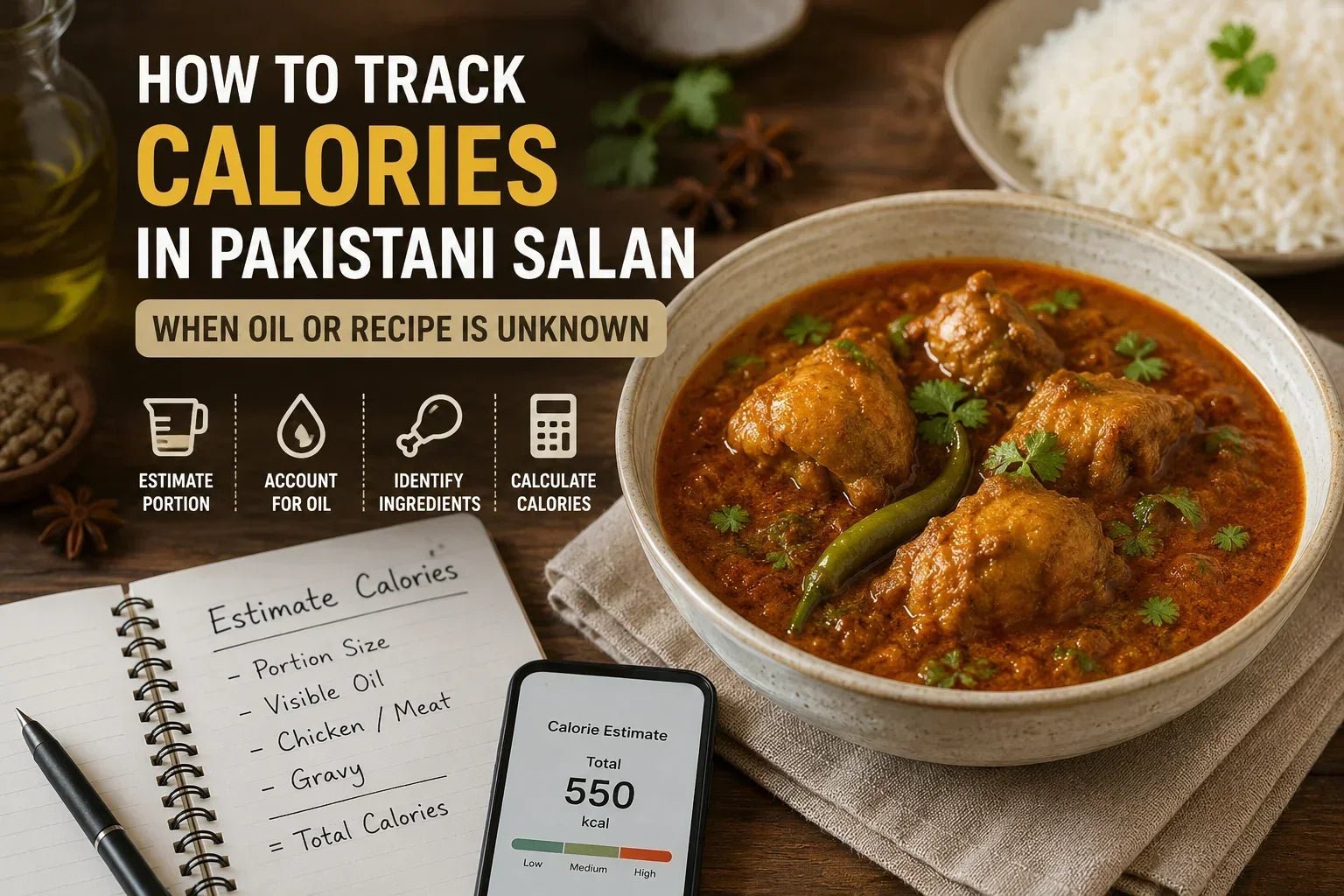
How to Track Calories in Pakistani Salan When Oil Is Unknown
Don’t know how much oil went into your homemade salan? Learn a practical, evidence-based method to estimate calories in Pakistani curries when the recipe is unknown.
If you do not know how much oil or which exact ingredients were used in a Pakistani salan, you cannot calculate its exact calories.
But you can still make a useful estimate.
The most practical method is to:
- Weigh the amount of salan you eat.
- Estimate the main ingredient such as chicken, beef, mutton, daal, chickpeas, potatoes or vegetables.
- Account for important gravy ingredients such as yogurt, potatoes, cream, nuts or fried onions when relevant.
- Estimate cooking oil or ghee separately.
- If the oil is unknown, use a reasonable calorie range instead of inventing one exact number.
- Log the estimate consistently.
- If your family cooks the same salan often, measure one normal batch and save it as your household recipe.
A useful formula is:
The goal is not laboratory-level accuracy.
The goal is to make the best reasonable estimate from the information you actually have.
Quick Decision Guide
| What you know | Best way to track the salan |
|---|---|
| You know the complete recipe | Calculate all ingredients and divide by final cooked weight |
| You know roughly how much oil went into the pot | Estimate oil per portion from the whole batch |
| You know the ingredients but not their exact amounts | Estimate the major ingredients and cooking fat |
| You know your serving weight but not the recipe | Estimate the main ingredient, gravy and oil separately |
| Nobody knows how much oil was used | Use similar recipes to create a reasonable oil range |
| You only have a food photo | Use it for clues, not an exact calorie count |
| You eat the same family salan often | Measure one typical batch and save it |
| Your calorie app shows very different values | Choose the closest recipe or build your own estimate |
Why Pakistani Salan Is Difficult to Count Accurately
Pakistani salan is a mixed dish.
Unlike a banana, boiled egg or plain piece of bread, its calories are spread across several ingredients.
A chicken salan may contain:
- chicken;
- cooking oil or ghee;
- onions;
- tomatoes;
- yogurt;
- potatoes;
- spices;
- water.
A qorma may also contain fried onions, nuts, seeds, cream or more cooking fat.
A daal may contain lentils plus a separate oil or ghee tarka.
Two bowls that look almost identical can therefore contain very different amounts of energy.
Oil is often the biggest unknown
Fat provides about 9 calories per gram, compared with about 4 calories per gram from protein or carbohydrate.[1]
That means even a fairly small difference in oil can change the calorie estimate.
For example:
- 5 g fat ≈ 45 kcal
- 10 g fat ≈ 90 kcal
- 15 g fat ≈ 135 kcal
- 20 g fat ≈ 180 kcal
This does not mean every serving of salan contains 5, 10, 15 or 20 grams of oil.
Those numbers simply show why unknown cooking fat matters.
The recipe changes from family to family
There is no universal recipe for:
- chicken salan;
- daal;
- aloo gosht;
- chana;
- keema;
- bhindi;
- baingan;
- qorma;
- karahi.
One household may use little oil.
Another may use much more.
One chicken curry may contain mostly lean meat and thin tomato gravy. Another may use fattier chicken, more oil and thicker masala.
That is why searching for “1 bowl chicken salan calories” cannot give one reliable answer for every home.
The contents of each serving can differ
Even within the same pot, two servings may not be identical.
One person may take:
- two chicken pieces;
- little gravy.
Another may take:
- one chicken piece;
- a large amount of gravy.
The same problem occurs with aloo gosht, where one bowl may contain more meat and another more potatoes.
Water changes weight without adding calories
Water increases the weight and volume of salan but does not add calories.
A thinner daal may therefore contain fewer calories per 100 g than a thicker daal made with similar ingredients.
This is one reason that weight alone cannot tell you the calories of an unknown mixed dish.
Bones can distort meat estimates
If a chicken piece weighs 130 g, that does not mean you ate 130 g of chicken.
Part of that weight may be:
- bone;
- cartilage;
- skin;
- attached gravy.
For bone-in salan, estimating the edible portion can improve accuracy.
The Best Method for Estimating Unknown Pakistani Salan Calories
Step 1: Weigh the Salan You Actually Eat
If you have access to a kitchen scale, start there.
Instead of recording:
“1 bowl chicken salan”
record:
“275 g chicken salan”
A bowl is not a standard measurement.
One household bowl may contain 180 g while another may hold 350 g or more.
How to weigh your serving
- Put your empty bowl or plate on the scale.
- Press tare or zero.
- Add your salan.
- Record the weight.
- Weigh any second serving too.
Weighing does not reveal the hidden recipe.
It simply removes one major source of uncertainty: how much food you actually ate.
Step 2: Identify the Main Calorie-Containing Ingredient
Ask:
What is this salan mainly made from?
Chicken salan
Focus mainly on:
- chicken;
- cooking fat;
- gravy.
Aloo gosht
Focus on:
- meat;
- potatoes;
- cooking fat;
- gravy.
Daal
Focus on:
- lentils;
- cooking fat or tarka;
- other substantial additions.
Chana salan
Focus on:
- chickpeas;
- potatoes if included;
- cooking fat;
- gravy.
Bhindi or baingan
Focus on:
- vegetables;
- cooking oil.
Qorma
You may need to consider:
- meat;
- oil or ghee;
- yogurt;
- fried onions;
- nuts or seeds if used;
- cream or other rich ingredients if used.
You usually do not need to calculate every chilli, coriander leaf or pinch of spice when estimating an unknown meal.
Start with the ingredients that can meaningfully affect the total.
Step 3: Estimate How Much of the Main Ingredient You Ate
If possible, estimate or weigh the edible amount separately.
For boneless chicken, beef or mutton, you may be able to remove the meat from the gravy and weigh it.
Then use a reliable food-composition source for the closest matching food.
USDA FoodData Central is one useful database for basic ingredients.[2]
FAO/INFOODS also maintains information about national and regional food-composition databases, including food-composition resources for Pakistan.[3][4]
Match cooked food with cooked data
If you weigh cooked chicken, use a suitable cooked chicken entry.
If you measure an ingredient raw while calculating a recipe, use a suitable raw entry.
Food weight can change during cooking because water is lost or absorbed.
As a result, calories per 100 g may differ between raw and cooked versions even though cooking itself does not magically create energy.
Step 4: Estimate the Gravy and Important Additions
Do not automatically treat gravy as calorie-free.
Pakistani salan gravy may contain:
- onion;
- tomato;
- yogurt;
- oil;
- ghee;
- potatoes;
- chickpeas;
- cream;
- coconut;
- nuts;
- seeds;
- fried onions.
Water and many spices may contribute little to the calorie total compared with the main ingredients.
But ingredients such as potatoes, yogurt, cream, nuts and cooking fat can matter.
A useful question is:
Which calorie-containing ingredients are likely to be hiding in this gravy?
You do not need to physically separate every ingredient.
The purpose is to stop treating the entire bowl as one mysterious food.
Step 5: Estimate the Unknown Oil or Ghee
For many homemade salans, this is the hardest step.
Best case: you know the amount used
If the cook knows the amount of oil added to the entire pot, include that oil in the recipe calculation.
Second-best case: the cook remembers roughly
You do not need an answer in exact grams.
Instead of asking:
“Exactly how many grams of oil did you use?”
ask:
“Was it a few tablespoons, around a quarter cup, around half a cup, or more?”
You can also ask:
- Was it a small amount, normal amount or generous amount?
- How much chicken or meat went into the pot?
- How many people did it feed?
- Was ghee added too?
- Was there a separate tarka?
- Were the onions fried in extra oil?
A rough answer is better than no information.
If the oil is completely unknown
Do not automatically add a fixed number of tablespoons to every serving.
Instead:
- Find several recipes for the same type of dish.
- Look for recipes with a similar amount of meat, daal or vegetables.
- Compare the amount of cooking oil used.
- Compare the total cooked quantity or number of realistic servings.
- Use those recipes to build a reasonable range, not an exact number.
For example, your non-oil ingredients might reasonably be estimated at 250 kcal.
After looking at comparable recipes and what you know about the dish, you might decide that the oil uncertainty in your portion is equivalent to another 50–120 kcal.
Your estimate becomes:
That range is specific to the assumptions used in the example.
It is not a standard calorie range for all Pakistani salan.
Can You Tell How Much Oil Is in Salan Just by Looking at It?
Not exactly.
Appearance can give clues.
For example, a salan with a clear layer of separated oil may reasonably be treated as richer than a very thin curry with little visible fat.
But sight alone cannot tell you:
- how much oil entered the entire pot;
- how much stayed behind;
- how much is mixed into onions or gravy;
- how much entered your serving;
- how much fat came naturally from the meat.
Visible oil is therefore a clue, not a measuring tool.
A better rule is:
Use appearance to adjust your estimate, not to create false precision.
A Practical Low–Middle–High Method for Unknown Oil
When the oil cannot be measured, you can create scenarios instead of pretending there is one exact answer.
Lower estimate
A lower estimate may be more reasonable when:
- the household normally uses little oil;
- the cook confirms the dish was made with less oil;
- the curry is thin;
- very little oil is visible;
- you ate little gravy.
Middle estimate
A middle estimate may fit when:
- it appears to be normal home-style salan;
- some oil is visible;
- the cook cannot remember the quantity;
- there is no reason to assume either unusually low or unusually high oil.
Higher estimate
A higher estimate may fit when:
- a large amount of separated oil is visible;
- the cook says a generous quantity was used;
- the dish contains ghee or other extra fats;
- it is a richer preparation such as some qormas or restaurant-style curries.
The goal is to choose the narrowest reasonable range supported by what you know.
How to Calculate Salan Calories When You Know the Full Recipe
If the complete recipe is available, you can make a much stronger estimate.
Use this method:
- Record the amount of every major ingredient.
- Include all oil and ghee.
- Calculate the calories for each ingredient.
- Add them to get total recipe calories.
- Cook the salan.
- Weigh the finished batch.
- Calculate calories per gram or per 100 g.
- Weigh the portion you eat.
Formula
Then:
Example
Suppose:
Total recipe calories = 2,400 kcal
Final cooked weight = 1,600 g
Calories per gram:
2,400 ÷ 1,600 = 1.5 kcal/g
If you eat 250 g:
250 × 1.5 = 375 kcal
You could also calculate:
Calories per 100 g = total recipe calories ÷ final cooked weight × 100
This is generally more useful than saying the pot contains “six servings,” because six servings may not actually be equal.
What If Some Oil Is Left in the Pot?
If you count all the oil added to a recipe but a visible amount remains uneaten in the pot, the calculation may slightly overestimate how much oil was actually consumed.
However, you also should not assume:
“I did not eat the visible oil, so I ate no cooking oil.”
Some fat may remain mixed into:
- gravy;
- meat;
- lentils;
- onions;
- vegetables.
Unless the leftover oil is measured, the exact amount eaten is still uncertain.
For normal calorie tracking, a reasonable estimate is usually more practical than trying to recover every gram of leftover oil.
Example: How to Estimate Chicken Salan Calories Without the Recipe
Imagine you eat 250 g of homemade chicken salan.
You know:
- the serving contains chicken;
- the gravy is mainly onion and tomato;
- no potatoes are present;
- the oil was not measured.
First, estimate the edible chicken using a suitable food database.
Next, make a reasonable estimate for the non-oil gravy.
For illustration only, suppose:
Chicken + non-oil gravy = 215 kcal
Now consider oil uncertainty.
If your possible scenarios are:
- 5 g oil → about 45 kcal;
- 10 g oil → about 90 kcal;
- 15 g oil → about 135 kcal;
then the example totals become:
- 260 kcal
- 305 kcal
- 350 kcal
You could therefore record the example as approximately:
or choose a reasonable point within that range based on what you know about the dish.
The key lesson is not that chicken salan contains 260–350 calories.
It does not have one universal calorie range.
The lesson is how to build an estimate instead of copying a random “chicken curry” value from an app.
How to Track Bone-In Chicken Salan
Bone-in chicken creates a common tracking problem.
Suppose your chicken piece weighs 140 g before you eat it.
After eating, the leftover bone weighs 40 g.
A rough edible-weight calculation is:
You can then use approximately 100 g as the starting point for estimating the chicken you consumed.
Remember that the original piece may also contain:
- skin;
- cartilage;
- attached gravy.
If you ate the gravy too, estimate that separately.
This method is usually better than treating the full bone-in weight as edible chicken.
How to Estimate Beef or Mutton Salan Calories
Use the same basic method:
But meat fat deserves extra attention.
Calories can vary according to:
- lean versus fatty cuts;
- visible fat;
- bone;
- portion size;
- cooking fat added to the pot.
Do not assume all fat in a meat salan came from cooking oil.
Beef and mutton may contribute their own fat as well.
How to Calculate Aloo Gosht Calories
Break aloo gosht into four major parts:
- edible meat;
- potatoes;
- gravy;
- cooking oil or ghee.
A bowl containing one small meat piece and lots of potato will not have the same composition as a bowl containing more meat and fewer potatoes.
This is why generic entries such as:
“1 bowl aloo gosht”
should be treated cautiously unless the recipe and serving size closely match your meal.
How to Estimate Daal Calories When the Tarka Is Unknown
Daal may seem simple to track, but the tarka can change its calorie content.
Estimate:
- cooked lentils;
- onion or tomato base if substantial;
- oil or ghee used in cooking;
- oil or ghee used in tarka;
- fried onions, butter or cream if added.
Water matters
Adding more water does not add calories.
It spreads the existing calories across a larger final weight.
That means two bowls of daal of the same weight may differ if one is very watery and the other is thick and concentrated.
Example
Suppose you estimate the lentils and non-oil ingredients in your bowl at about 170 kcal.
If the unknown tarka could plausibly contribute between 3 g and 10 g of fat in your specific example:
3 g × 9 ≈ 27 kcal
10 g × 9 ≈ 90 kcal
The example estimate becomes roughly:
197–260 kcal
Again, this is a demonstration of the method, not a universal calorie range for daal.
How to Estimate Chana Salan Calories
For chana salan, chickpeas are usually one of the main calorie sources.
Estimate:
- cooked chickpeas;
- potatoes if present;
- gravy;
- oil or ghee.
Do not estimate chana by using a daal entry simply because both foods are legumes.
Use a suitable cooked chickpea entry from a reliable database when possible.
How to Estimate Bhindi, Baingan and Vegetable Salan
A raw vegetable may be relatively low in calories, but the finished vegetable dish is not automatically low-calorie.
Cooking fat may become a major part of the final energy content.
For vegetable salan, ask:
- How much vegetable did I eat?
- Was it shallow-fried or heavily bhunoed?
- How much oil was likely used?
- Did I eat the oily masala or leave some behind?
Preparation matters as much as the name of the vegetable.
How to Estimate Karahi, Qorma and Richer Curries
Do not treat every Pakistani curry as ordinary chicken salan.
Depending on the recipe, richer dishes may contain more:
- oil;
- ghee;
- butter;
- yogurt;
- cream;
- fried onions;
- nuts;
- seeds;
- fattier meat.
A generic “chicken curry” app entry may therefore badly represent a rich chicken qorma.
When choosing a comparison recipe or calorie-app entry, match the style of dish, not just the main protein.
Should You Count Salan Gravy Separately?
If you eat a meaningful amount of gravy, yes, it should be included.
Consider three different plates.
Mostly meat, little gravy
The estimate may be driven mainly by:
- edible meat;
- attached sauce;
- some cooking fat.
Normal meat-to-gravy ratio
Estimate both the meat and gravy.
Mostly gravy
Gravy ingredients and cooking oil may become a much larger part of the total.
Someone who eats two chicken pieces with little gravy may have a different calorie intake from someone who eats one small piece but uses a large amount of gravy with roti or rice.
Does Leaving the Gravy Reduce Calories?
Usually, eating less gravy will reduce the amount of whatever calories were present in that gravy.
But you cannot say that leaving a certain amount behind always saves a specific number of calories.
The gravy may contain different amounts of:
- oil;
- onions;
- tomato;
- yogurt;
- potatoes;
- cream;
- other ingredients.
If you clearly leave a large amount of oily gravy uneaten, it may be reasonable to use the lower end of your estimate.
Do not subtract an exact number of calories unless you actually have enough information to calculate it.
Does Removing Visible Oil From the Top Reduce Calories?
If you physically leave some visible oil uneaten, you probably consume less of that oil.
But you still cannot know the exact calorie reduction just by looking.
Oil may remain mixed into the salan even after visible oil is removed.
So:
less visible oil eaten probably means fewer calories, but the exact difference is unknown unless measured.
How to Track Restaurant, Dawat or Wedding Salan
Restaurant and event food is more difficult because you usually have even less recipe information.
Use this order:
- Estimate your serving size.
- Identify the main ingredients.
- Consider whether it is a rich or relatively simple preparation.
- Look for restaurant or recipe entries that match the actual dish style.
- Use a range if oil, cream, ghee or other fats are uncertain.
Do not automatically choose:
- the lowest calorie app result; or
- an extremely high number simply because it is restaurant food.
Choose the estimate that best matches the available evidence.
What If You Do Not Have a Kitchen Scale?
You can still track salan.
Your uncertainty will simply be higher.
Use consistent household measures such as:
- cups;
- tablespoons;
- ladles;
- serving spoons;
- number of chicken pieces;
- number of potato pieces;
- your usual bowl.
For example, if you regularly use the same bowl at home, measure its typical filled weight once when a scale is available.
You will then have a better idea of what your usual serving looks like.
Whenever practical, grams are still more useful than vague labels such as “one bowl.”
How to Use MyFitnessPal, FatSecret, Cronometer or Other Calorie Apps for Salan
Calorie-tracking apps can help record your estimate.
They cannot know an unknown family recipe.
Searching:
“chicken curry”
may return entries made from very different recipes.
One may contain:
- lean chicken;
- little oil.
Another may contain:
- coconut milk;
- cream;
- much more oil.
Another may be an unverified user-created entry.
Better method
Use the app as a recording tool, not as a substitute for reasoning.
When possible:
- use reliable ingredient entries;
- match raw foods with raw entries and cooked foods with cooked entries;
- estimate the main ingredients yourself;
- account for oil;
- create a custom food or custom recipe.
You might save an entry as:
“Home Chicken Salan – Estimated”
If your family prepares it similarly each time, this can make future tracking easier.
Can AI or ChatGPT Calculate Salan Calories From a Photo?
A photo can help with an estimate, but it cannot reveal the exact hidden recipe or oil quantity.
Research on image-based dietary assessment shows that mixed dishes can be difficult because foods overlap, ingredients may be hidden, and portion or calorie estimation can contain error.[5][6][7]
A picture may help identify:
- the type of dish;
- number of chicken pieces;
- visible potatoes;
- approximate amount of gravy;
- visible oil;
- rough portion size.
But a picture alone usually cannot tell whether the cook added:
- 30 g oil;
- 60 g oil;
- 100 g oil;
- extra ghee;
- hidden cream or other fats.
This is especially important for salan because much of the cooking fat can be mixed into the gravy.
How to get a better AI calorie estimate
If using an AI tool, give it more than a photo.
Useful information includes:
- total portion weight;
- exact dish name;
- number and type of meat pieces;
- bone-in or boneless;
- amount of gravy;
- potatoes or chickpeas;
- visible oil level;
- any information about the whole recipe;
- approximate oil used in the pot;
- number of people or amount of food the recipe served.
For example:
“This is 270 g homemade Pakistani chicken salan. It has one bone-in thigh and onion-tomato gravy. The pot used approximately 1 kg chicken and my family thinks around half a cup of oil was used.”
That gives an AI system far more useful information than a photo by itself.
How Accurate Does Your Salan Calorie Estimate Need to Be?
The answer depends on the information available.
| Information available | Practical confidence |
|---|---|
| Exact recipe + oil + final cooked weight | Highest |
| Approximate recipe + weighed serving | Good |
| Weighed serving + main ingredient + unknown oil | Moderate |
| Dish name + rough portion | Low |
| Photo alone | Lowest |
A number can look very precise without actually being accurate.
For example:
342 kcal
looks more scientific than:
300–380 kcal
But if the cooking oil is unknown, the range may actually represent the evidence more honestly.
That does not mean ranges are always better.
If the recipe is known, calculate it more closely.
If important information is missing, admit the uncertainty.
Which Number Should You Log: Low, Middle or High?
Do not automatically log the highest number just because you want to lose weight.
And do not always choose the lowest number because it fits your calorie goal.
Use the available evidence.
For example:
- clearly lighter preparation → move toward the lower end;
- ordinary home preparation → a middle estimate may fit;
- clearly richer preparation → move upward.
Most importantly, use the same decision rule consistently.
If similar portions of your household chicken salan are usually logged around the same value, your food diary becomes more useful for observing patterns over time.
Consistency does not turn an estimate into a fact.
It simply reduces random changes in the way you record similar meals.
Eat the Same Salan Often? Calibrate It Once
This is one of the best long-term solutions.
If your household regularly cooks chicken salan, daal, aloo gosht or another dish in roughly the same way, measure one normal batch.
Next time it is prepared:
- weigh or record the main ingredients;
- measure the oil or ghee;
- calculate total recipe calories;
- weigh the final cooked salan;
- calculate calories per 100 g;
- save the recipe in your app.
Then you have:
“Our chicken salan”
instead of:
“random chicken curry entry from the internet.”
Future batches will still vary.
But your own household recipe is usually a better starting point than an unrelated recipe.
Common Mistakes When Counting Calories in Pakistani Salan
1. Logging only “one bowl”
Bowls do not have a standard size.
Weigh your serving when possible.
2. Counting the chicken but ignoring cooking fat
Oil and ghee can meaningfully change the calorie total.
3. Adding a fixed amount of oil to every salan
There is no universal amount of oil per serving.
Use what you know about the actual dish.
4. Counting bone as edible meat
For bone-in meat, estimate the edible portion.
5. Ignoring potatoes, chickpeas or rich gravy ingredients
These can add meaningful calories.
6. Assuming all visible oil equals all the oil
Some fat may remain mixed throughout the dish.
7. Assuming vegetables automatically mean low calories
Cooking method matters.
8. Using raw nutrition data for a cooked weight
Match the food entry to the way you measured it.
9. Choosing the first calorie-app entry
The underlying recipe may be completely different.
10. Trusting a photo as an exact calorie measurement
Photos cannot reliably reveal hidden cooking fats and recipe details.
11. Spending time counting tiny spices while guessing the major ingredients
Focus first on meat, lentils, potatoes, chickpeas, oil, ghee and other ingredients that can materially change the total.
12. Pretending an estimate is exact
When information is missing, say that it is an estimate.
30-Second Pakistani Salan Calorie Checklist
Before logging your meal, ask:
- How much salan did I eat?
- Can I weigh it in grams?
- What is the main ingredient?
- How much of that ingredient did I actually eat?
- Was any of the weight bone?
- Did it contain potatoes, chickpeas, yogurt, cream, nuts or other major additions?
- How much gravy did I eat?
- Do I know anything about the total oil or ghee used?
- Does the preparation appear lighter, normal or richer than usual?
- Would a calorie range be more honest than an exact number?
If you can answer most of these questions, you can usually create a useful estimate.
Frequently Asked Questions
How do I count calories in salan when my mother cooks it?
Weigh your serving if possible, estimate the main ingredients, and ask your mother or the person who cooked it for rough recipe details.
You do not need exact grams.
Even knowing approximately how much chicken, daal, meat or oil went into the whole pot can improve your estimate.
If the oil remains unknown, use a reasonable range based on comparable recipes.
How many calories are in one bowl of chicken salan?
There is no single reliable calorie value for one bowl of chicken salan.
It depends on:
- bowl size;
- chicken cut;
- amount of edible chicken;
- skin;
- cooking oil;
- gravy;
- potatoes or other ingredients.
A weighed portion with some recipe information is much more useful than the phrase “one bowl.”
How do I estimate oil in homemade curry?
The best option is to estimate the amount used in the entire recipe.
If the cook remembers roughly, use that.
If nobody knows, compare several similar recipes and create a reasonable low-to-high range for the oil contribution.
Do not assume every serving contains a fixed number of tablespoons.
Should I overestimate salan calories if I am trying to lose weight?
Do not deliberately choose an unrealistic high number.
Use the most reasonable estimate supported by what you know.
The purpose of calorie tracking is to create useful information, not to punish yourself for an uncertain meal.
How do I track desi food calories?
For mixed desi foods, break the dish into its major calorie sources.
For salan, that usually means:
main ingredient + important additions + gravy + cooking fat
Weigh your serving whenever practical.
Can I count the chicken and ignore the gravy?
Only if you eat very little or none of the gravy.
If you eat the gravy, it may contain oil and other calorie-containing ingredients and should be considered.
Does adding water to salan increase its calories?
No.
Water adds weight and volume but no calories.
It can therefore lower the calorie density per 100 g by spreading the same food energy through a larger final weight.
Does removing oil from the top reduce calories?
If you leave that oil uneaten, you probably consume fewer calories.
But you cannot know the exact amount removed unless it is measured.
The remaining salan may still contain oil.
How do I calculate calories in bone-in chicken curry?
One practical method is:
weight of chicken piece before eating − leftover bone weight = approximate edible amount
Then estimate the gravy separately.
Can MyFitnessPal accurately track homemade Pakistani salan?
It can record your estimate, but it cannot know your family recipe.
Avoid blindly using the first curry entry you find.
Choose ingredient entries that match your food or build your own recipe when possible.
Can ChatGPT calculate Pakistani food calories?
AI can help calculate a range if you provide useful information.
The estimate improves when you include:
- serving weight;
- dish name;
- meat quantity;
- bone-in or boneless;
- gravy amount;
- visible additions;
- approximate recipe details;
- likely cooking oil.
A photo alone cannot reveal the exact hidden oil quantity.
Should I count spices in salan?
For a full recipe calculation, you may include them.
For an unknown meal, it is usually more useful to first estimate ingredients that can make a larger difference, such as:
- meat;
- daal;
- chickpeas;
- potatoes;
- oil;
- ghee;
- cream;
- nuts.
What should I do if my calorie app shows five very different values for chicken curry?
Do not automatically choose the lowest or highest.
Look for the entry whose:
- dish style;
- ingredients;
- portion size;
- meat type;
- richness
most closely match your meal.
If none fits, build your own estimate.
How accurate does calorie tracking need to be?
It does not need to produce laboratory-perfect numbers to be useful.
Use better information when it is available.
When the recipe is known, calculate more precisely.
When important information is unknown, use a reasonable range and record it consistently.
Need Personalized Help With Calories and Pakistani Meals?
Get individualized nutrition guidance for your goals, portions, calorie intake and everyday Pakistani meals.
Book an MNT Dietitian ConsultationBottom Line
If you do not know the recipe or how much oil was used in Pakistani salan, you cannot know its exact calorie count.
But that does not mean you have to give up on tracking it.
Use this method:
Start with the amount you actually ate.
Estimate the main ingredient.
Account for potatoes, chickpeas, gravy and other meaningful additions.
Treat unknown oil as a source of uncertainty instead of automatically assigning it an exact number.
If your family cooks the same dish regularly, measure one typical batch and save it.
The most important principle is simple:
Do not chase an exact calorie number when the information required to calculate that number does not exist. Aim for the most reasonable, repeatable estimate you can make.
That method works for chicken salan, daal, aloo gosht, chana, beef or mutton salan, bhindi, baingan, qorma, karahi and many other homemade Pakistani dishes.
We rely on peer-reviewed studies and reputable medical journals.