


Pakistani Food Calorie Chart: Calories per Serving and 100 g
Use this Pakistani food calorie chart to compare calories in roti, naan, biryani, daal, curries, snacks, chai and sweets by serving size and per 100 g. It also explains why recipes vary and how to...
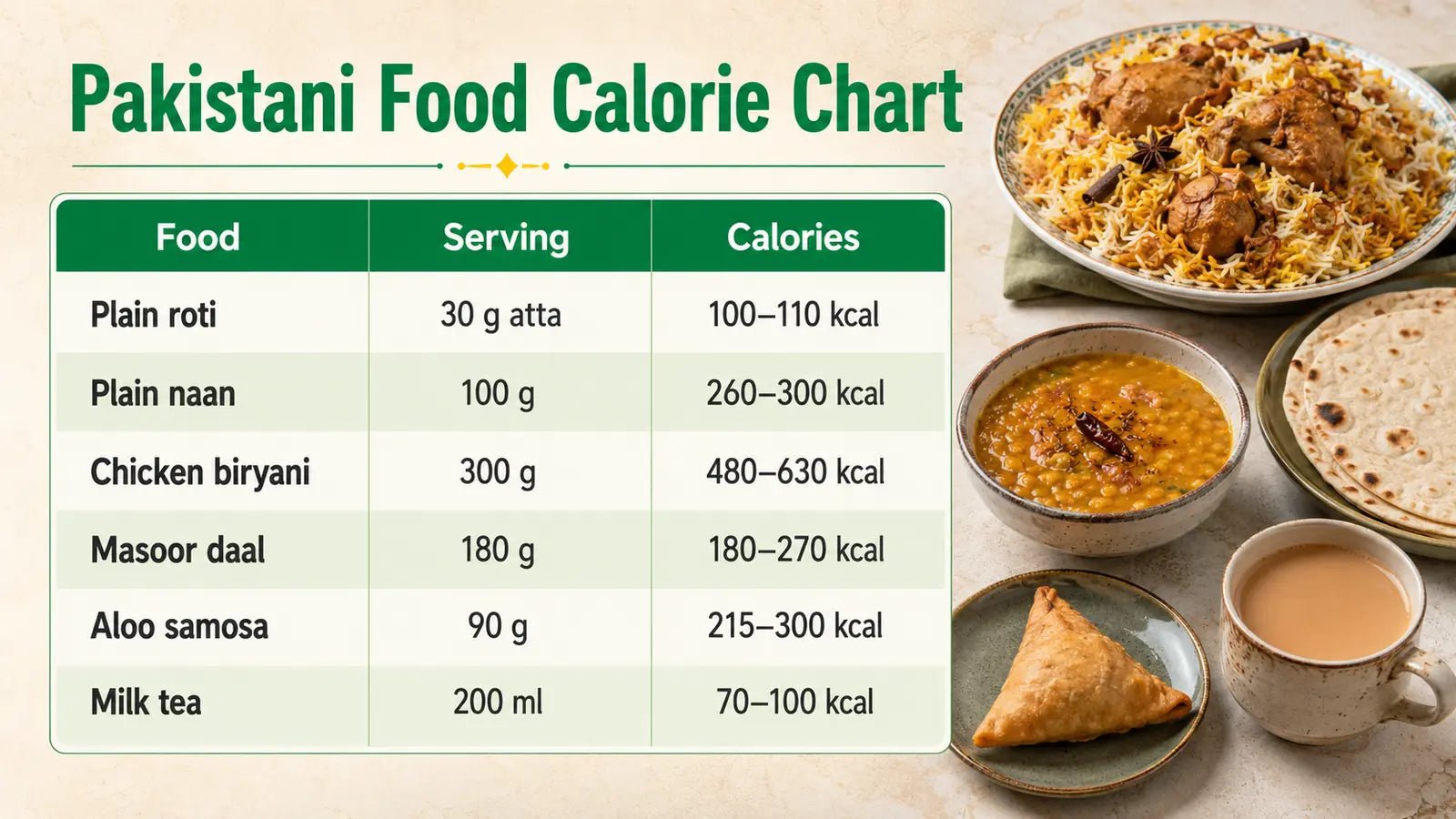
Direct answer: Calories in Pakistani food depend on the serving size, recipe, and amount of oil or ghee used. A plain roti made with 30 g of dry atta provides about 100–110 calories, while one made with 40 g of dry atta provides about 130–150 calories. A 100 g plain naan has about 260–300 calories, and a 300 g household plate of chicken biryani has about 480–630 calories.
Use the serving column to estimate what you ate. Use the per-100 g column to compare foods. Mixed dishes are shown as ranges. Two recipes with the same name can contain very different amounts of oil, meat, sugar, and water.
Important: These values are practical estimates, not exact nutrition-label numbers. Unless stated otherwise, weights refer to cooked, edible food. If a packaged food has a nutrition label, use the label.
In nutrition, Calories and kilocalories (kcal) mean the same thing.
This guide covers common desi foods, from roti, rice, and daal to karahi, street food, chai, and Pakistani sweets.
Pakistani Food Calories at a Glance
| Pakistani food | Practical serving | Estimated calories | Approx. calories per 100 g or 100 ml |
|---|---|---|---|
| Plain roti or chapati | Made with 30 g dry atta | 100–110 kcal | 250–300 kcal per 100 g cooked |
| Plain roti or chapati | Made with 40 g dry atta | 130–150 kcal | 250–300 kcal per 100 g cooked |
| Plain naan | 1 medium, 100 g | 260–300 kcal | 260–300 kcal |
| Plain paratha | 1 medium, 90 g | 250–310 kcal | 280–340 kcal |
| Boiled white rice | 1 cup, 160 g | 180–220 kcal | 115–135 kcal |
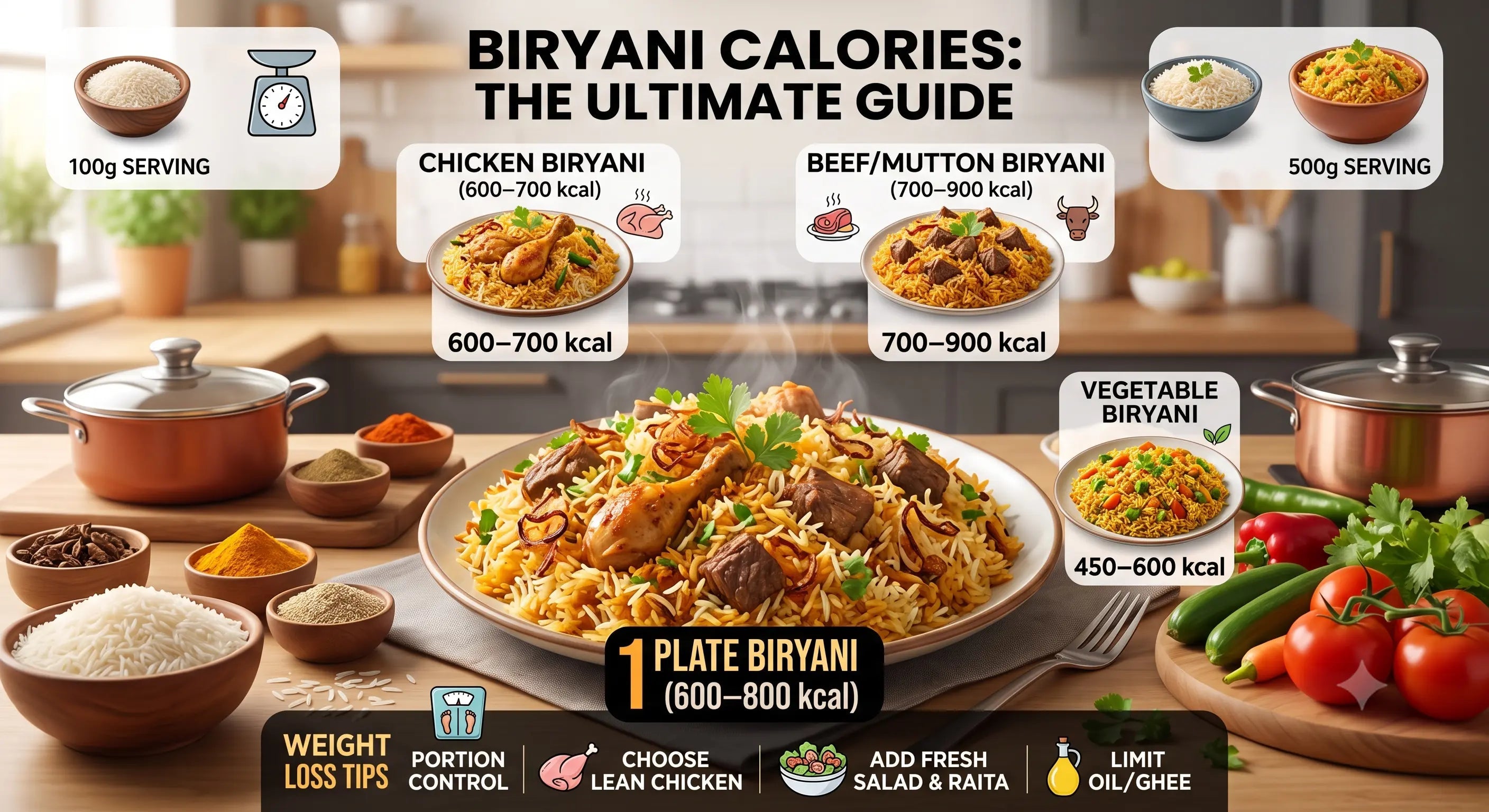
| Chicken biryani | 1 household plate, 300 g | 480–630 kcal | 160–210 kcal |
| Moong or masoor daal | 1 katori, 180 g | 160–270 kcal | 90–150 kcal |
| Chicken salan or curry | 1 bowl, 200 g | 300–440 kcal | 150–220 kcal |
| Mixed sabzi | 1 katori, 180 g | 160–265 kcal | 90–145 kcal |
| Aloo samosa | 1 medium, 90 g | 215–300 kcal | 240–330 kcal |
| Pakistani milk tea with sugar | 1 cup, 200 ml | 70–100 kcal | 35–50 kcal per 100 ml |
| Gulab jamun | 1 medium, 50 g | 150–220 kcal | 300–440 kcal |
In This Guide
- How to use the serving and per-100 g values
- Calories in roti, naan, paratha, rice, pulao, and biryani
- Calories in daal, chana, beans, and Pakistani sabzi
- Pakistani breakfast calories
- Calories in chicken, beef, mutton, curries, and fish
- Calories in snacks and street food
- Calories in chai, lassi, and other drinks
- Calories in Pakistani sweets and desserts
- Calories in common Pakistani meals
- Why the same dish can have different calories
- Raw versus cooked food weight
- How to calculate calories in homemade Pakistani food
- How to use the chart for weight loss
- Common calorie-counting mistakes
- Frequently asked questions
- Methodology and references
How to Read This Pakistani Food Calorie Chart
Use these rules to avoid the most common tracking errors:
- Match the food and the weight. “One plate” is not a standard serving. A 300 g plate of biryani and a 500 g restaurant plate are not equal.
- Check whether the weight is raw or cooked. Do not use a dry-rice calorie entry for cooked rice.
- Count oil, ghee, sugar, sauces, and toppings. These can add more calories than expected.
- Use dry flour weight for roti when possible. Diameter is unreliable because two rotis can be the same size but have different thicknesses.
- Use edible meat weight. Do not count bones as food eaten.
- Treat mixed dishes as estimates. The lower end of a range usually represents a lighter home recipe. The upper end represents more oil, meat, sugar, or a richer restaurant recipe.
- Use the nutrition label for packaged food. A brand’s label is more relevant than a general chart.
The per-100 g values in this guide refer to cooked food unless the row clearly says dry atta or dry flour.
The household terms in this guide are always paired with a weight. A katori is usually shown as 180 g, a bowl as 200–250 g, and a household plate of rice or biryani as 300 g. Your utensils may hold more or less, so use the gram value when accuracy matters.
Calories in Roti, Naan, Paratha, Rice, and Biryani
How Many Calories Are in One Roti?
A plain roti has no single calorie value because the amount of atta changes. A roti made with 30 g of dry whole-wheat atta provides about 100–110 calories. A roti made with 40 g of dry atta provides about 130–150 calories.
These values apply to roti made without oil, butter, or ghee. Adding one teaspoon of ghee adds about another 40–45 calories.
| Bread or rice dish | Typical serving | Estimated calories | Approx. calories per 100 g cooked |
|---|---|---|---|
| Small plain roti | Made with 30 g dry atta | 100–110 kcal | 250–300 kcal |
| Medium plain roti | Made with 40 g dry atta | 130–150 kcal | 250–300 kcal |
| Large plain roti | Made with 50 g dry atta | 165–185 kcal | 250–300 kcal |
| Tandoori roti | 1 medium, 80 g | 200–240 kcal | 250–300 kcal |
| Bajra roti | Made with 40 g dry flour | 140–160 kcal | About 230–290 kcal |
| Makki ki roti | Made with 50 g dry flour | 170–200 kcal | About 230–300 kcal |
| Plain naan | 1 medium, 100 g | 260–300 kcal | 260–300 kcal |
| Roghni naan | 1 medium, 110 g | 330–400 kcal | 300–360 kcal |
| Kulcha | 1 medium, 100 g | 260–330 kcal | 260–330 kcal |
| Plain paratha | 1 medium, 90 g | 250–310 kcal | 280–340 kcal |
| Aloo paratha | 1 medium, 150 g | 300–390 kcal | 200–260 kcal |
| Puri | 1 small, 40 g | 120–160 kcal | 300–400 kcal |
| Sheermal | 1 medium, 100 g | 300–420 kcal | 300–420 kcal |
| Boiled white or basmati rice | 1 cup, 160 g | 180–220 kcal | 115–135 kcal |
| Cooked brown rice | 1 cup, 195 g | 215–235 kcal | 110–120 kcal |
| Peas pulao | 1 cup, 200 g | 280–360 kcal | 140–180 kcal |
| Vegetable pulao | 1 household plate, 250 g | 350–450 kcal | 140–180 kcal |
| Chicken pulao | 1 household plate, 300 g | 420–600 kcal | 140–200 kcal |
| Beef or mutton pulao | 1 household plate, 300 g | 540–660 kcal | 180–220 kcal |
| Chicken biryani | 1 household plate, 300 g | 480–630 kcal | 160–210 kcal |
| Beef biryani | 1 household plate, 300 g | 540–720 kcal | 180–240 kcal |
| Mutton biryani | 1 household plate, 300 g | 570–750 kcal | 190–250 kcal |
| Chicken biryani | 1 large restaurant plate, 400–500 g | 640–1,050 kcal | 160–210 kcal |
| Khichdi | 1 bowl, 250 g | 220–350 kcal | 90–140 kcal |
| Zarda | 1 bowl, 200 g | 360–520 kcal | 180–260 kcal |
Source basis: Basic ingredients and practical recipe calculations using references [1], [2], [4], and [5]. Laboratory analysis supports a lower benchmark of about 160 kcal per 100 g for chicken biryani. It found about 181 kcal per 100 g for beef pulao [1]. Richer recipes can be higher.
Why Does Paratha Have More Calories Than Roti?
Roti is usually made from flour and water. Paratha also contains oil or ghee and may absorb more fat during cooking.
Fat provides about 9 calories per gram. Carbohydrate and protein provide about 4 calories per gram. This is why even a small amount of added oil can raise the calorie count quickly.
How Many Calories Are in a Plate of Chicken Biryani?
A measured 300 g household plate of chicken biryani has about 480–630 calories. A 400–500 g restaurant plate may contain about 640–1,050 calories.
The total depends on:
- Rice quantity
- Number and type of chicken pieces
- Oil or ghee
- Fried onions
- Potatoes
- Plate size
- Raita, soft drinks, and other sides
A weight in grams is more useful than the phrase “one plate.” Rice itself does not prevent weight loss. Portion size and total calorie intake matter. Read MNT’s guide on whether rice is bad for weight loss.
Calories in Daal, Chana, Beans, and Pakistani Sabzi
Daal provides carbohydrate, plant protein, fibre, and minerals. Its calorie content rises when more oil or ghee is used in the tarka.
Vegetables are generally low in calories before oil is added. Some vegetables, especially baingan, can absorb a large amount of oil.
| Daal, bean, or vegetable dish | Typical serving | Estimated calories | Approx. calories per 100 g |
|---|---|---|---|
| Masoor daal | 1 katori, 180 g | 180–270 kcal | 100–150 kcal |
| Moong daal | 1 katori, 180 g | 160–265 kcal | 90–145 kcal |
| Chana daal | 1 katori, 180 g | 230–415 kcal | 130–230 kcal |
| Mash or maash daal | 1 katori, 180 g | 250–495 kcal | 140–275 kcal |
| Mixed daal | 1 katori, 180 g | 195–325 kcal | 110–180 kcal |
| Cholay, chole, or chickpea curry | 1 bowl, 200 g | 260–370 kcal | 130–185 kcal |
| Rajma or kidney bean curry | 1 bowl, 200 g | 240–350 kcal | 120–175 kcal |
| Lobia | 1 katori, 180 g | 220–315 kcal | 120–175 kcal |
| Bhindi or okra | 1 katori, 150 g | 150–255 kcal | 100–170 kcal |
| Palak or saag | 1 katori, 150 g | 120–255 kcal | 80–170 kcal |
| Aloo gobi | 1 katori, 180 g | 180–290 kcal | 100–160 kcal |
| Mixed sabzi | 1 katori, 180 g | 160–265 kcal | 90–145 kcal |
| Lauki | 1 katori, 180 g | 75–145 kcal | 40–80 kcal |
| Tori | 1 katori, 180 g | 75–145 kcal | 40–80 kcal |
| Baingan | 1 katori, 180 g | 180–375 kcal | 100–210 kcal |
| Matar aloo | 1 katori, 180 g | 200–290 kcal | 110–160 kcal |
| Karela sabzi | 1 katori, 180 g | 110–220 kcal | 60–120 kcal |
| Karela qeema | 1 katori, 180 g | 375–495 kcal | 210–275 kcal |
| Chana palak | 1 bowl, 200 g | 220–330 kcal | 110–165 kcal |
| Kadhi pakora | 1 bowl, 200 g | 300–440 kcal | 150–220 kcal |
Source basis: Pakistani laboratory benchmarks, national and regional food-composition data, and recipe calculations [1], [2], [4], [5], [6]. The upper values for chana daal, mash daal, and baingan reflect oil-rich standardized recipes. A thinner, lower-oil home recipe may be much lower.
Is Daal Good for Weight Loss?
Daal can fit well into a weight-loss diet. It provides fibre and some protein, which may support fullness. However, it is not calorie-free.
Use a measured serving and control the oil in the tarka. When daal is the main protein source, pair it with salad or sabzi and a moderate serving of roti or rice.
Pakistani Breakfast Food Calories
The oil used in paratha, puri, and eggs creates much of the variation in breakfast calories.
| Pakistani breakfast food | Reference serving | Estimated calories |
|---|---|---|
| Boiled egg | 1 large, 50 g | 70–80 kcal |
| Fried egg | 1 egg with about 1 teaspoon oil | 110–130 kcal |
| Pakistani vegetable omelette | 2 eggs with onion, tomato, and oil | 180–280 kcal |
| Plain paratha | 1 medium, 90 g | 250–310 kcal |
| Anda paratha | 1 complete serving, 150–200 g | 350–500 kcal |
| Suji halwa | 1 small bowl, 150 g | 330–450 kcal |
| Puri | 1 small, 40 g | 120–160 kcal |
| Cholay | 1 bowl, 200 g | 260–370 kcal |
| Halwa puri with chana | 2 puris, small halwa serving, and chana | 650–900 kcal |
| Large restaurant halwa puri breakfast | Large halwa, chana, and 2–3 puris | 800–1,200 kcal |
| Bread with butter and jam | 2 slices | 250–350 kcal |
| Dalia made with milk | 1 bowl, 250 g | 180–280 kcal |
| Doodh patti with sugar | 1 cup, 200 ml | 90–180 kcal |
A breakfast should not be judged by calories alone. Protein, fibre, added sugar, portion size, and overall meal balance also matter.
Source basis: Basic ingredient values and recipe calculations using references [2], [4], and [5]. Oil, ghee, sugar, and serving size account for most of the range.
Calories in Pakistani Chicken, Beef, Mutton, Curries, and Fish
Meat curries have some of the widest calorie ranges in Pakistani food. The meat cut, visible fat, skin, gravy, oil, cream, and serving size can all change the result.
| Pakistani meat or fish dish | Typical serving | Estimated calories | Approx. calories per 100 g |
|---|---|---|---|
| Chicken salan or curry | 1 bowl, 200 g | 300–440 kcal | 150–220 kcal |
| Chicken karahi | 1 serving, 200 g | 400–490 kcal | 200–245 kcal |
| Chicken qorma | 1 bowl, 200 g | 380–520 kcal | 190–260 kcal |
| Chicken tikka | 1 serving, 150 g edible meat | 255–330 kcal | 170–220 kcal |
| Chicken seekh kebab | 2 kebabs, 160 g | 300–420 kcal | 190–260 kcal |
| Beef curry | 1 bowl, 200 g | 350–500 kcal | 175–250 kcal |
| Beef karahi | 1 serving, 200 g | 400–520 kcal | 200–260 kcal |
| Mutton karahi | 1 serving, 200 g | 440–520 kcal | 220–260 kcal |
| Beef qorma | 1 bowl, 200 g | 380–500 kcal | 190–250 kcal |
| Beef or mutton qeema | 1 katori, 180 g | 320–450 kcal | 180–250 kcal |
| Kofta curry | 1 bowl, 200 g | 400–520 kcal | 200–260 kcal |
| Aloo gosht | 1 bowl, 200 g | 350–440 kcal | 175–220 kcal |
| Beef nihari | 1 bowl, 250 g | 425–550 kcal | 170–220 kcal |
| Haleem | 1 bowl, 250 g | 310–450 kcal | 125–180 kcal |
| Paya | 1 bowl, 250 g | 300–500 kcal | 120–200 kcal |
| Chapli kebab | 1 medium, 100 g | 260–320 kcal | 260–320 kcal |
| Grilled fish or fish tikka | 1 serving, 150 g | 180–270 kcal | 120–180 kcal |
| Fish curry | 1 bowl, 200 g | 240–360 kcal | 120–180 kcal |
| Fried fish | 1 serving, 150 g | 255–450 kcal | 170–300 kcal |
Source basis: Pakistani laboratory benchmarks and practical mixed-recipe estimates [1], [2], [4], [5]. The study measured about 241 kcal per 100 g for its chicken karahi and 242 kcal per 100 g for mutton karahi. It found about 172 kcal per 100 g for beef nihari and 128 kcal per 100 g for haleem [1]. Different recipes can fall outside those values.
Does Salan Gravy Contain Calories?
Yes. Salan gravy may contain calories from:
- Oil or ghee
- Fried onions
- Yogurt
- Cream
- Nuts or seeds
- Potatoes
- Flour or another thickener
Leaving visible oil on the plate may reduce the amount you eat, but it does not make the original recipe low in calories. Measuring cooking oil before it goes into the pot gives a more reliable estimate.
Pakistani Snacks and Street Food Calories
Street-food portions are not standard. Sauces, mayonnaise, frying time, fillings, and oil absorption can create large differences.
| Snack or street food | Typical serving | Estimated calories | Approx. calories per 100 g |
|---|---|---|---|
| Aloo samosa | 1 medium, 90 g | 215–300 kcal | 240–330 kcal |
| Chicken samosa | 1 medium, 80 g | 175–260 kcal | 220–320 kcal |
| Mixed pakora | About 5 pieces, 100 g | 280–400 kcal | 280–400 kcal |
| Aloo tikki | 1 medium, 90 g | 150–250 kcal | 165–280 kcal |
| Chana chaat | 1 bowl, 250 g | 275–375 kcal | 110–150 kcal |
| Fruit chaat | 1 bowl, 250 g | 150–250 kcal | 60–100 kcal |
| Dahi bhallay | 1 bowl, 250 g | 325–475 kcal | 130–190 kcal |
| Gol gappay | 6 pieces with filling, about 200 g | 180–300 kcal | 90–150 kcal |
| Bun kebab | 1, about 220 g | 305–420 kcal | 140–190 kcal |
| Seekh kebab roll | 1, about 250 g | 425–650 kcal | 170–260 kcal |
| Chicken paratha roll | 1, about 250 g | 425–650 kcal | 170–260 kcal |
| Chicken shawarma | 1 medium, about 250 g | 400–600 kcal | 160–240 kcal |
| French fries | 1 small serving, 100 g | 290–330 kcal | 290–330 kcal |
Mayonnaise, garlic sauce, cheese, chutney, and extra oil must be included. In some rolls and shawarmas, the sauces can add more calories than expected.
Source basis: Basic ingredient values and practical recipe calculations using references [2], [4], and [5]. Vendor portions and oil absorption are not standardized.
Calories in Chai, Lassi, Milk, and Other Pakistani Drinks
Tea leaves and water add almost no calories. Milk, sugar, syrup, fruit, and cream provide most of the calories in Pakistani drinks.
| Drink or dairy food | Typical serving | Estimated calories | Approx. calories per 100 ml or 100 g |
|---|---|---|---|
| Black tea without milk or sugar | 1 cup, 200 ml | 0–5 kcal | 0–2 kcal per 100 ml |
| Tea with a little milk, no sugar | 1 cup, 200 ml | 25–45 kcal | 13–23 kcal per 100 ml |
| Pakistani milk tea with sugar | 1 cup, 200 ml | 70–100 kcal | 35–50 kcal per 100 ml |
| Doodh patti without sugar | 1 cup, 200 ml | 70–120 kcal | 35–60 kcal per 100 ml |
| Doodh patti with sugar | 1 cup, 200 ml | 90–180 kcal | 45–90 kcal per 100 ml |
| Full-fat milk | 1 cup, 240 ml | 145–160 kcal | 60–67 kcal per 100 ml |
| Plain yogurt | 1 cup, 240 g | 140–180 kcal | 58–75 kcal per 100 g |
| Raita | 100 g | 60–100 kcal | 60–100 kcal per 100 g |
| Salted lassi | 1 glass, 300 ml | 75–135 kcal | 25–45 kcal per 100 ml |
| Sweet lassi | 1 glass, 300 ml | 180–300 kcal | 60–100 kcal per 100 ml |
| Regular soft drink | 1 can, 330 ml | 130–150 kcal | 39–45 kcal per 100 ml |
| Packaged fruit drink | 1 glass, 250 ml | 110–160 kcal | 44–64 kcal per 100 ml |
| Rooh Afza with water | 1 glass, 250 ml | 75–115 kcal | 30–45 kcal per 100 ml |
| Rooh Afza with milk | 1 glass, 250 ml | 175–250 kcal | 70–100 kcal per 100 ml |
| Sweetened mango shake | 1 glass, 300 ml | 255–405 kcal | 85–135 kcal per 100 ml |
| Sugarcane juice | 1 glass, 250 ml | 160–215 kcal | 65–85 kcal per 100 ml |
One teaspoon of sugar adds about 16 calories. If you drink three cups of tea with two teaspoons of sugar in each, the sugar alone provides about 96 calories.
Source basis: Milk, yogurt, sugar, and beverage ingredient values from references [2] and [4], calculated for the stated serving sizes.
Pakistani Sweets and Dessert Calories
Pakistani sweets often contain sugar, ghee, milk solids, syrup, or nuts. Two pieces that look similar may not weigh the same.
| Pakistani sweet or dessert | Typical serving | Estimated calories | Approx. calories per 100 g |
|---|---|---|---|
| Gulab jamun | 1 medium, 50 g | 150–220 kcal | 300–440 kcal |
| Jalebi | 1 medium, 50 g | 150–220 kcal | 300–440 kcal |
| Barfi | 1 piece, 35 g | 130–175 kcal | 380–500 kcal |
| Laddu | 1 medium, 45 g | 180–250 kcal | 400–555 kcal |
| Ras malai | 1 piece with milk, 100 g | 150–250 kcal | 150–250 kcal |
| Kheer | 1 bowl, 200 g | 200–350 kcal | 100–175 kcal |
| Firni | 1 bowl, 200 g | 220–340 kcal | 110–170 kcal |
| Gajar ka halwa | 1 small bowl, 150 g | 255–390 kcal | 170–260 kcal |
| Suji halwa | 1 small bowl, 150 g | 330–450 kcal | 220–300 kcal |
| Sheer khurma | 1 bowl, 200 g | 260–440 kcal | 130–220 kcal |
| Zarda | 1 bowl, 200 g | 360–520 kcal | 180–260 kcal |
| Kulfi | 1 stick, 90 g | 180–300 kcal | 200–330 kcal |
You do not have to completely avoid sweets. A smaller portion eaten less often is easier to fit into a balanced diet than an unmeasured large serving.
Source basis: Basic ingredient values and recipe calculations using references [2], [4], and [5]. Sugar syrup, ghee, milk solids, and serving weight create most of the variation.
Calories in Common Pakistani Meals
People usually eat meals rather than single foods. These totals use the reference portions in the tables above.
| Pakistani meal | Reference portions | Estimated total calories |
|---|---|---|
| Two rotis with chicken salan and salad | 2 rotis made with 40 g atta each, 200 g salan, and salad | 590–800 kcal |
| Roti, daal, and sabzi | 1 roti, 1 katori moong, masoor, or mixed daal, and 1 katori mixed sabzi | 450–740 kcal |
| Masoor daal chawal with raita | 180 g daal, 160 g rice, and 100 g raita | 420–590 kcal |
| Chicken biryani with raita | 300 g biryani and 100 g raita | 540–730 kcal |
| Anda paratha with chai | 1 plain paratha, 1 fried egg, and 1 cup milk tea | 430–540 kcal |
| Halwa puri with chana | 2 puris, small halwa serving, and chana | 650–900 kcal |
| Chicken karahi with naan | 200 g karahi and 1 plain naan | 660–790 kcal |
| Nihari with naan | 250 g nihari and 1 plain naan | 685–850 kcal |
| Seekh kebab meal | 2 kebabs, 1 medium roti, and chutney | 450–620 kcal |
| Khichdi with yogurt | 1½ bowls khichdi and 100 g yogurt | 390–600 kcal |
| Bun kebab with a soft drink | 1 bun kebab and a 330 ml regular soft drink | 435–570 kcal |
These totals can rise when a meal includes extra oil, another naan or roti, fried sides, dessert, or a sweetened drink.
Calculation basis: Each meal total is calculated from the reference portions shown in the earlier tables. It is not a separate laboratory value.
Why Can the Same Pakistani Dish Have Different Calories?
1. Cooking Oil and Ghee
Oil is often the largest source of variation in salan, daal, sabzi, karahi, and biryani.
One tablespoon of oil provides about 120 calories. If a pot contains five tablespoons instead of two, the full recipe has about 360 extra calories. Those calories are divided among the servings, but they still count.
2. Portion Size
A cup of biryani and a large restaurant plate are not equal. The restaurant plate may contain twice as much rice, along with a larger chicken piece and more oil.
3. Meat Cut and Skin
Chicken breast, thigh, mutton, and fatty beef do not provide the same calories. Chicken skin and visible meat fat can also raise the total.
4. Bone-In Versus Edible Weight
A 200 g bone-in chicken piece does not provide 200 g of edible meat. Count only the meat and skin that you eat.
5. Cooking Method
Grilling, steaming, and boiling usually require less added fat than frying. Deep-fried foods can absorb oil, which raises their calorie content.
6. Water Gain or Loss
Rice and daal absorb water during cooking. Meat often loses water. Water has no calories, but it changes the calories per 100 g.
7. Extra Ingredients
| Addition | Standard amount | Approximate calories added |
|---|---|---|
| Oil or ghee | 1 teaspoon | 40–45 kcal |
| Oil or ghee | 1 tablespoon | About 120 kcal |
| Sugar | 1 teaspoon | About 16 kcal |
| Sugar | 1 tablespoon | About 48 kcal |
| Mayonnaise | 1 tablespoon | 90–100 kcal |
| Raita | 100 g | 60–100 kcal |
| Regular soft drink | 330 ml | 130–150 kcal |
| Medium plain roti | Made with 40 g dry atta | 130–150 kcal |
| Plain naan | 1 medium, 100 g | 260–300 kcal |
Should Pakistani Food Be Weighed Raw or Cooked?
You can use raw or cooked weights, but the calorie entry must match the weight.
Rice
If you weigh rice after cooking, use a cooked-rice entry. Do not compare 100 g of cooked rice with the calories listed for 100 g of dry rice.
Dry rice absorbs water and becomes heavier. The water adds weight but no calories.
Daal and Beans
Dry lentils absorb water during cooking. Use cooked weight when selecting a cooked-daal entry.
For a more accurate homemade estimate, calculate the full recipe from its ingredients and then divide by the final cooked weight.
Roti
Use the amount of dry atta for the clearest estimate. “Medium roti” is less reliable because thickness varies.
Meat and Fish
Be consistent about whether the weight is raw or cooked. Remove estimated bone weight if the bone is not eaten.
Restaurant Food
Restaurant meals are difficult to calculate because the recipe and oil quantity are unknown. Use a reasonable range instead of treating one app entry as exact.
How to Calculate Calories in Homemade Pakistani Food
The most useful method for daal, salan, biryani, sabzi, or another mixed dish is to calculate the complete recipe.
Step 1: Weigh Every Calorie-Containing Ingredient
Record the amount of:
- Flour, rice, daal, or another grain
- Meat, chicken, or fish
- Vegetables
- Oil or ghee
- Yogurt, cream, or milk
- Sugar
- Sauces, nuts, seeds, and pastes
Spices usually add few calories, but larger amounts of seeds, nuts, and pastes should be counted.
Step 2: Find the Calories for Each Ingredient
Use the food package, a recognized food-composition table, or a reliable nutrient database.
Step 3: Add the Full Recipe Calories
Add the calories from every ingredient. Water does not add calories.
Step 4: Weigh the Cooked Dish
Weigh the complete dish after cooking. Subtract the weight of the empty pot.
Step 5: Calculate Calories per Gram or per 100 g
Calories per gram = total recipe calories ÷ final cooked weight in grams
Calories per 100 g = total recipe calories ÷ final cooked weight × 100
Calories in your serving = calories per gram × serving weight
Worked Example: Homemade Masoor Daal
Suppose a daal recipe contains:
| Ingredient | Amount | Estimated calories |
|---|---|---|
| Dry masoor daal | 200 g | About 700 kcal |
| Cooking oil | 1 tablespoon | About 120 kcal |
| Onion | 100 g | About 40 kcal |
| Tomatoes | 200 g | About 35–40 kcal |
| Ginger, garlic, and spices | Recipe amount | About 20–30 kcal |
| Estimated recipe total | About 920 kcal |
If the final cooked daal weighs 1,000 g:
920 ÷ 1,000 = 0.92 calories per gram
This is about 92 calories per 100 g.
A 250 g bowl would contain:
0.92 × 250 = about 230 calories
If the same recipe uses three tablespoons of oil instead of one, the pot gains about 240 calories. If the finished weight remains close to 1,000 g, a 250 g serving gains about 60 calories.
This is why two bowls of “masoor daal” may not have the same calorie count.
How to Use This Chart for Weight Loss
A Pakistani food calorie chart can help you understand portions, but it cannot tell you exactly how many calories you need.
Your needs depend on:
- Age
- Sex
- Height and weight
- Activity level
- Muscle mass
- Pregnancy or breastfeeding
- Health conditions
- Medicines
- Weight goal
Read MNT’s guide to how many calories you should eat to lose weight for a step-by-step explanation.
You Do Not Have to Stop Eating Roti or Rice
Weight loss requires a consistent calorie deficit over time. It does not require the removal of every traditional food.
A practical main meal may include:
- A measured serving of roti or rice
- Chicken, fish, eggs, daal, chana, or another protein source
- Sabzi or salad
- A small portion of yogurt or raita
- A measured amount of cooking oil
For complete meal examples, see MNT’s Pakistani weight-loss diet plan and guide to the best foods to eat in a calorie deficit.
Lower-Calorie Pakistani Food Choices
The following foods can form part of a lighter meal when prepared with controlled oil:
| Food | Reference serving | Estimated calories |
|---|---|---|
| Cucumber and tomato salad | 1 cup | 30–60 kcal |
| Lauki or tori | 1 katori, 180 g | 75–145 kcal |
| Palak | 1 katori, 150 g | 120–255 kcal |
| Plain roti | Made with 30 g dry atta | 100–110 kcal |
| Grilled fish | 150 g | 180–270 kcal |
| Moong daal | 1 katori, 180 g | 160–265 kcal |
| Vegetable omelette | 2 eggs | 180–280 kcal |
“Lower calorie” does not always mean “more nutritious,” and a higher-calorie food is not automatically unhealthy. Also consider protein, fibre, vitamins, minerals, and how filling the meal is.
Common Calorie-Counting Mistakes With Pakistani Food
Forgetting Cooking Oil
Oil added to daal, salan, biryani, and sabzi must be included. Pouring oil directly from the bottle makes it difficult to estimate.
Recording Raw Rice as Cooked Rice
Raw and cooked rice have very different calorie values per 100 g because cooked rice contains much more water.
Calling Every Roti “Medium”
Weigh the dry atta. One family’s medium roti may be another family’s large roti.
Ignoring Chai
Milk and sugar in several daily cups can add a meaningful number of calories.
Choosing the Lowest App Entry
The lowest result is not automatically the most accurate. Match the ingredients, cooking method, and serving weight.
Ignoring Sauces and Sides
Raita, mayonnaise, chutney, soft drinks, fried onions, and dessert all contribute to the meal total.
Counting Bone Weight as Meat
Only count the edible amount.
Treating Restaurant Food Like Home Food
Restaurant meals may contain more oil, butter, cream, sugar, and larger servings.
Trying to Be Perfect
Calorie counting is always an estimate. Use the same reasonable method over time instead of changing entries to produce the number you want.
Frequently Asked Questions
How many calories are in one Pakistani roti?
A plain roti made with 30 g of dry atta has about 100–110 calories. One made with 40 g of dry atta has about 130–150 calories. Oil, butter, or ghee must be added separately.
How many calories are in two rotis?
Two rotis made with 30 g of dry atta each have about 200–220 calories. Two made with 40 g of atta each have about 260–300 calories. This does not include salan, daal, sabzi, butter, or ghee.
How many calories are in one naan?
One plain naan weighing about 100 g has around 260–300 calories. Roghni naan or naan brushed with butter or ghee can provide 330–400 calories or more.
How many calories are in one paratha?
One medium plain paratha weighing about 90 g has around 250–310 calories. An aloo paratha weighing about 150 g may provide 300–390 calories.
How many calories are in one plate of chicken biryani?
A 300 g household plate has about 480–630 calories. A large 400–500 g restaurant plate may provide about 640–1,050 calories, depending on the recipe.
How many calories are in one bowl of daal?
One 180 g katori of moong or masoor daal usually has about 160–270 calories. Mash or chana daal made with more oil can provide 300–400 calories or more.
How many calories are in one cup of daal?
One measuring cup of cooked daal, usually about 220–250 g, may provide roughly 200–340 calories. A thin, lower-oil daal may be near the lower end. A thick daal with a rich tarka may be higher.
How many calories are in one samosa?
One medium 90 g aloo samosa has about 215–300 calories. Mini samosas provide less, while large restaurant samosas can provide more.
How many calories are in one cup of Pakistani chai?
One 200 ml cup of milk tea with sugar has about 70–100 calories. Doodh patti may provide 90–180 calories because it often contains more milk and sugar.
Is Pakistani food high in calories?
Not all Pakistani food is high in calories. Calories depend more on portion size, oil, sugar, meat cut, and cooking method than on the dish’s name. Roti, rice, daal, grilled meat, yogurt, salad, and lightly cooked sabzi can all fit into a balanced diet.
How many calories are in a typical Pakistani meal?
A measured home meal often provides about 400–800 calories, but there is no single standard. A meal with one roti, daal, and sabzi may be near the lower end. A meal with karahi, naan, fried sides, and a sweet drink may be much higher.
Should Pakistani food be weighed before or after cooking?
For a mixed homemade recipe, weigh the ingredients before cooking and the complete dish after cooking. When using this chart, weigh the cooked portion you plan to eat. For roti, dry atta weight is usually the clearest method.
Why do calorie apps show different values for the same food?
Many app entries do not state the recipe, oil amount, or serving weight. One person may log a 200 g biryani serving, while another logs a 400 g plate under the same name.
Can I lose weight while eating roti and rice?
Yes. Roti and rice can fit into a weight-loss diet when portions and total daily calorie intake are suitable. Pair them with protein, vegetables, and measured cooking fat.
How many calories should I eat each day?
There is no single target for everyone. Your calorie needs depend on your body size, age, sex, activity, health, and goal. A qualified dietitian can provide more personal guidance.
How This Pakistani Food Calorie Chart Was Prepared
This guide combines several evidence levels rather than treating every Pakistani recipe as identical:
- Laboratory analysis of standardized Pakistani dishes. A 2019 study selected 30 commonly consumed dishes in Khyber Pakhtunkhwa, averaged five household recipes for each dish, prepared them under controlled conditions, and analysed their macronutrient and energy content [1]. These values provide useful benchmarks, not fixed national values.
- Pakistan food-composition data. The Food Composition Table for Pakistan currently indexed by FAO was revised in 2001 and includes basic foods and traditional recipes [2]. It does not represent every modern product, restaurant recipe, or household method.
- Recognized ingredient databases. USDA FoodData Central was used as a supporting source for basic ingredients when suitable Pakistani values were unavailable [4].
- Recipe calculation. Mixed-dish estimates use ingredient calories and final cooked yield. This follows the general food-composition approach described by FAO for recipe calculations [5].
- Recent Pakistan-specific methodology. A 2024 study from rural Matiari, Sindh, shows why local, regional, and international databases often need to be combined with standardized recipe calculations when Pakistan-specific data are incomplete [6].
The values were rounded into practical ranges. MNT did not laboratory-test every food in this chart. The figures should not be treated as exact nutrition-label values.
Pakistan Dietary Guidelines were used for the article’s general healthy-eating context, not as the main source for individual calorie values [3].
Bottom Line
Pakistani food does not have one fixed calorie count. Portion size, oil, ingredients, water content, and cooking method can greatly change the result.
For a more useful estimate:
- Match the correct food and cooking method.
- Check the serving weight.
- Keep raw and cooked entries separate.
- Define roti by dry flour weight when possible.
- Include oil, sugar, sauces, and drinks.
- Use ranges for restaurant meals.
- Calculate the full recipe when you need better accuracy.
You can continue eating familiar foods such as roti, rice, daal, sabzi, chicken, and chai while managing your calorie intake. The goal is not to make every estimate perfect. The goal is to understand your usual portions and use one consistent method.
Get a Personalised Pakistani Diet Plan
A general calorie chart cannot account for your health, routine, appetite, medicines, food preferences, or personal calorie needs.
MNT’s online consultation may include:
- A complete nutrition assessment
- A personalised Pakistani food-based diet plan
- Clear portion guidance
- Support for weight loss or weight gain
- Follow-up and plan adjustment
We rely on peer-reviewed studies and reputable medical journals.