


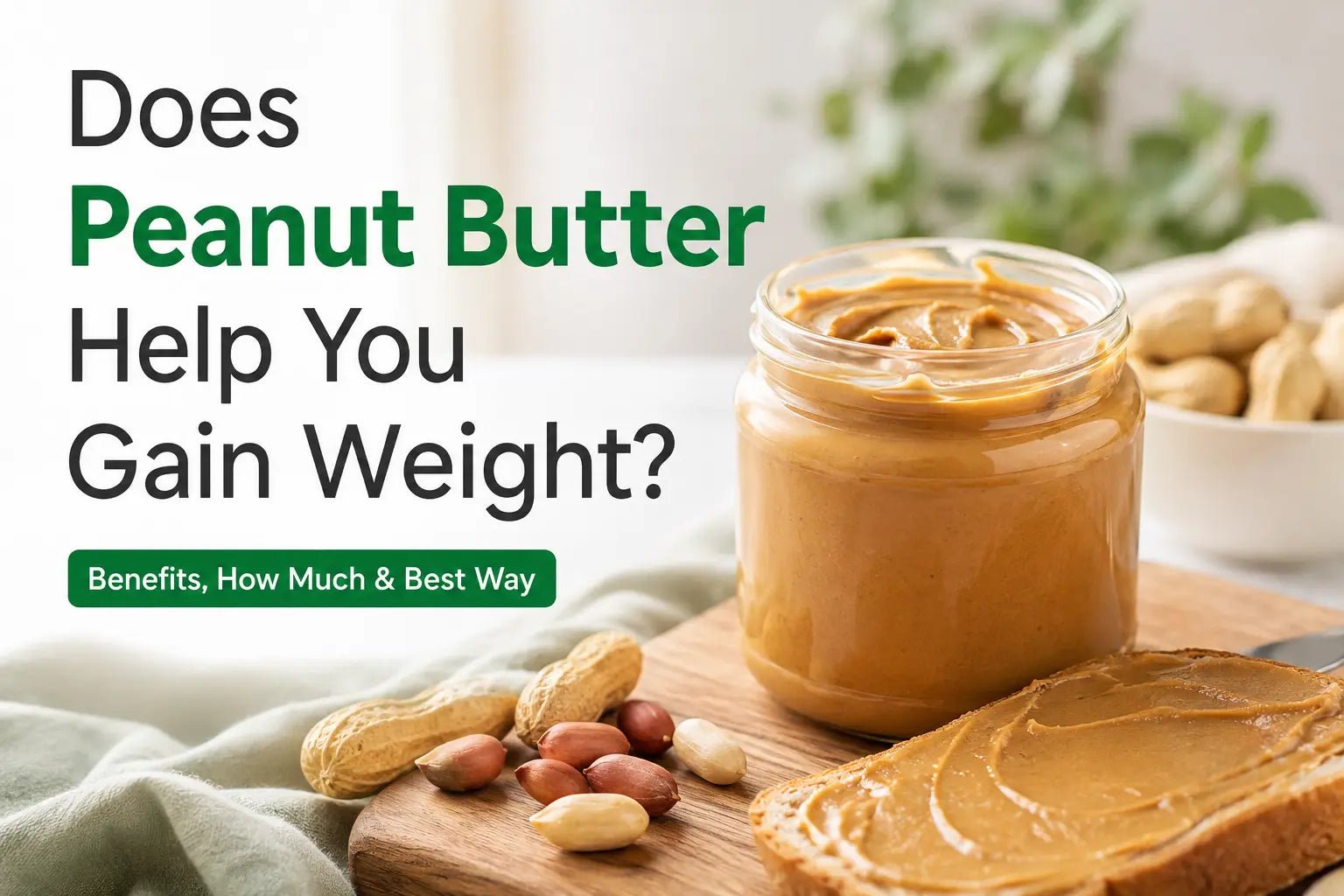
Does Peanut Butter Help You Gain Weight?
Peanut butter can support weight gain by adding calories in a small serving. Learn how much to eat, when to eat it, and how to use it without replacing balanced meals.
Yes, peanut butter can help you gain weight when it increases your total daily calorie intake. Two tablespoons provide about 190–200 calories, so peanut butter can add energy without making a meal much larger.
However, peanut butter does not automatically cause weight gain. You gain weight when you consistently consume more calories than your body uses. Peanut butter will be most helpful when you add it to your normal meals or snacks rather than use it to replace other food.
Peanut Butter and Weight Gain at a Glance
| Question | Direct answer |
|---|---|
| Does peanut butter help you gain weight? | Yes, when it helps create a consistent calorie surplus. |
| How many calories does it contain? | About 95–100 calories per tablespoon. |
| How much should you eat? | Many adults can start with one or two measured tablespoons daily. |
| What is the best time to eat it? | Any time it adds calories without reducing your appetite for meals. |
| Does it build muscle? | Not by itself. Muscle gain also requires resistance training and enough protein. |
| Can it cause belly fat? | Excess calories can increase body fat, but peanut butter does not target the belly. |
| Is peanut butter and banana good for weight gain? | Yes, when the combination adds calories to your normal diet. |
| Can you eat it before bed? | Yes, when it helps you reach your daily calorie needs. |
How Does Peanut Butter Help You Gain Weight?
Peanut butter is an energy-dense food. This means it provides many calories in a relatively small serving.
A person gains weight when calorie intake remains higher than energy use over time. This is known as a calorie surplus. Peanut butter may make that surplus easier to achieve, especially for people who struggle to eat large meals.
The main rule is simple:
Peanut butter supports weight gain when it adds calories instead of replacing calories from other foods.
For example:
- Adding peanut butter to your normal breakfast increases the meal’s calories.
- Eating peanut butter between meals may add calories without replacing lunch or dinner.
- Replacing a larger breakfast with a smaller peanut butter snack may not increase your total intake.
- Eating peanut butter and then skipping your next snack may cancel out the added calories.
Peanut butter is therefore a useful weight-gain tool, but it is not a complete weight-gain plan.
Calories and Protein in Peanut Butter
The exact nutrition content varies by brand, ingredients, and serving size. Regular peanut butter generally provides approximately:
| Amount | Approximate calories | Approximate protein |
|---|---|---|
| 1 teaspoon | 30–35 | 1–1.2 g |
| 1 tablespoon | 95–100 | 3–4 g |
| 2 tablespoons | 190–200 | About 7 g |
| 3 tablespoons | 285–300 | About 10–11 g |
| 4 tablespoons | 380–400 | About 14 g |
Most of the calories in peanut butter come from fat. Fat provides more calories per gram than protein or carbohydrate, which is one reason peanut butter adds so much energy without adding a large volume of food.
Always check the nutrition label on your product. Sweetened, reduced-fat, powdered, or flavoured peanut butter may provide different amounts of calories, protein, sugar, fat, and sodium.
USDA FoodData Central is the United States Department of Agriculture’s comprehensive food-composition database and includes both standard and branded food data.
Why Peanut Butter Does Not Always Cause Weight Gain
Peanut butter contains many calories, but calorie density does not mean it will automatically increase your weight.
It may reduce your appetite
Peanut butter contains fat, protein, and some fibre. These nutrients may make a person feel satisfied after eating.
You may add 190 calories from peanut butter but then eat less at your next meal. If this happens, your total daily intake may rise by less than expected or may not rise at all.
Research involving peanuts and tree nuts supports this idea. A systematic review found that people may compensate for some nut calories by reducing food intake later. The degree of compensation varies between people and depends on how and when the food is eaten.
People who regularly struggle with hunger or early fullness may also benefit from learning how to increase appetite naturally for weight gain.
Food form may affect absorbed energy
Research on whole nuts has also found that some fat can remain trapped within plant cell walls and may not be fully available for absorption. Processing changes this effect. Nut butters generally release more fat than whole nuts because grinding breaks down the food structure.
This does not mean peanut butter cannot help you gain weight. It means its effect depends on:
- The portion you eat
- Whether it replaces another food
- How it affects your appetite
- Your total calorie intake
- Your activity level
- How consistently you eat it
Large reviews of nut intake have not found the automatic increase in body weight that might be expected from calorie calculations alone.
How Much Peanut Butter Should You Eat to Gain Weight?
There is no single amount that works for everyone. Your needs depend on your:
- Current food intake
- Body size
- Activity level
- Appetite
- Target weight
- Health
- Other calorie-dense foods
- Response to peanut butter
A practical starting amount for many adults is one or two measured tablespoons per day, added to their normal diet.
Start with one tablespoon when:
- You want to increase calories gradually.
- You feel full easily.
- Larger servings reduce your appetite.
- You are adding calories from several other foods.
- You are not used to eating peanut butter regularly.
One tablespoon adds approximately 95–100 calories.
Start with two tablespoons when:
- You struggle to meet your calorie needs.
- You want to increase the calories in breakfast or a smoothie.
- You need a simple between-meal snack.
- The serving does not reduce your appetite for later meals.
Two tablespoons add approximately 190–200 calories.
What about three or four tablespoons?
Three to four tablespoons can provide approximately 285–400 calories. This amount may be useful for some people, but eating it all at once could reduce appetite or cause digestive discomfort.
It may be easier to divide a larger amount throughout the day:
- One tablespoon with breakfast
- One tablespoon in a smoothie
- One tablespoon with an evening snack
Do not keep increasing peanut butter without considering your complete diet. More peanut butter is not always better.
The NHS suggests that adults trying to gain weight gradually may consider adding around 300–500 calories per day. This is a general starting point, not a personal prescription. Those calories should come from a varied diet rather than peanut butter alone.
How to Know Whether It Is Working
Do not judge your progress from one scale reading. Body weight naturally changes because of water, food in the digestive system, salt intake, bowel movements, and other factors.
A better approach is to:
- Weigh yourself under similar conditions.
- Record your weight several times each week.
- Calculate or compare your weekly average.
- Follow the same eating plan consistently.
- Look for a gradual upward trend over several weeks.
If your average weight is not increasing, consider these two questions:
- Are you eating enough extra calories overall?
- Is peanut butter making you eat less later?
The solution may be to change when you eat it, divide the portion, or add calories from a wider range of foods.
Sudden or unexplained weight loss should not be managed only by adding peanut butter. Seek medical advice to check for an underlying cause. The NHS also recommends medical assessment when weight loss happens suddenly or without changes to diet or activity.
Best Ways to Eat Peanut Butter for Weight Gain
The most effective method is one you can follow consistently without losing your appetite for normal meals.
| Method | Why it may help |
|---|---|
| Peanut butter on toast or roti | Adds calories to breakfast or a snack |
| Peanut butter with banana | Combines fat, protein, and carbohydrates |
| Peanut butter in oatmeal | Raises calories without greatly increasing volume |
| Peanut butter with yoghurt | Adds calories while yoghurt provides more protein |
| Peanut butter with dates | Creates a compact, calorie-dense snack |
| Peanut butter with milk | Can increase calories and protein |
| Peanut butter in a smoothie | May be easier for people who struggle with large meals |
| Peanut butter on crackers | Creates a quick between-meal snack |
Peanut butter and banana
Peanut butter and banana can be a useful weight-gain combination.
Peanut butter contributes fat, protein, and concentrated calories. Banana adds carbohydrates and makes the snack or drink easier to eat.
You can try:
- Peanut butter spread on banana slices
- A peanut butter and banana sandwich
- Banana and peanut butter oatmeal
- A banana, milk, and peanut butter smoothie
- Peanut butter toast topped with banana
The combination helps only when it increases your overall intake.
Peanut butter with milk
Peanut butter and milk can provide calories, fat, carbohydrate, and protein. This combination may work well in a shake between meals.
Full-fat milk provides more calories than lower-fat milk. Fortified soy milk may be a suitable alternative for people who do not consume dairy. Choose an option that fits your health needs and dietary preferences.
Peanut butter with yoghurt
Yoghurt usually provides more protein than peanut butter alone. Mix peanut butter into plain or Greek yoghurt and add banana, oats, dates, or fruit.
Use it as:
- A between-meal snack
- Part of breakfast
- A post-exercise snack
- An evening snack
Peanut butter with dates
Dates provide carbohydrates, while peanut butter provides fat and some protein.
Split the dates, remove the stones, and add a measured amount of peanut butter. Both foods are calorie-dense, so portion them according to your needs.
Simple Peanut Butter Weight-Gain Shake
A shake can be helpful when you need more calories but struggle to eat another full meal.
Basic ingredients
- 1 cup of milk or fortified soy milk
- 1 medium banana
- 1–2 tablespoons of peanut butter
- ¼–½ cup of oats
- Yoghurt or protein powder, when required
- Extra milk or water to adjust the texture
Blend until smooth.
The total calories and protein will depend on the ingredients, brands, and amounts used. Treat the shake as an addition to your diet rather than a replacement for several meals.
Start with a smaller shake if liquid calories make you too full.
What Is the Best Time to Eat Peanut Butter for Weight Gain?
There is no special time when peanut butter becomes more fattening. Your total calorie intake matters more than the time on the clock.
The best time is when peanut butter helps you eat more without reducing your appetite for important meals.
Between meals
For many people, this is the most useful time.
A snack between breakfast and lunch or between lunch and dinner may add calories without replacing a main meal.
At breakfast
Add peanut butter to:
- Toast
- Roti
- Oatmeal
- Yoghurt
- A smoothie
- Banana
This may be especially useful if you normally eat a small breakfast.
Before exercise
Peanut butter can be eaten before exercise, but its fat content may slow digestion. A large amount immediately before intense exercise may feel uncomfortable.
A smaller serving with bread or banana may be easier to tolerate.
After exercise
Peanut butter can add calories to a post-workout meal, but it should be paired with a stronger protein source.
Examples include:
- Milk
- Greek yoghurt
- Eggs
- Chicken
- Soy milk
- Lentils
- Protein powder
Before bed
Eating peanut butter before bed may help if you have not reached your calorie needs for the day.
It is not automatically more fattening at night. It supports weight gain only when the bedtime snack increases your total daily calorie intake.
Avoid eating it close to bedtime if it causes reflux, stomach discomfort, or poor sleep.
Is Peanut Butter Good for Muscle Gain?
Peanut butter can support muscle gain, but it cannot build muscle by itself.
Its main role is to provide extra calories. Two tablespoons contain only about seven grams of protein, and most of their calories come from fat. It should not be treated as your main protein source.
Muscle-focused weight gain requires:
- Enough total calories
- Enough high-quality protein
- Regular resistance training
- Rest and recovery
- Consistency over time
Research shows that resistance training increases muscle size and that adequate protein can improve muscle and strength gains during training.
Better protein sources may include:
- Eggs
- Milk
- Greek yoghurt
- Chicken
- Fish
- Meat
- Lentils
- Beans
- Soy foods
- Whey or another suitable protein supplement
Peanut butter can be combined with these foods to increase the meal’s total calories.
Examples include:
- Peanut butter toast with eggs
- Peanut butter oatmeal made with milk
- Peanut butter blended with milk and protein powder
- Peanut butter yoghurt with fruit
- A peanut butter smoothie after training
Without resistance training, extra calories can still increase body weight, but a larger share may be stored as body fat rather than muscle.
Does Peanut Butter Increase Belly Fat?
Peanut butter does not directly target belly fat.
No food can choose where your body stores fat. Fat distribution is affected by factors such as genetics, age, sex, hormones, activity, and overall energy intake.
Peanut butter may contribute to body-fat gain when:
- Portions are much larger than needed.
- It is added to an already high-calorie diet.
- The calorie surplus is excessive.
- Physical activity is low.
- Weight is increasing very quickly.
Some of the gained fat may be stored around the abdomen, but peanut butter does not specifically send calories to the belly.
A measured portion is more useful than eating directly from the jar.
Can Peanut Butter Increase Weight in the Face, Hips, Arms, or Legs?
Peanut butter cannot make you gain weight in one chosen body part.
Genetics and hormones influence where body fat is stored. Resistance exercises can build particular muscles, but peanut butter itself cannot direct weight to the face, hips, arms, legs, chest, or buttocks.
Is Peanut Butter Good for Weight Gain Without Exercise?
Yes, peanut butter can increase body weight without exercise when it creates a calorie surplus.
However, exercise affects the type of weight you gain. Resistance training gives your body a reason to build muscle. Without it, more of the gained weight may be body fat.
Exercise is not required for the number on the scale to rise. It is important when your goal is to improve strength, function, or muscle mass.
Which Peanut Butter Is Best for Weight Gain?
The best peanut butter is one that:
- You enjoy eating
- You tolerate well
- Fits your budget
- Is available regularly
- Provides enough calories for your plan
- Has peanuts as the main ingredient
- Fits your medical and dietary needs
Natural peanut butter
Natural peanut butter often contains peanuts and possibly salt. Peanut oil may separate and rise to the top. Stir it before use.
It is a good option for people who prefer a simple ingredient list.
Regular commercial peanut butter
Regular peanut butter may contain added sugar, salt, and stabilising oils. It can still support weight gain.
Compare the serving size, calories, protein, added sugar, sodium, and ingredient list rather than judging a product only by its marketing claims.
Smooth or crunchy peanut butter
Smooth and crunchy peanut butter usually provide similar calories.
Choose the texture you prefer. Smooth peanut butter may be easier to blend into shakes or mix into oatmeal and yoghurt.
Powdered peanut butter
Powdered peanut butter usually contains less fat and fewer calories because much of the oil has been removed.
It may add peanut flavour and some protein, but regular peanut butter is generally more useful when your main goal is to increase calories.
Reduced-fat peanut butter
Reduced-fat does not always mean healthier or better. Removing fat can lower calories, while sugar or other ingredients may be added to change the taste and texture.
Check the label before buying.
Why Is Peanut Butter Not Helping You Gain Weight?
1. It is replacing another food
A peanut butter snack will not create a surplus if you skip another snack or eat less at dinner.
Add it to your current intake instead of swapping it for a larger meal.
2. Your portion is too small
A teaspoon provides far fewer calories than a tablespoon.
Use a measuring spoon or food scale when accurate portions matter.
3. You eat it only occasionally
One high-calorie snack will not cause meaningful long-term weight gain. Weight change comes from a repeated pattern.
4. It reduces your appetite
Some people feel full after eating peanut butter.
Try:
- A smaller serving
- Eating it after a meal
- Dividing the serving
- Using it in a drink
- Moving it to a time when it does not affect lunch or dinner
5. Your activity level has increased
Exercise, physical work, walking, and daily movement can increase the calories your body uses.
Your food intake may need to change when your activity changes.
6. Your complete diet is still too low in calories
Peanut butter cannot correct a diet that remains too low in energy throughout the day.
You may also need:
- Larger meals
- More snacks
- Milk or yoghurt
- Rice, bread, potatoes, or oats
- Eggs, meat, fish, beans, or lentils
- Fruit
- Other suitable calorie-dense foods
See the complete MNT guide explaining why you may not be gaining weight even though you eat a lot.
7. You expect all gained weight to be muscle
Extra calories do not become muscle automatically.
Muscle gain also requires resistance training, enough protein, recovery, and time.
8. You depend on peanut butter for protein
Peanut butter contains protein, but it provides many calories for a modest amount of protein.
Use it mainly as a calorie source and combine it with stronger protein foods.
Can Eating Too Much Peanut Butter Cause Unwanted Weight Gain?
Yes. Large portions can make it easy to consume more calories than you planned.
Two tablespoons provide approximately 190–200 calories, while four tablespoons may provide close to 400 calories. Eating directly from the jar makes the portion difficult to judge.
Too much peanut butter may:
- Increase calorie intake more than required
- Cause faster fat gain
- Reduce appetite for balanced meals
- Cause digestive discomfort in some people
- Add more sugar or sodium when using certain products
A measured serving is more useful than an unlimited amount.
Can You Eat Peanut Butter Every Day for Weight Gain?
Most people without a peanut allergy can include peanut butter regularly as part of a varied diet.
Daily peanut butter may support weight gain when:
- The serving fits your calorie target.
- It does not replace balanced meals.
- You digest it comfortably.
- You eat other protein sources.
- Your complete diet remains varied.
- You consistently consume enough calories.
Eating it every day does not guarantee weight gain. The result still depends on your complete calorie intake.
Who Should Avoid or Limit Peanut Butter?
People with a peanut allergy
Peanuts are classified as a major food allergen. Anyone with a diagnosed peanut allergy should avoid peanut butter and follow the advice of their healthcare professional.
A serious allergic reaction may include:
- Difficulty breathing
- Wheezing
- Throat swelling
- Swelling of the lips, tongue, or face
- Dizziness
- Fainting or collapse
Seek emergency medical care immediately for signs of a severe allergic reaction.
People with unexplained weight loss
Peanut butter may add calories, but it should not be used to hide an unexplained health problem.
Seek medical advice when weight loss is:
- Unplanned
- Sudden
- Rapid
- Continuing
- Linked with weakness or poor appetite
- Linked with vomiting, diarrhoea, pain, fever, or another symptom
People following a medical diet
Individual advice may be needed if you have:
- Kidney disease
- Diabetes
- Swallowing difficulties
- Digestive disorders
- A condition requiring sodium or calorie control
- Another condition affecting nutrition
Children, older adults, and pregnant people with weight concerns should also receive guidance suited to their needs.
Frequently Asked Questions
Does peanut butter make you gain weight?
Peanut butter can make you gain weight when it helps you consume more calories than your body uses. It does not cause weight gain automatically. It may not work if it replaces another food or reduces your appetite later.
Is peanut butter good for weight gain?
Yes. Peanut butter can be useful for weight gain because it provides approximately 190–200 calories in two tablespoons. It can be added to meals, snacks, and shakes without greatly increasing food volume.
How much peanut butter should I eat daily to gain weight?
Many adults can start with one or two measured tablespoons per day. The right amount depends on your total calorie needs, appetite, activity, health, and the rest of your diet.
Is two tablespoons of peanut butter enough for weight gain?
Two tablespoons may support weight gain if the calories are added to your normal diet. They may not be enough if your total food intake remains below your energy needs.
Can one tablespoon of peanut butter help with weight gain?
Yes. One tablespoon adds approximately 95–100 calories. A smaller daily addition may be useful for gradual weight gain or for someone who feels full easily.
Is peanut butter and banana good for weight gain?
Yes. Peanut butter adds fat, protein, and calories, while banana contributes carbohydrates. Adding milk, yoghurt, oats, or bread can increase the meal further.
Is peanut butter with milk good for weight gain?
Yes. Peanut butter and milk can provide calories, protein, fat, and carbohydrates. They can be blended with banana and oats to create a higher-calorie shake.
Can thin people gain weight with peanut butter?
Yes, provided peanut butter creates a consistent calorie surplus. It will not increase weight when the complete diet still provides fewer calories than the body needs.
How quickly can peanut butter increase weight?
There is no fixed timeline. Results depend on the amount eaten, total calorie intake, activity level, health, appetite, and consistency. Judge progress through weekly weight trends rather than daily changes.
Does peanut butter increase weight in one week?
A clear change may not appear within one week. Short-term scale changes are often affected by water and food in the digestive system. Look at your average weight over several weeks.
Does peanut butter increase belly fat?
It does not specifically target the belly. However, an excessive calorie surplus can increase total body fat, including abdominal fat.
Is peanut butter good for muscle gain?
Peanut butter can provide extra calories for muscle gain, but it is not a strong protein source compared with its calorie content. Combine it with higher-protein foods and resistance training.
Can I use peanut butter for weight gain without going to the gym?
Yes. It may increase body weight without exercise if it creates a calorie surplus. However, a greater share of the gained weight may be fat rather than muscle.
Should I eat peanut butter before or after a workout?
You can eat it at either time. Before exercise, use a moderate serving if high-fat foods cause discomfort. After exercise, combine it with carbohydrates and a stronger protein source.
Does eating peanut butter before bed increase weight?
It can support weight gain when the bedtime snack adds calories to your daily intake. Eating it at night does not make it more fattening than eating it earlier.
Which peanut butter is best for weight gain?
Choose a product you enjoy, digest comfortably, and can afford regularly. Regular peanut butter is usually more calorie-dense than powdered peanut butter. Check the nutrition label and choose a product with peanuts as the main ingredient.
Final Verdict: Does Peanut Butter Help You Gain Weight?
Peanut butter can help you gain weight because it provides many calories in a small serving. Two tablespoons add approximately 190–200 calories and can be mixed into toast, oatmeal, yoghurt, milk, smoothies, bananas, dates, and snacks.
However, peanut butter works only when it creates a consistent calorie surplus. It may not increase your weight when it replaces another food or causes you to eat less later.
For better results:
- Start with one or two measured tablespoons.
- Add it to your normal diet instead of replacing meals.
- Divide larger servings if they reduce your appetite.
- Combine it with milk, yoghurt, oats, bread, banana, or dates.
- Use stronger protein sources when your goal is muscle gain.
- Include resistance training to support muscle growth.
- Monitor average weekly weight rather than daily changes.
- Avoid an excessive calorie surplus that may increase unwanted fat gain.
Peanut butter can be a useful part of a weight-gain diet, but it is not the only food you need. Your complete diet, activity, appetite, health, and consistency determine the result.
Need a Personalized Weight-Gain Plan?
Peanut butter can help add calories, but the right amount depends on your body, appetite, routine, activity level, health, and complete diet. MNT’s online dietitians can prepare a personalized Pakistani food-based weight-gain plan with calorie and protein guidance, practical meal timing, and progress monitoring.
Book Your MNT Weight-Gain ConsultationWe rely on peer-reviewed studies and reputable medical journals.